A Historic Achievement in Space Exploration
NASA achieved a groundbreaking milestone when its Double Asteroid Redirection Test (DART) mission successfully altered the orbit of an asteroid around the Sun. This marked the first time in human history that a spacecraft measurably changed the path of a celestial body in heliocentric orbit, demonstrating humanity’s growing ability to influence objects in deep space.
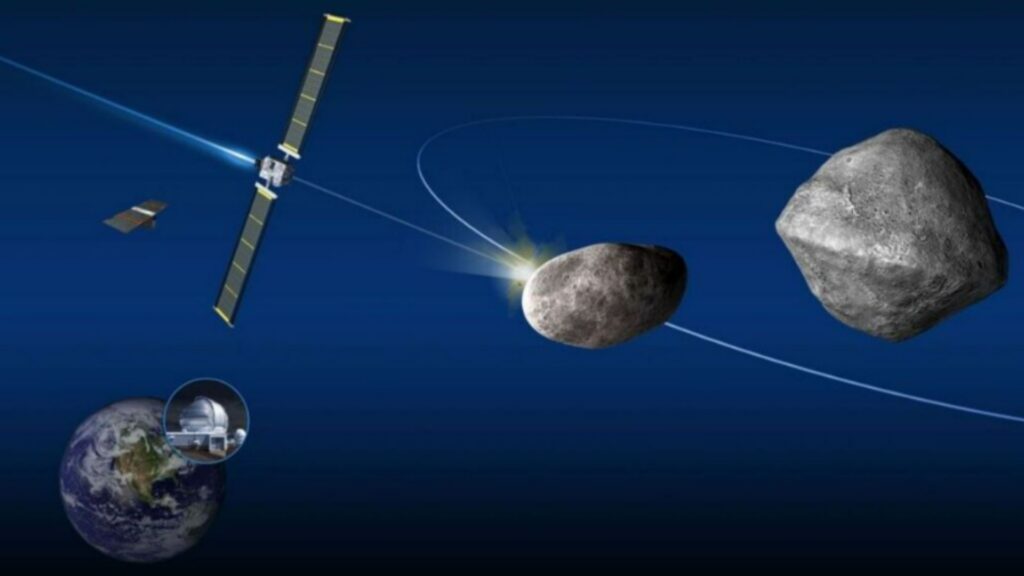
The mission targeted the binary asteroid system Didymos and its smaller moonlet, Dimorphos. While the primary goal was to modify Dimorphos’ orbit around Didymos, subsequent research revealed that the impact also shifted the pair’s shared orbit around the Sun. Because the two asteroids are gravitationally linked, changes to one body inevitably affected the motion of the entire system.
Although the adjustment to the heliocentric orbit was extremely small, measured as a fraction of a second in the system’s orbital period, it represented a monumental achievement. Scientists emphasize that even minute changes can accumulate over time, potentially preventing a hazardous asteroid from colliding with Earth if applied early enough.
How the DART Mission Worked
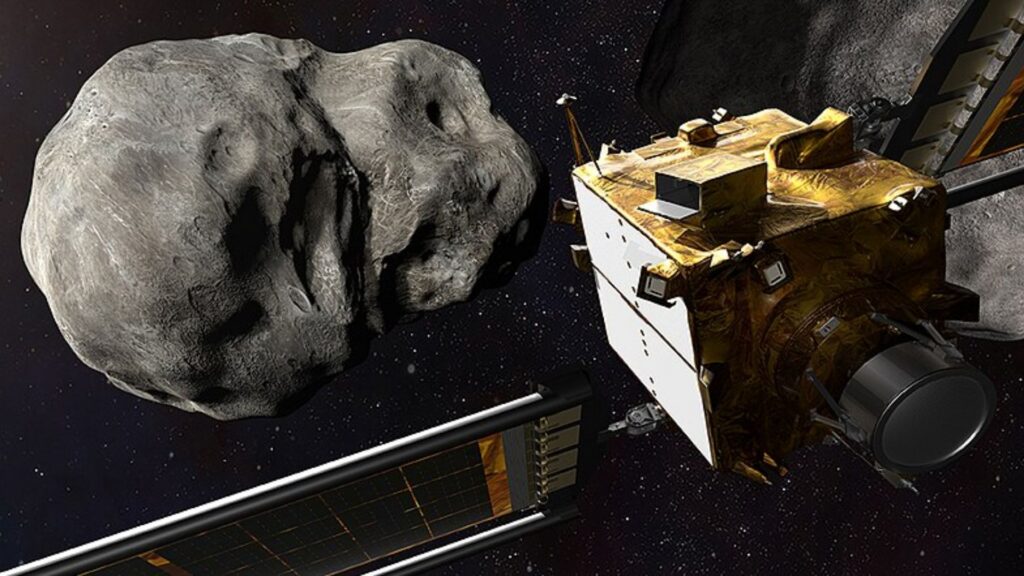
Launched in November 2021, the DART spacecraft was designed to test the “kinetic impactor” technique, a planetary defense strategy that involves deliberately crashing a spacecraft into an asteroid to alter its trajectory. The spacecraft traveled millions of miles before intentionally colliding with Dimorphos on September 26, 2022, at a speed of approximately 6.6 kilometers per second.
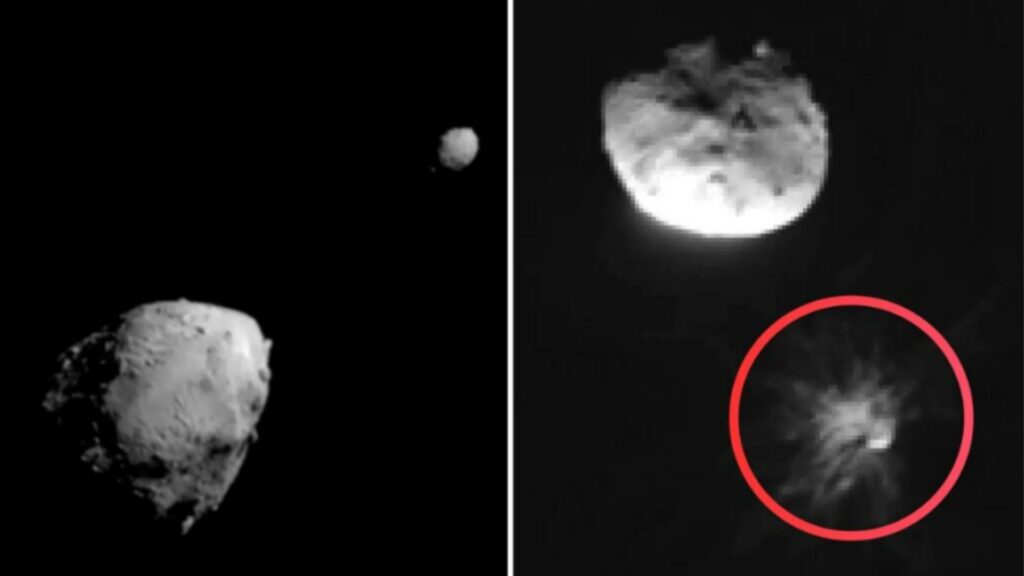
The collision produced a dramatic plume of debris that enhanced the impact’s effectiveness. This ejected material created what scientists call a “momentum enhancement factor,” effectively giving the asteroid an additional push beyond the force of the spacecraft alone. As a result, Dimorphos’ orbital period around Didymos was shortened by about 33 minutes, far exceeding initial expectations.
To document the event, the Italian Space Agency’s LICIACube captured images of the impact and the expanding debris cloud, while telescopes such as the Hubble and James Webb Space Telescopes observed the aftermath. These observations provided invaluable data that allowed scientists to measure the mission’s success with remarkable precision.
Measuring the Change in the Asteroid’s Solar Orbit
Determining the subtle shift in the asteroid system’s orbit around the Sun required years of meticulous observation. Scientists relied on a technique known as stellar occultation, which involves monitoring the brief dimming of distant stars as an asteroid passes in front of them. By analyzing these events, researchers were able to calculate the system’s position and velocity with extraordinary accuracy.
Data collected from 22 stellar occultations between October 2022 and March 2025 enabled researchers to detect a measurable change in the asteroid system’s heliocentric motion. The impact slowed the orbit of the Didymos–Dimorphos pair by more than 10 micrometers per second, corresponding to a shift of approximately 0.15 seconds in its orbital period around the Sun.
While this adjustment may seem insignificant, its implications are profound. Over long timescales, even tiny variations in an asteroid’s trajectory can translate into substantial positional differences, potentially determining whether a future asteroid passes safely by Earth or poses a serious threat.
What This Means for Earth’s Future Safety

The success of the DART mission represents a major step forward in planetary defense. Although Didymos and Dimorphos were never a threat to Earth, the mission provided a real-world demonstration that the kinetic impactor technique can effectively alter the course of potentially hazardous asteroids.
This achievement also highlights the importance of early detection. NASA is developing the Near-Earth Object (NEO) Surveyor mission to identify difficult-to-detect asteroids and comets, ensuring that any future threats can be addressed with sufficient lead time. By combining detection capabilities with proven deflection strategies, scientists aim to establish a comprehensive planetary defense system.
Looking ahead, the European Space Agency’s Hera mission will further investigate the Didymos–Dimorphos system, providing detailed measurements of the impact crater and refining models of asteroid deflection. Together, these international efforts underscore a new era in space exploration—one in which humanity is not merely observing the cosmos but actively shaping it to safeguard our planet.