Mexico City’s Sinking Crisis Revealed by New Satellite Technology
Parts of Mexico City are sinking at an alarming rate, with some areas dropping more than half an inch every month. A new radar satellite has now provided precise measurements of this urban land subsidence, offering a detailed view of the problem that earlier space-based systems could not consistently achieve in dense or cloudy environments.
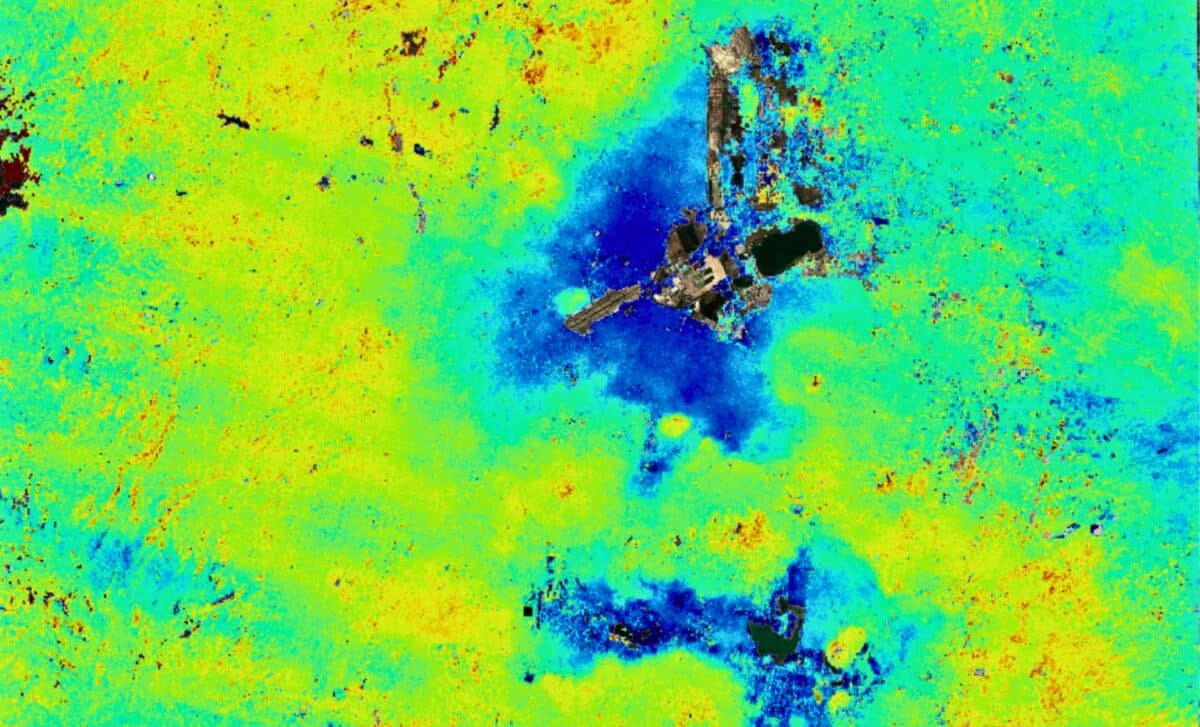
The data, released on April 29 by NASA’s Jet Propulsion Laboratory (JPL), comes from the NISAR satellite, which tracks ground movement across one of the world’s largest cities. The readings were taken between October 2025 and January 2026 during Mexico City’s dry season. Dark blue areas on the imagery indicate the fastest sinking zones, with some regions recording ground subsidence exceeding two centimeters per month. Benito Juarez International Airport sits at the center of the frame, while Lake Nabor Carrillo is visible to the northeast.
A Century of Sinking, Still Accelerating
The issue of sinking in Mexico City is not new—it dates back over a century. The city is built on the remnants of an ancient lakebed, and relentless groundwater pumping combined with the weight of development above has compacted the soft sediment beneath it for generations. An engineer first documented the sinking in 1925.
By the 1990s and 2000s, parts of the city were dropping roughly 14 inches, or 35 centimeters, per year. This rate was enough to fracture Metro tunnels, buckle roads, and split water mains across the metropolitan area. The damage is not just cosmetic; it accumulates in infrastructure that serves millions of people daily. Once compressed, the sediment has no natural mechanism for recovery.
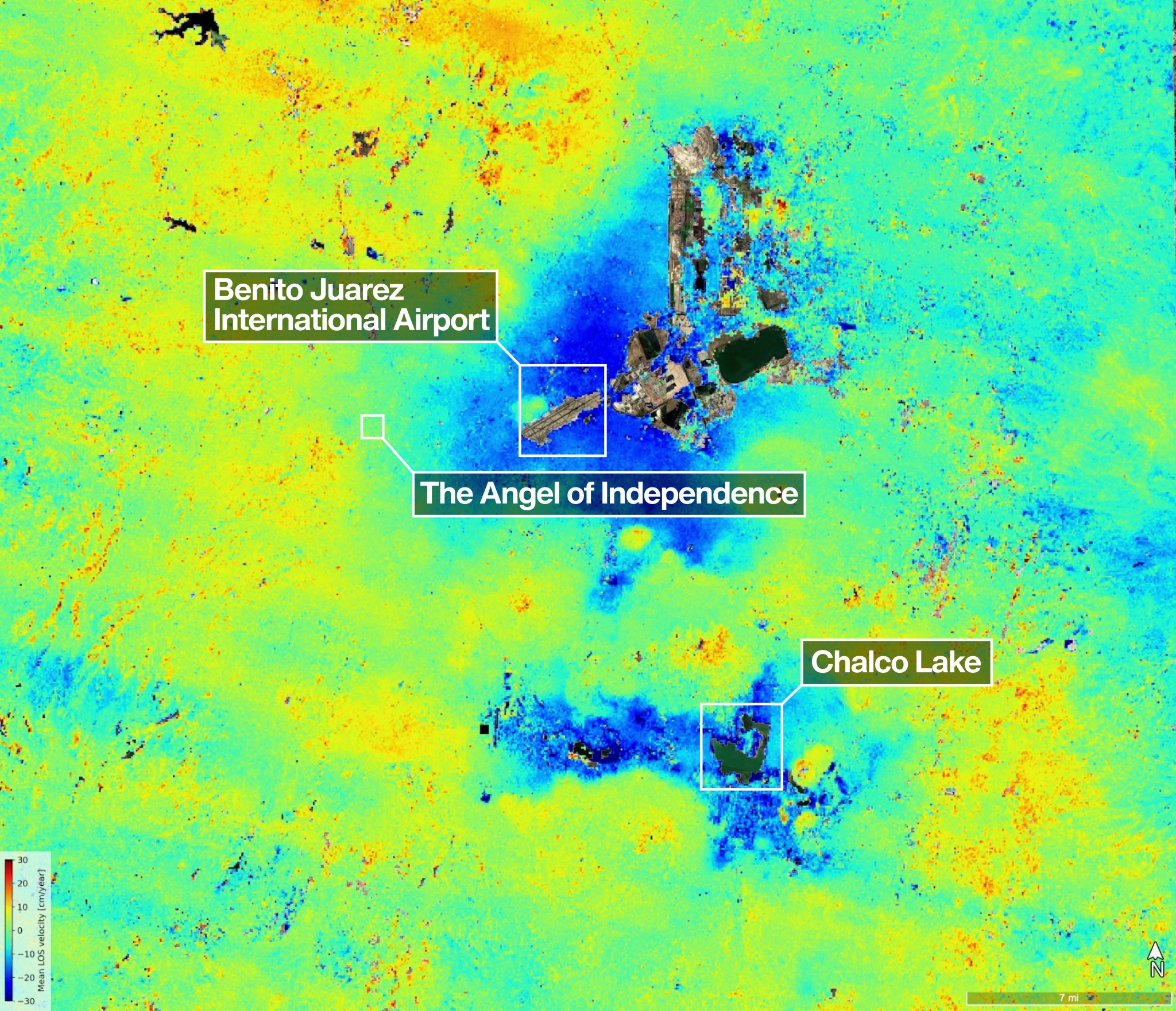
The Angel of Independence monument on the Paseo de la Reforma tells the story plainly. Built in 1910 for Mexico’s centennial, it once sat at street level. Fourteen steps have since been added to its base as the surrounding ground dropped away. The monument has not moved—the city has.
Why NISAR Sees What Other Satellites Miss
Previous radar satellites have tracked Mexico City’s subsidence, but with limitations. Cloud cover, dense vegetation, and darkness all degrade optical sensors and higher-frequency radar systems. NISAR’s L-band radar, operating at a 24-centimeter wavelength, cuts through these obstacles without losing signal quality.
The satellite also carries an S-band instrument at 9.4 centimeters, making it the first ever launched with a dual-frequency synthetic aperture radar configuration. Together, the two instruments give researchers more ways to separate genuine ground motion from atmospheric interference, improving confidence in the measurements, particularly in regions where a single instrument would struggle.

NISAR passes over the same point on Earth’s surface twice every 12 days, building a consistent record that researchers can compare over time to detect motion measured in millimeters. Craig Ferguson, deputy project manager at NASA Headquarters in Washington, said the Mexico City imagery confirms the sensors are performing as designed. He pointed specifically to the L-band’s value for coastal regions where land subsidence and rising seas occur simultaneously, compounding flood risk in ways that are difficult to untangle without precise ground-movement data.
Built for Scale, Designed to Last
NISAR launched from Satish Dhawan Space Centre on India’s southeastern coast on July 30, 2025. The mission is a partnership between NASA and the Indian Space Research Organisation (ISRO), with JPL leading the U.S. side and providing the L-band instrument and antenna. ISRO supplied the spacecraft and the S-band radar.
The satellite’s most striking physical feature is its antenna reflector: a drum-shaped structure 39 feet, or 12 meters, across. NASA calls it the largest radar antenna reflector ever sent to orbit. A wider antenna captures more of the returning radar signal, which translates directly into finer surface measurements across larger areas—a critical advantage when the goal is detecting motion of just a few millimeters across an entire city.
The satellite operates at an altitude of 464 miles and is currently in its active science phase. As of late February 2026, it had released more than 100,000 data products through the Alaska Satellite Facility, all publicly available. That open-access model is deliberate: the mission is designed to serve not just NASA researchers but government agencies, urban planners, and disaster-risk teams around the world who need reliable ground-deformation data.
What the Maps Show and What Comes Next
The Mexico City results are preliminary. JPL notes that the yellow and red areas visible in the imagery are likely noise artifacts that should diminish as the mission collects more passes and builds a stronger baseline. The dark-blue subsidence zones, by contrast, align with decades of prior measurements and the known behavior of compressed lakebed sediment.
David Bekaert, a project manager at the Flemish Institute for Technological Research and a member of the NISAR science team, called Mexico City a proof-of-concept for what the satellite will do worldwide. “Mexico City is a well-known hot spot when it comes to subsidence, and images like this are just the beginning for NISAR,” he said. “We’re going to see an influx of new discoveries from all over the world, given the unique sensing capabilities of NISAR and its consistent global coverage.”
NISAR data is archived and openly accessible through the Alaska Satellite Facility DAAC. Mexico City’s next dry season will produce another comparable set of measurements, giving scientists a cleaner year-over-year look at how the city’s sinking lakebed is responding—or not—to any changes in water use or urban load above it.