The Trauma of War and the Power of Poetry
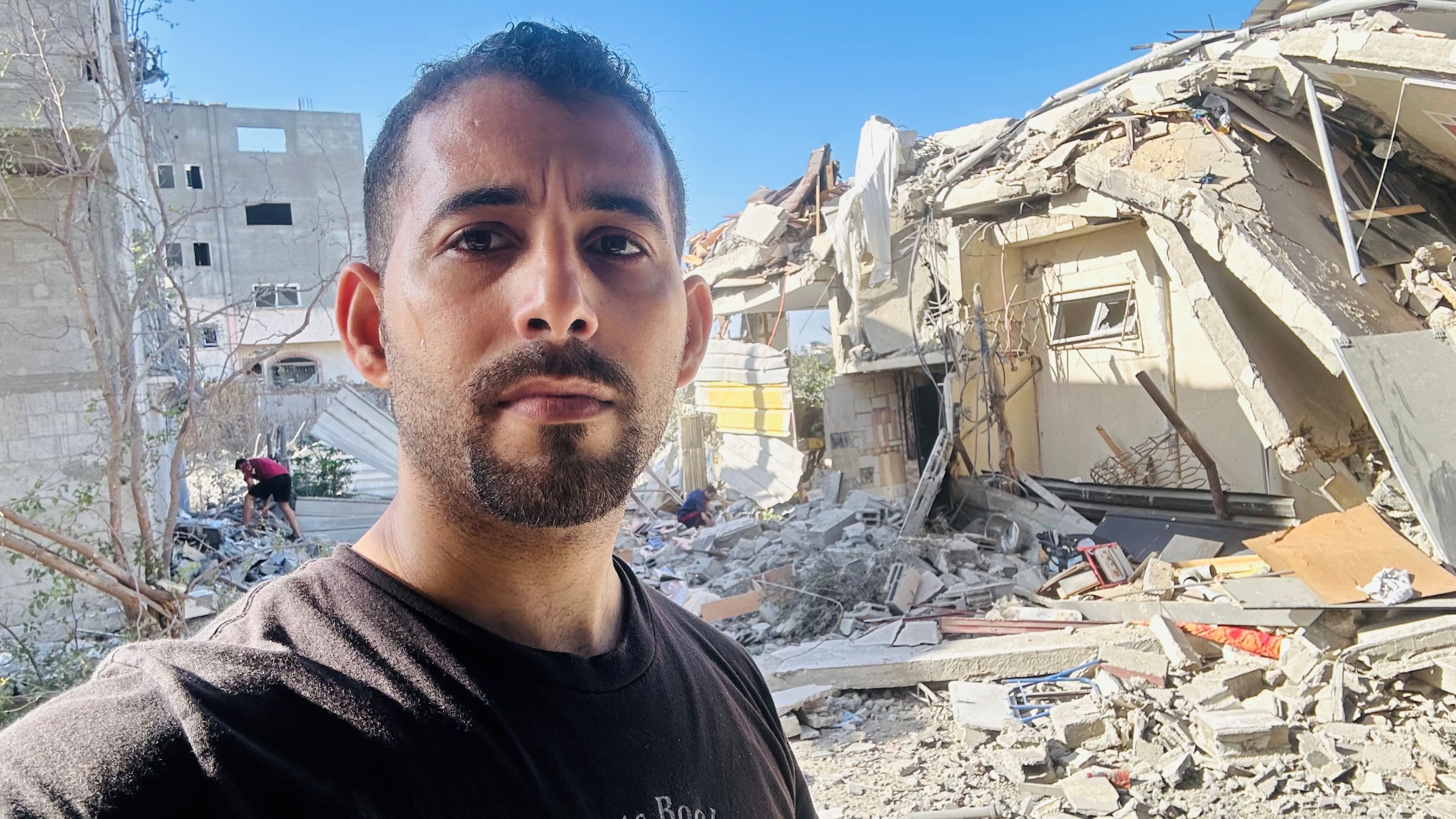
When Hamas attacked Israel on October 7, 2023, Palestinian poet Mosab Abu Toha and his family were living in an apartment in Gaza, in the same building as his parents and brothers. Israel invaded Gaza in response, and the family soon received warning that Israeli forces planned to attack the area. They evacuated to the Jabalia refugee camp, in Gaza’s north, where they learned their home had been destroyed by an Israeli strike.
The refugee camp was also bombed, and the family moved to another location, a school run by the United Nations Relief and Work Agency (UNRWA). It, too, was bombed. In November, the month he turned 30, Abu Toha and his wife, Maram, made the heart-wrenching decision to escape Gaza — leaving behind parents, siblings and cousins — for the sake of their children, Yazzan, Yaffa and Mostafa, who was born in the US and has an American passport.
“In Gaza, a child is not really a child,” Abu Toha wrote in an article in The New Yorker, part of the Letters from Gaza series that won the 2025 Pulitzer Prize for Commentary. The family fled south in a donkey cart, heading to the Rafah border crossing. At an Israeli checkpoint on the way, a soldier singled out Abu Toha, who was detained at gunpoint and taken away.
What ensued was a terrifying episode: he was stripped, blindfolded, handcuffed, beaten, forced into a truck and transported to a detention centre in Israel, where he was interrogated on suspicion of being a member of Hamas. The poet professed his innocence and was eventually released with a cursory apology. He rejoined his family and, in December 2023, they made their way to Egypt and then the US, where they still live.
Abu Toha — whose 2022 debut poetry collection, Things You May Find Hidden in My Ear, was a finalist for the National Book Critics Circle Award for Poetry and won the Palestine Book Award — writes about this traumatic period in his acclaimed second poetry collection, Forest of Noise (2024).
This week, the poet and founder of Gaza’s first English-language library will appear via video at the Sydney Writers’ Festival to discuss his poetry and the occupation that shaped it.
Poetry is Immediate
Abu Toha wrote half of the poems in Forest of Noise before October 2023 and the other half afterwards, in Gaza, Egypt and the US. “I wrote some poems while I was watching my people, my friends and relatives and neighbours, being slaughtered,” he tells ABC Arts in a video call from his home in the US. “For me, as an individual, as a writer, as an artist, it was very important for me to express myself using my art form, which is poetry.”
Poetry as a form is well-suited to the task of conveying life in a war zone. “Poetry combines the human sense of seeing and watching and smelling, but also feeling, something that you can’t easily express in other forms,” he says. “Poetry is immediate. You’re not planning to write a poem. You’re not sitting, for example, and saying, ‘OK, I’m going read some books … in order to write about education in Gaza.’ It’s not something that you prepare for. It is something that compels you to sit and write about these feelings.”
Writing poetry has allowed Abu Toha to confront his fears, which often manifest in disturbing nightmares of the bombardment. “I have relatives in my family who were killed with their spouses and their children. So many times, I would wonder, what does it mean to be buried under the rubble of your house? Because whoever was killed in an air strike, it’s not necessary that they were killed instantly. Maybe they were bleeding under the rubble, like what happened to some of my relatives. Poetry helps me … explore these scenarios that could have happened to me.”
The Language of War
Abu Toha began learning English in fifth grade and immediately felt an affinity for the language. Later, at university, he fell in love with the Romantic poets, and went on to complete a fellowship at Harvard University. He wrote the poems in his two published collections in English. “I haven’t written, unfortunately, a single poem in Arabic since October 2023,” he says. He finds writing in Arabic different to writing in English.
“When I write in my mother tongue, it’s like exploring universal themes: family, what does it mean to be a father, a son … What is the sea? What is the sky? What are the clouds? And how do you see them as a human?” Abu Toha offers an example: a poem he wrote in Arabic, in which he considered death in philosophical terms. “I personified death,” he says. “When I talk to death, I talk to it as a natural phenomenon, as if death is responsible for the crashing of a plane, for car accidents, for illnesses. And I was questioning death — ‘Why don’t you knock at the door before you enter the room?’”
English, however, brings with it different associations. In Under the Rubble, he writes: “heaven has been blocked by the drones / and F-16s and the smoke of death”. “When I write about death in English, it’s about death that comes through airstrikes, through bullets,” he says.
Growing Up in Gaza
Abu Toha was born in 1992 in the Al-Shati refugee camp, one of eight refugee camps in Gaza. Of the 2.4 million people who live in Gaza, around 1.6 million are registered refugees. “Interestingly, and unfortunately, and heartbreakingly, that is the same refugee camp where my father was born,” he says. It was also the camp where his paternal grandfather, great-grandfather and great-great grandmother lived and died.
In 2000, when Abu Toha was eight, the family moved to Beit Lahia, a city not far from the Jabalia camp where his mother was born. Jabalia — the largest camp in Gaza, with a population of 110,000 — has been largely destroyed by Israeli air strikes. “Israel is not only killing Palestinians, which is a tragedy, but it’s killing refugees,” Abu Toha says. “And Israel is not only bombing houses; Israel is bombing refugee camps.”
One attack on Jabalia, on October 31, 2023, killed more than 120 people. “I was a witness to that massacre,” Abu Toha says. “I took videos, I took photos, very, very graphic. I can’t start to tell you about that.” For the young Abu Toha, life in Beit Lahia, an agricultural town surrounded by trees and fields, was very different to living among the cramped, narrow alleys of Al-Shati. “[There] you barely can walk between the houses,” Abu Toha says.
Like much of Beit Lahia — “now a heap of rubble” — the high school Abu Toha attended has been destroyed in the war. He tells me it’s where a nine-year-old girl, Ritaj Rihan, was shot by Israeli forces on April 9, 2026, while sitting in a makeshift classroom among the high school’s ruins. Abu Toha documents the dead on his social media accounts, “humanising” the Palestinian victims of the war, like Ritaj, who would otherwise remain an anonymous statistic.
Founding Gaza’s First English-Language Library
Abu Toha’s graduation ceremony was postponed after the Islamic University’s English department, which held many books, was destroyed in the 2014 Gaza War. He visited the ruins and found a copy of The Norton Anthology of American Literature amid the wreckage. He wrote in Literary Hub in 2022 that “carefully lifting the anthology from under the rubble felt like saving the life of a child”.
Rescuing the book gave Abu Toha an idea: to establish a library in Gaza. Growing up in Gaza, “the term library was absent”, he says. “There are no libraries in the refugee camp.” In 2016, he set up a Facebook page requesting book donations. Receiving books, however, posed a challenge in a besieged city lacking a regular residential postal service.
Since 2007, Israel has instituted an air, land and sea blockade of Gaza that means everything that enters the city must first go through Israel. As a result, it took weeks and weeks for deliveries to reach Abu Toha. “That was one of the hardest parts of creating the library,” he says. Abu Toha eventually raised enough money to rent a space and opened the first branch of the Edward Said Public Library, named after the influential Palestinian and American academic, in 2017.
It was the first English-language public library in Gaza, and a second branch with a computer lab opened in Beit Lahia in 2019. “Unfortunately, both branches have been destroyed by the Israeli attacks,” he says. Abu Toha labelled the act a war crime in a statement posted on social media at the time: “All the dreams that I and friends in Gaza and abroad were drawing for our children have been burnt by Israel’s genocidal campaign to erase Gaza and everything that breathes of life and love,” he wrote.
A Message for Readers
So, what does Abu Toha hope the Australian audience at his Sydney Writers’ Festival appearance takes away from his poetry? “For me, my poetry is not merely poetry. It is not my personal experience as an individual,” he says. For Abu Toha, poetry is not just about self-expression and survival. It’s also about bearing witness to the devastation of Gaza, what he describes as “live-streamed genocide”.
This is a particularly important task since Israel banned international journalists from entering Gaza after it launched its invasion in 2023. “These are not personal poems. These are collective poems,” he says. “They should not be read as an individual account, but these are accounts of the lives of hundreds if not thousands, if not hundreds of thousands of Palestinians, some of whom were killed, some of whom are being killed right now, some of whom may get killed [in the future].”
One example is Right or Left!, which he wrote after an airstrike killed his friend and his friend’s family. “That poem is about us finding the bones of a girl after she was buried under the rubble for months,” Abu Toha says. “We only find one small bone from her body. It is a bone from her arm. Right or left? It does not matter as long as we cannot find the henna from her neighbors’ wedding on her skin, or the ink from a school pen on a little index finger.”
“This is not about me,” he says. “This is about my friends, the families of my friends, my neighbours, my students.”
Forest of Noise is published by 4th Estate. Mosab Abu Toha is at Sydney Writers’ Festival on May 24.