Economic Growth and Slowdown
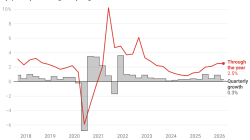
Australia’s economy experienced a 2.5 per cent annual growth rate in the March quarter, maintaining the same pace as the previous quarter. However, on a quarterly basis, the economy only managed to grow by 0.3 per cent, which is significantly lower than the 0.9 per cent recorded in the prior quarter. This marked a notable slowdown in growth, coinciding with the Reserve Bank of Australia (RBA) increasing interest rates in February and March.
The RBA has projected that the economy will expand by 1.9 per cent over the year ending in June, suggesting further economic weakening in the coming months. Grace Kim, head of National Accounts at the Australian Bureau of Statistics (ABS), highlighted that modest household and public sector spending, along with disruptions caused by cyclones affecting mining and export activities, contributed to the slowdown. She also noted that rising interest rates and higher fuel costs likely led to more cautious consumer behavior, resulting in reduced spending across various household expenditure categories.
External Factors and Economic Forecasts
Westpac’s economics team pointed out that the Australian economy was already slowing before the Middle East conflict or the RBA’s recent rate hikes had a significant impact. They warned that the major headwinds from the conflict would be more fully reflected in the second quarter of 2026, potentially leading to a quarterly contraction—the first since the Global Financial Crisis (excluding the pandemic).
RBA Governor Michele Bullock recently cautioned that Australia was facing “staring down the barrel” of a difficult period ahead, with rising inflation, a slowing economy, and increasing unemployment. She emphasized that the recent rate hikes would not have an immediate effect on inflation due to the lag in monetary policy impacts.
Economists have also predicted that the decline in business and consumer confidence, driven by the war in the Middle East and global inflation surges, could severely affect Australia’s economic activity. The RBA’s latest statement on monetary policy suggests that the annual growth rate may slow to just 1.3 per cent by the end of this year.
Harry Murphy Cruise, head of economic research for Oxford Economics Australia, stated that economic activity is expected to weaken further, with surging inflation, high oil prices, and shattered confidence likely to reduce spending throughout the rest of the year. He forecasts that per capita household spending will remain flat in 2026, while softer hiring could push unemployment close to 5 per cent by 2027.
Business Investment and Sector Performance
In the March quarter, business investment in data centres was the main driver of growth. However, the impact on GDP growth was tempered by a large negative contribution from net trade, as most capital assets were imported. Private investment increased by 3.6 per cent, led by machinery and equipment, which saw a 16.3 per cent rise. This was attributed to increased business investment in data centres in New South Wales and Victoria.
Public investment grew by 0.9 per cent, with defence investment rising by 6.8 per cent due to increased imports of defence weapons platforms. Construction activity also contributed to growth, with higher residential construction services, apartment projects, and data centre fit-outs.
Westpac economists Pat Bustamante and Ryan Wells noted that the large investment in data centres, including spill-over effects, drove all of the growth in the March quarter. They highlighted that outside of this, investment and economic activity were weak, with the increase in household consumption offset by a decrease in public demand.
Manufacturing and Mining Challenges
Manufacturing saw a rise due to heightened demand for fertilizers and pesticides from farms. However, mining was the largest detractor, as coal production was negatively impacted by Cyclone Koji. Consumer-facing service industries, such as retail trade, accommodation, and food services, experienced weakness due to subdued household spending on discretionary goods and services.
Implications for Interest Rates
CBA economists believe that no further rate hikes are expected from the RBA, as signs of a softening economy outweigh lingering inflation concerns. Belinda Allen, a CBA economist, stated that the Australian economy is expected to slow, primarily due to weaker household spending and dwelling investment. She also mentioned that business investment will be lumpy given the nature of the data centre build-out and import intensity.
However, other economists suggest that the RBA might still raise rates at some point. EY senior economist Paula Gadsby noted that today’s results are unlikely to influence the RBA’s decisions at its June meeting, and she expects the board to tighten monetary policy further in the second half of the year. Citi economist Faraz Syed also suggested that more rate hikes could occur this year, emphasizing the persistent stagflation risk and the need to balance growth and inflation concerns.