Rising Popularity of Night Trains in Europe
Trains are quickly becoming one of the most preferred modes of travel for people across Europe. A 2025 survey conducted by Hitachi Rail, which involved over 11,000 participants, revealed that nearly half of the respondents plan to increase their train travel and reduce air travel in the next five years. However, there is a growing concern that the current infrastructure, cost, and availability of train services are not matching the rising demand.
The same survey highlighted that 70% of global respondents would use public transport more if it were better connected. Night trains, in particular, have become a clear example of this mismatch between enthusiasm for the service and its current offerings. Despite the ongoing climate emergency, short-haul flights are increasing in frequency, while sleeper services are being reduced in Europe, according to Back-on-Track.eu, a European network dedicated to promoting cross-border night trains.
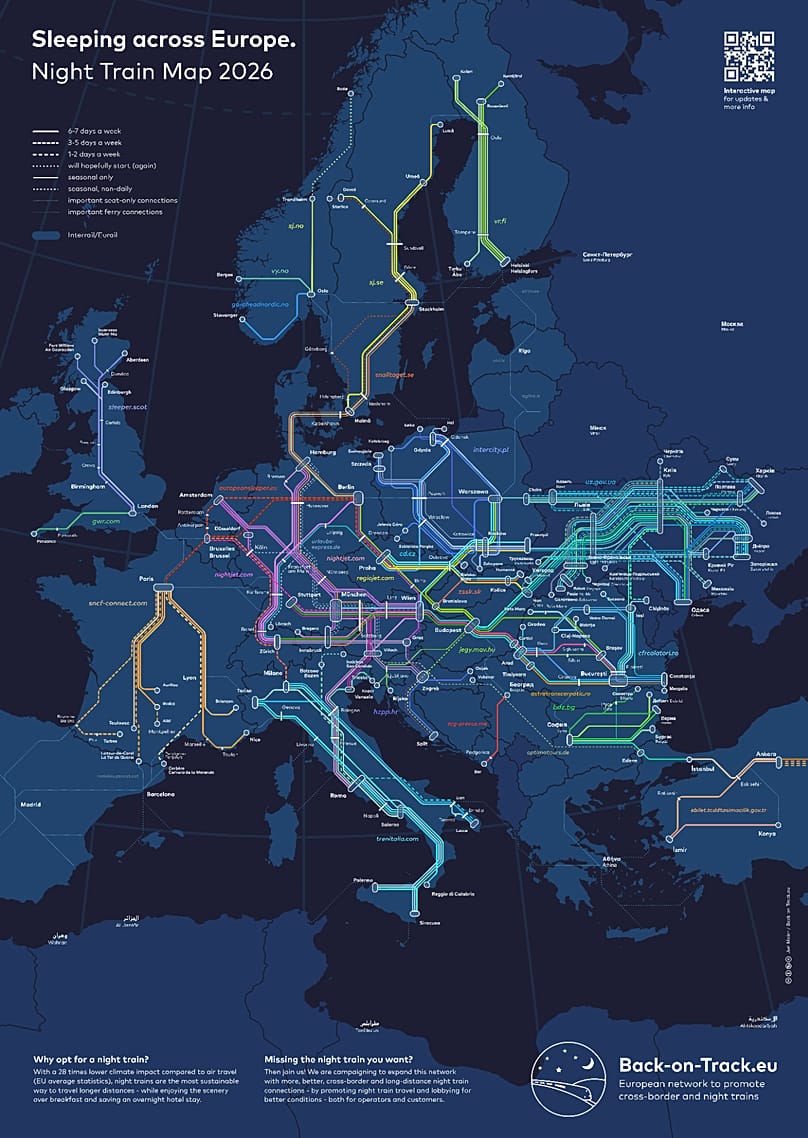
To address this gap and provide travelers with an updated resource, Back-on-Track has released its 2026 interactive night train map. This map showcases all regular night train routes across Europe and serves as a valuable guide for those planning their journeys.
An Up-to-Date Guide to Europe’s Night Trains
The interactive map displays every night train connection across the continent in a transport-network style format. Additionally, the organization’s website offers a detailed database with information about each route, including booking tips and other useful resources.
The 2026 edition of the map includes five new connections, such as the European Sleeper’s Paris–Berlin line, new PKP routes linking Poland to Praha and München, and a planned Bruxelles–Milano service. However, some routes have been discontinued, notably several popular ÖBB Nightjet routes and the 1,456km-long Stockholm-Narvik link, which was one of the longest night train routes in Europe.
Some services have also been shortened, such as the ÖBB route that previously ran from Bratislava to Split but now starts in Vienna. Juri Maier, chair of Back-on-Track and designer of the map, explained that the main challenge for night trains in Europe is the lack of investment in rolling stock. “The demand is there, and competition with planes is not as fierce anymore. Concepts exist to carry up to 750 sleeping passengers per train, which would make operations profitable on many routes. But to unlock this potential, we need significant investments – now.”
Challenges and Future Prospects
Ongoing track works across Europe continue to disrupt night train schedules. However, new infrastructure projects are expected to improve connectivity significantly by 2032. The newly planned Bruxelles–Milano line is anticipated to fill a critical gap on the map. Giovanni Antoniazzi, vice chair of Back-on-Track and a spatial data scientist based in Amsterdam, noted that the route through Switzerland will be an operational challenge. “We’re excited to see if it works out,” he said.
The interactive night train map is freely available at back-on-track.eu/night-train-map, where users can also order a printed poster. This resource aims to support travelers in making informed decisions about their journeys and highlights the potential of night trains as a sustainable and accessible mode of travel.