Pandemic’s Long Shadow: Young Aussies Bounce Back, Teens Lag Behind
New federal data is casting a stark spotlight on the uneven academic recovery of students in Australia following the widespread disruptions caused by the COVID-19 pandemic. While younger learners are showing promising signs of regaining lost ground, their older counterparts are continuing to grapple with stagnant or even declining test scores, raising serious concerns for the nation’s future educational outcomes.
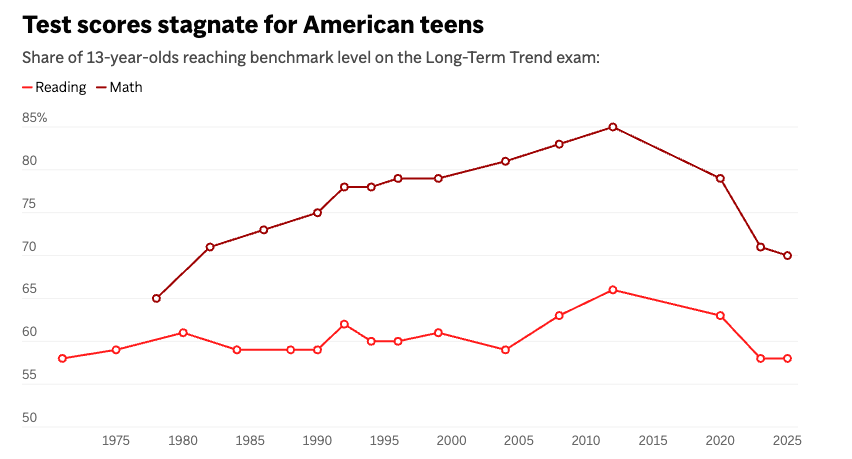
The latest national assessment, a long-running survey of academic skills administered to students at key developmental stages, reveals a significant divergence. Nine-year-old Australians have largely rebounded to pre-pandemic reading levels and have even demonstrated some improvement in mathematics. However, the situation for 13-year-olds is considerably more concerning. Their test scores in both reading and mathematics remain stubbornly below pre-pandemic averages, with reading proficiency effectively mirroring levels not seen in over five decades.
This critical disparity, highlighted by educational experts, underscores an urgent need for a broader focus from educators and policymakers. While significant attention and resources have understandably been directed towards early literacy initiatives, particularly for younger primary school students, the data strongly suggests that adolescent learners require more intensive and targeted support.
The 13-year-olds who participated in this recent assessment would have experienced the most significant upheaval of the pandemic during their crucial formative elementary school years. Without immediate and effective intervention, there is a tangible risk that these students will graduate from high school still academically behind their peers, impacting their future educational and career pathways.
“The 13-year-olds tested are now transitioning into high school or are already enrolled,” explained Lesley Muldoon, executive director of the National Assessment Governing Board. “Schools have a limited window of opportunity with these students. We cannot afford to hesitate or delay if we are serious about reversing these concerning trends.”
A Consistent Benchmark: The National Assessment
The long-term trends assessment, typically conducted every four years, provides a consistent and invaluable snapshot of the academic capabilities of Australian students at ages nine and thirteen. The most recent iteration of this assessment involved approximately 31,000 public and private school students across the country during the 2024-2025 school year.
A key strength of this particular assessment is its remarkable consistency. Unlike many other national tests that are periodically updated to reflect evolving curricula, this assessment has maintained its core structure and content since its inception, providing a stable and reliable benchmark for tracking academic progress and decline over extended periods. This allows for direct comparisons with data stretching back to the 1970s.
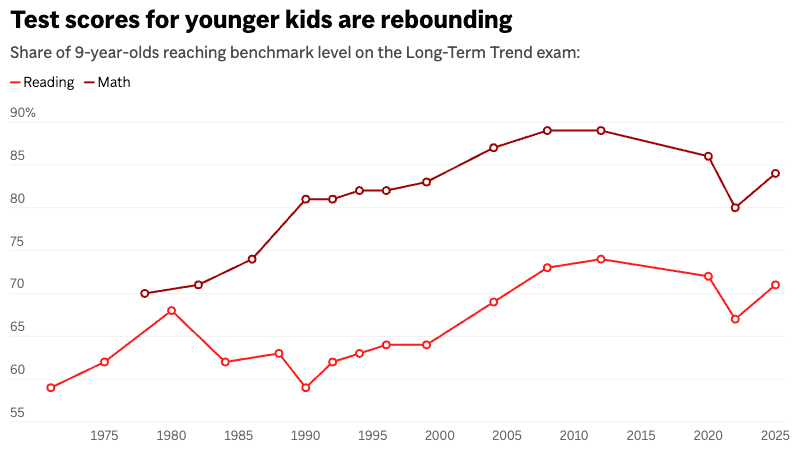
Matthew Soldner, acting commissioner of the National Center for Education Statistics, pointed out that the decline in Australian students’ academic achievement was a pre-existing concern even before the pandemic. Test scores had shown a peak around 2012, indicating that the disruptions of COVID-19 exacerbated an already challenging educational landscape. “We can clearly see that this isn’t just a pandemic story,” Soldner commented, suggesting a deeper, long-standing issue that predates recent global events.
The Data Unpacked: Younger Students Rebound, Teenagers Stagnate
The detailed results of the assessment paint a clear picture:
Nine-Year-Olds: These younger students have demonstrated improvement in foundational skills. This includes their ability to identify facts within news articles and perform basic multiplication tasks. In reading, 71 percent of nine-year-olds met the established benchmark, while a robust 84 percent achieved the benchmark in mathematics. These figures represent a slight but positive increase compared to the 2022 data.
Thirteen-Year-Olds: In stark contrast, teenagers, who were assessed on more complex skills such as making generalisations from texts and interpreting data presented in charts, showed no statistically significant improvement since 2023. Only 58 percent of this age group met the reading benchmark, and 70 percent met the mathematics benchmark.
The Erosion of Reading for Pleasure
Compounding the issue of stagnant literacy rates among older students is a significant decline in the habit of reading for pleasure. A supplementary survey conducted alongside the assessment revealed a deeply concerning trend:
- Thirteen-Year-Olds: A mere 14 percent of 13-year-olds reported reading for fun on a daily basis. This is a dramatic drop from 27 percent in 2012 and a historical peak of 37 percent recorded in 1992.
- Nine-Year-Olds: While still higher than their older counterparts, the trend is also evident in younger students. In the 2024-2025 assessment, 37 percent of nine-year-olds reported reading for fun daily, a decrease from 53 percent in 2012.
Researchers have frequently linked this decline in reading for pleasure to the pervasive influence and increased use of social media on mobile devices.
Soldner described the academic recovery observed in younger children as “incredibly encouraging.” However, he expressed deep regret that “almost 50 years of progress has been eliminated” for the 13-year-old cohort. The significant difference in their pandemic experience is a key factor. The older group would have been in their crucial second or third years of primary school during the initial stages of the pandemic, missing out on vital foundational learning. Conversely, the younger cohort began kindergarten or their first year of formal schooling as educational institutions began to reopen, allowing them to experience more typical in-person instruction during their formative years.
Despite the alarming recent declines, there are voices of optimism within the educational community. Mark Miller, an experienced eighth-grade mathematics teacher and a former member of the National Assessment Governing Board, remains hopeful. “We have made progress in the past, from the early ‘70s to 2012,” Miller stated. “Can it be done again? Absolutely.” This sentiment underscores the belief that with focused effort and strategic interventions, Australia can indeed turn the tide and foster academic growth across all age groups.