The Humble Beginnings and Revolutionary Rise of Glassblowing
We encounter glass objects countless times a day, often without a second thought. The sheer ubiquity and affordability of mass-produced glass have made us forget the transformative power this material holds. Yet, the art of glassblowing boasts a rich and fascinating history, with its roots stretching back to the late first century BCE. It was the Roman era’s innovative approach to glass, particularly their experimentation with recycling, that fundamentally reshaped daily life, catalysing a significant expansion in trade and economic activity. Remarkably, the core techniques of glassblowing employed during Roman times remain strikingly similar to those used by artisans today.
From Moulded Vessels to the Dawn of Blowing
Glass, as a material, predates the technique of glassblowing by a considerable margin. The earliest known glass artefacts, simple beads, were crafted in ancient Mesopotamia during the latter half of the third millennium BCE, approximately 4,500 to 4,000 years ago. Later, around 1500–1400 BCE, the first closed glass vessels emerged, also originating from Mesopotamia and the neighbouring ancient Egyptian civilisations.
These early glass vessels were not blown but were instead meticulously moulded. The creation of closed containers relied on a process known as core-forming. This involved affixing a core, typically made from a mixture of animal dung, clay, mud, and sand, to the end of an iron rod. Molten glass, possessing a consistency akin to treacle and heated to over 1,000°C, was then carefully applied over this core. Once the glass was shaped, decorated, and allowed to cool, the hardened core had to be laboriously scraped out by hand.
Following this core-forming method, later vessels were produced using casting techniques. This method also involved heating glass and pouring it into moulds. However, both core-forming and casting were time-consuming processes, demanding extensive working periods and laborious grinding and polishing to achieve a finished product. Consequently, glass was a luxury item, accessible only to the affluent, as these artisanal methods could take tens of hours to complete a single piece.
A Technological Leap: The Invention of Glassblowing
The advent of glassblowing, which occurred towards the end of the first century BCE in the coastal Levant region – encompassing modern-day Syria, Lebanon, Israel, Palestine, and Jordan – dramatically streamlined the production process, reducing it to mere minutes. The earliest tangible evidence of this revolutionary technique has been unearthed in what is now Jerusalem. During the final quarter of the first century BCE, this area was under the dominion of Roman Jewish client kings, Herod the Great and Herod Archelaus, acting on behalf of the Roman Emperor Augustus.
The archaeological findings in Jerusalem suggest that furnace workers were experimenting with heating the ends of glass tubes and attempting to rework them. Scholarly consensus points towards these early experiments being an exploration of glass recycling. It’s a compelling narrative: one day, someone, perhaps by accident, blew into one of these heated tubes, forever altering the trajectory of the glass industry and, by extension, history. This simple act enabled the rapid and relatively easy creation of glass containers.
Spreading the Craft: Glassworkers on the Move
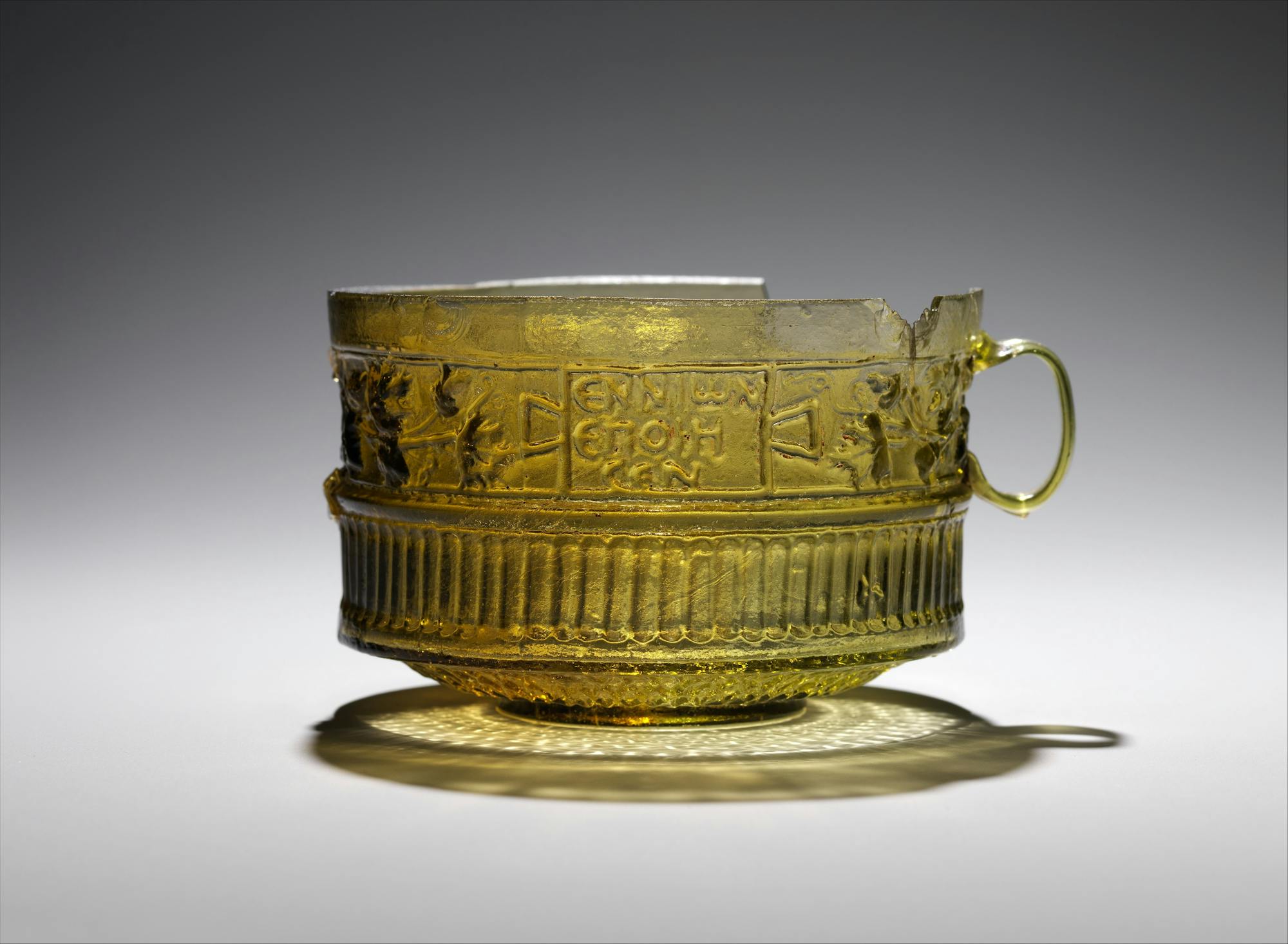
The revolutionary technique of glassblowing quickly spread as artisans travelled across the Mediterranean. During the first century BCE, the Levant served as a vibrant hub for glass technology and continuous innovation. Some of the few named glassworkers from this era, such as Ennion, were of Syrian origin and spoke Greek, reflecting the cosmopolitan nature of the region.
As glassworkers and their products dispersed, they followed the reach of the Roman Empire. Blown glass vessels soon found their way beyond Roman frontiers, reaching as far afield as northern Scotland, Scandinavia, the Sahara Desert, and even China. This widespread distribution meant that blown glass containers became accessible to a much broader segment of society.
The Greek historian Strabo, writing not long after the invention of glassblowing, noted that in Rome, a glass cup could be purchased for the equivalent of a single copper coin. This affordability had a profound impact on commerce. Previously, bulk liquids like olive oil and wine were transported and stored in large terracotta amphorae, a common sight in Roman shops. Glass containers, however, allowed consumers to purchase smaller, more manageable quantities. People could have their glass containers filled directly at shops and taverns.
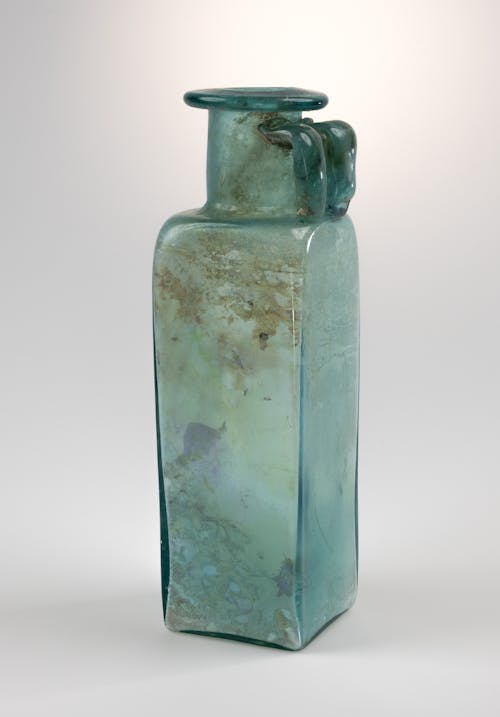
Furthermore, the inert nature of glass meant it did not impart any unwanted flavours to food or drink, allowing for longer preservation. This was a significant advantage over most ancient pottery, which was often unglazed and prone to seepage, and metal containers, which could alter the taste of their contents.
Roman writers like Petronius and Pliny the Elder recount a fanciful tale involving the supposed discovery of an unbreakable glass. The inventor presented it to Emperor Tiberius, who, fearing economic upheaval as gold and silver might lose their value, ordered the craftsman’s execution. This anecdote, though likely apocryphal, underscores the perceived value and transformative potential of glass during that period.
Much like today, the Romans stored their glass jars and bottles on shelves and in cupboards. The archaeological sites of Pompeii and Herculaneum offer poignant glimpses into this domestic practice, with vessels found exactly where they fell following the devastating eruption of Mount Vesuvius.
Diverse Applications and Artistic Expression
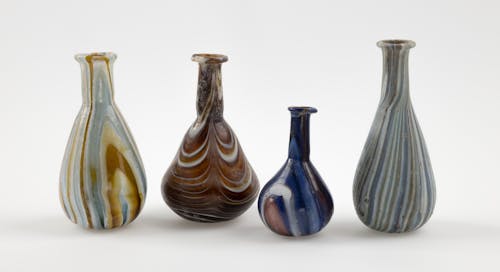
The simplest glass vessel to produce was a small flask for perfume or cosmetics. Roman perfumes, typically oil and fat-based, benefited greatly from these spoil-proof containers, making them more affordable and accessible. This innovation significantly altered how people interacted with food, drink, personal care products, and hygiene. Beyond domestic utility, glass also contributed to comfort, with glass windows providing draught-free light in Roman homes and public baths.
Roman art and everyday objects frequently took the form of animals, plants, and human figures, and sometimes even anatomical parts. While simple vessels remained the most common, Roman glass also showcased a more whimsical and even kitsch side, featuring designs like gladiator fight scenes or a monkey playing the pan-pipes.
To create these decorative elements, moulds were sometimes fashioned from stone or ceramic. These moulds were often lined with a thin layer of soot, typically derived from a lamp. This soot acted as a non-stick agent, allowing the hot glass bubble to be blown directly inside the mould without adhering to it.
Mythological scenes and thematic narratives were also popular motifs. Some vessels bore inscriptions featuring ancient Greek phrases that conveyed sentiments akin to modern expressions of joy and well-being, such as “katachaire kai euphrainou” (rejoice and enjoy yourself!) or “euphrainou epi toutoi eph hoi parei” (delight in that at which you are present).
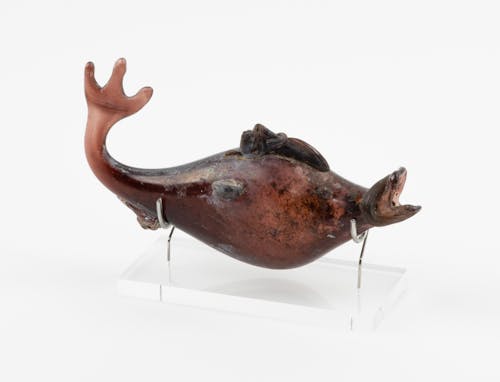
Flasks could be ingeniously shaped to resemble fish or fruits like dates and grapes. These were likely the ancient equivalents of today’s novelty sauce containers, such as the tomato-shaped dispenser at a diner or the plastic fish holding soy sauce at a sushi restaurant. Such designs offer insight into what the Romans found entertaining and what glassworkers believed would be commercially successful.