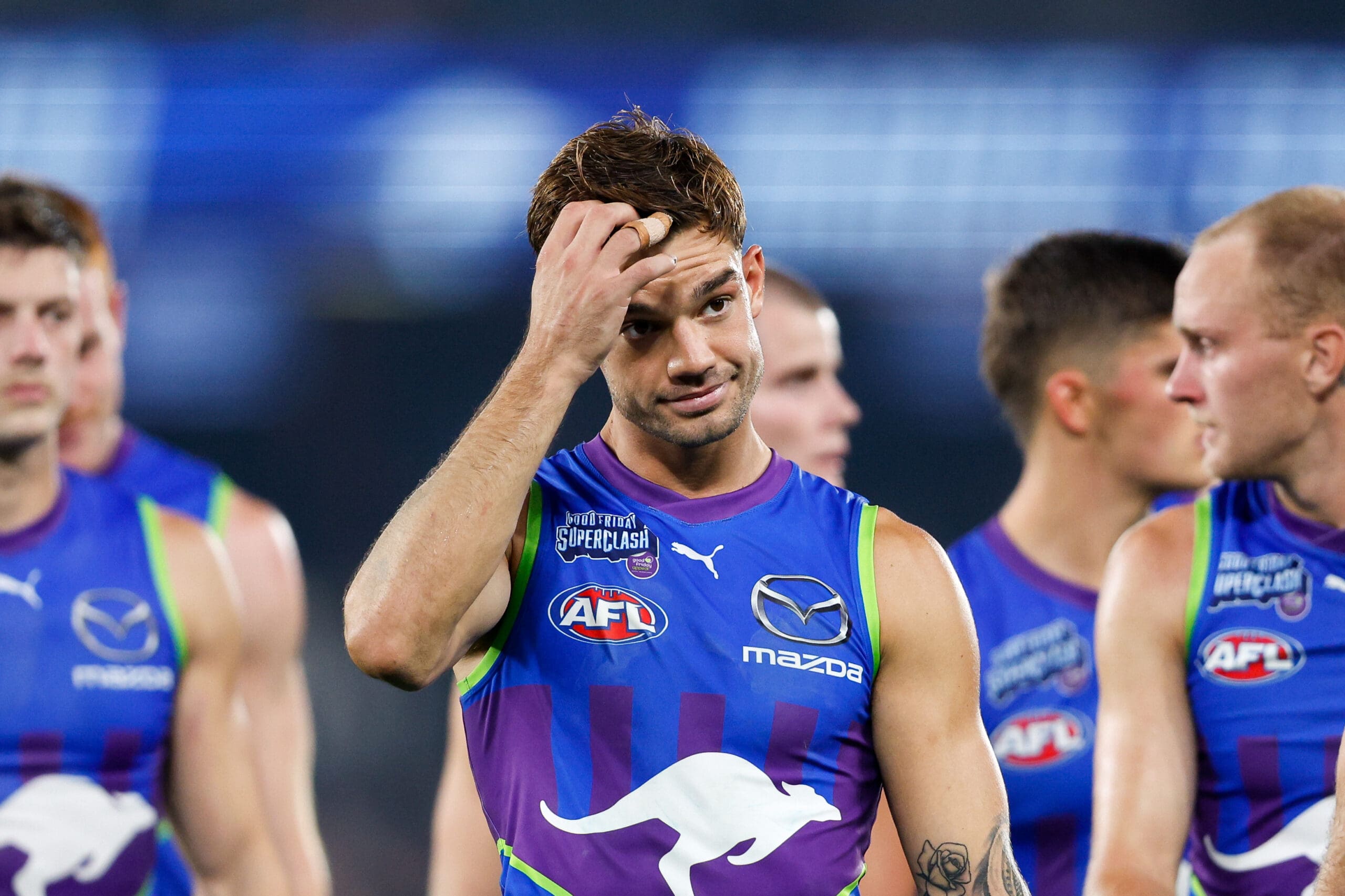
Former North Melbourne captain Jy Simpkin has publicly criticized the AFL Tribunal for upholding a three-week suspension of teammate Paul Curtis. The decision came after Curtis was involved in a tackle on West Coast’s Hamish Davis, which left the young Eagle with a concussion.
In an Instagram post, Simpkin highlighted a similar incident from last year’s preliminary final, where Hawthorn’s Mabior Chol was not banned for a tackle that caused Geelong defender Tom Stewart to be concussed. “Ball carrier gets concussed, tackler gets off with no suspension,” he wrote, drawing attention to what he sees as inconsistency in the application of rules.
The post included a still image of Curtis’ tackle, captioned: “Ball carrier gets concussed, tackler gets a three-week suspension.” Another slide emphasized the need for the AFL to address its rule changes and the role of the Match Review Officer (MRO), calling the current system “laughable.” Simpkin noted that players are confused about what is permissible on the field, stating, “Just hope for the best each week.”
Curtis also responded on social media before the post was removed. North Melbourne attempted to defend the tackle by arguing that Davis’ forearms were free and that Curtis acted reasonably. The club outlined five observable features of the tackle that they claimed did not constitute a dangerous play:
- There was only one action
- The momentum through the tackle is the ball-carrier’s; the tackle was from the side
- Arms were not pinned, rather arms were held at the biceps, allowing the forearms and hands of the tackled player to be free throughout
- The tackled player goes to ground first with his knees, then both hands, before his head makes contact with the ground, so the force goes through his knees and hands before his head
- The tackler is to Hamish’s side, not his back, as they land on the ground.
Despite these arguments, the AFL Tribunal maintained that Curtis did not attempt to release Davis’ arms or rotate the Eagle, leaving him in a vulnerable position. This decision has sparked further debate about the fairness and consistency of the review process, with many questioning whether the rules are being applied uniformly across the league.
The controversy highlights the challenges faced by players and clubs in navigating the ever-changing landscape of AFL regulations. With frequent rule updates and subjective interpretations, it is clear that there is a growing need for clarity and transparency in how incidents are assessed. As the season progresses, the focus will likely remain on ensuring that decisions made by the Tribunal reflect the spirit of the game while maintaining player safety.