Earth’s Climate System Under Unprecedented Strain, New Report Reveals
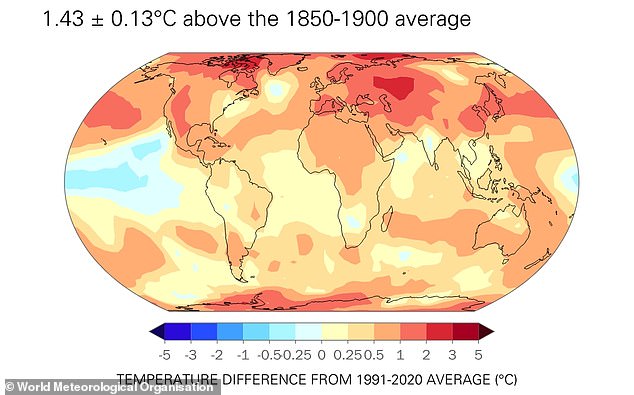
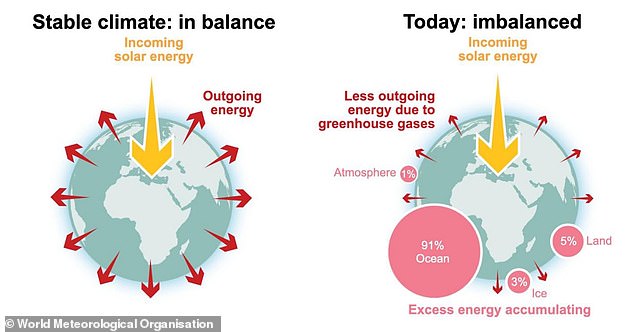
The planet’s climate is experiencing a level of imbalance unseen in recorded history, according to a stark new report. Scientists from the World Meteorological Organisation (WMO) have revealed that humanity has just endured the eleven hottest years on record, spanning from 2011 to the end of 2025. Last year, 2025, was confirmed as either the second or third hottest year on record, with average global temperatures soaring 1.43°C (2.57°F) above the pre-industrial baseline (1850–1900).
From the ever-increasing global temperatures and escalating greenhouse gas concentrations to rising sea levels and rapidly retreating glaciers, every critical indicator is now “flashing red,” scientists warn. The WMO’s comprehensive annual State of the Climate report details large-scale changes that experts predict could have profound and lasting impacts on the planet for centuries, if not millennia.
A key finding of the report is the first clear assessment of Earth’s energy imbalance. This imbalance measures the difference between the amount of solar energy absorbed by the atmosphere and the amount of heat radiated back into space.
Earth’s Energy Imbalance Reaches Historic Highs
Our planet’s energy imbalance has now reached its highest point in the 65-year observational record, driving rapid warming of both the atmosphere and the oceans. UN Secretary-General António Guterres has issued a grave warning: “Planet Earth is being pushed beyond its limits. Every key climate indicator is flashing red.”
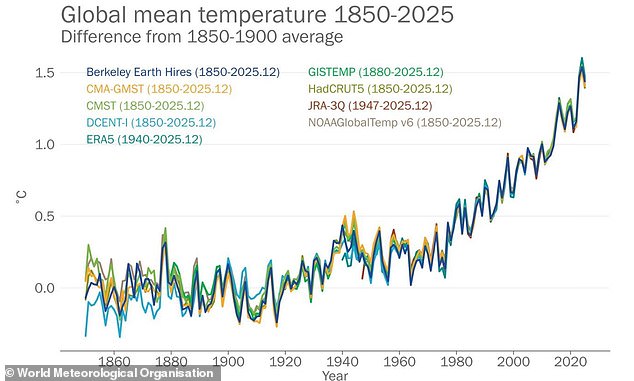
In an ideal scenario, the energy Earth receives from the sun would be balanced by the heat radiating away through the atmosphere. However, the accumulation of greenhouse gases – including carbon dioxide, methane, and nitrous oxide – traps infrared radiation, disrupting this delicate equilibrium and throwing Earth’s energy budget into disarray.
Greenhouse Gas Concentrations at Record Levels
The WMO report unequivocally confirms that concentrations of these critical greenhouse gases have reached unprecedented levels in human history.
- Carbon Dioxide (CO2): Atmospheric CO2 now stands at 423 parts per million. This represents a staggering 152% of pre-industrial levels and is the highest concentration observed in the last two million years.
- Methane (CH4): Methane concentrations have reached 266% of pre-industrial levels.
- Nitrous Oxide (N2O): Similarly, nitrous oxide is at 125% of its pre-industrial concentration. These levels are the highest recorded in the past 800,000 years.
This persistent imbalance means that heat is accumulating on Earth at an accelerating rate, far faster than it can escape, leading to a significant surplus of energy within the climate system.
WMO Secretary-General Celeste Saulo highlighted the significance of these findings: “Scientific advances have improved our understanding of the Earth’s energy imbalance and of the reality facing our planet and our climate right now.”
The Five Key Climate Indicators Flashing Red
The WMO report identifies five crucial climate indicators that are currently alarming scientists:
- Temperature: The last eleven years have collectively been the hottest ever recorded.
- Greenhouse Gases: Concentrations of carbon dioxide are at their highest levels in two million years, with methane and nitrous oxide also at historic highs.
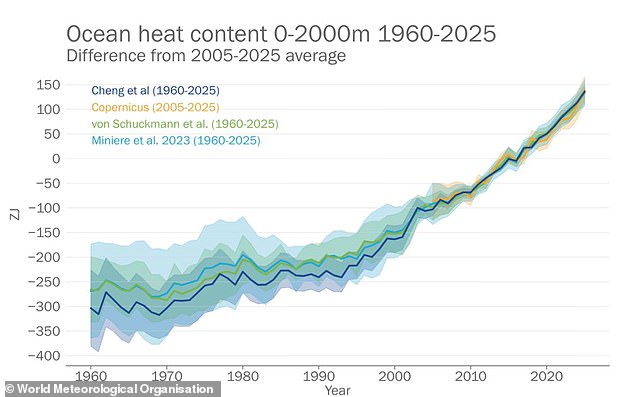
- Ocean Heating: The rate at which the world’s oceans are heating up is the fastest ever recorded.
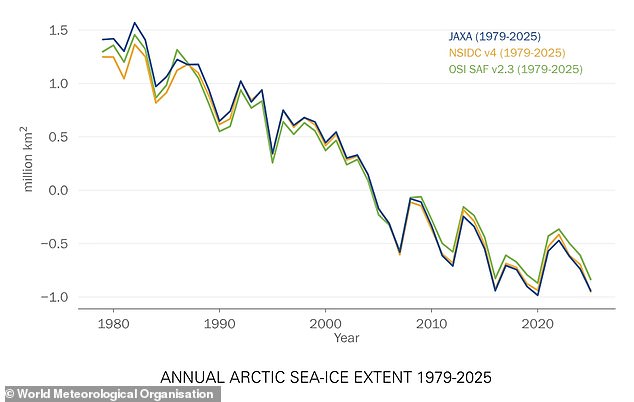
- Sea Ice: Arctic sea ice extent in 2025 was at or near record low levels.
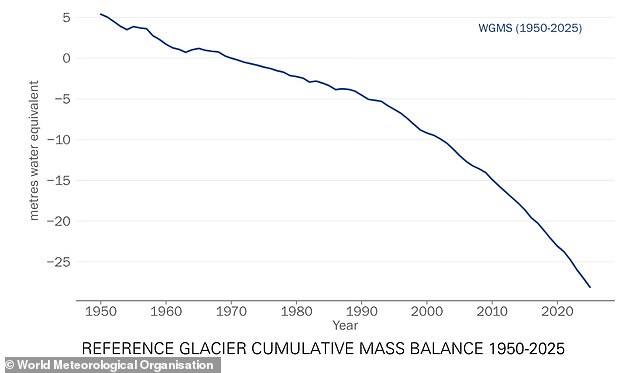
- Glaciers: 2025 saw one of the five worst years on record for glacier mass loss.
“Human activities are increasingly disrupting the natural equilibrium, and we will live with these consequences for hundreds and thousands of years,” Saulo added.
The Role of El Niño and Ocean Heat Absorption
While the last eleven years have been the hottest on record, experts anticipate further temperature increases in the coming years, partly due to the natural El Niño weather cycle. Dr. Akshay Deoras, a senior research scientist at the University of Reading, explained: “El Niño naturally releases a lot of heat from the ocean into the atmosphere, and when that sits on top of very high greenhouse gas levels, it can push global temperatures to new records.” He anticipates that El Niño conditions developing later this year could lead to another spike in global temperatures in 2026–2027, building upon the already elevated baseline.
The vast majority of the excess energy trapped by greenhouse gases is absorbed by the oceans. While the atmosphere feels only about 1% of this excess energy, the oceans absorb over 91%. Continental landmasses store about 5%, and 3% goes into melting ice.
Ocean heat content reached a new record high in 2025. Crucially, the rate at which the oceans are warming has doubled from the period 1960–2005 to 2005–2025. In fact, each of the last nine years has set a new record for the amount of heat stored within the oceans.
Record Global Temperatures
The following are the hottest years on record globally, according to Copernicus data:
- 2024 (59.2°F/15.1°C)
- 2023 (58.96°F/14.98°C)
- 2025 (58.95°F/14.97°C)
- 2016 (58.66°F/14.814°C)
- 2020 (58.65°F/14.807°C)
- 2019 (58.60°F/14.78°C)
- 2017 (58.50°F/14.723°C)
- 2022 (58.42°F/14.682°C)
- 2021 (58.38°F/14.656°C)
- 2018 (58.35°F/14.644°C)
(Figures in brackets refer to global average air temperature for the year)
The WMO estimates that the oceans absorb between 11 and 12.2 zettajoules of heat energy annually – a figure equivalent to 18 times humanity’s total yearly energy consumption. This immense heat absorption is driving profound changes, including more frequent and intense marine heatwaves, rising sea levels, and the melting of polar ice caps. In 2025, a remarkable 90% of the ocean’s surface experienced marine heatwaves, even during a cooler La Niña period.
Professor Scott Heron from James Cook University warned of the consequences: “Intensifying marine heatwaves have already impacted ocean systems through coral bleaching and mortality across the tropics, seagrass death and catastrophic marine disease outbreaks in tropical and temperate zones, as well as episodes of salmon lice in polar aquaculture. If rainforests are thought of as the lungs of our planet, the ocean provides the heart and circulation – and human-induced climate change is giving us all heart disease.”
Accelerating Sea Level Rise
The WMO’s research underscores an accelerating rate of sea level rise, primarily caused by the melting of ice sheets and the thermal expansion of warming ocean water. In 2025, sea levels were comparable to their record highs of 2024, standing 11 cm (4.3 inches) higher than at the commencement of satellite records in 1993.
Current projections from the Intergovernmental Panel on Climate Change (IPCC) suggest that sea levels could rise by approximately one metre (3.2ft) by 2100 if climate change is not significantly curbed. However, more recent studies indicate that sea levels at the end of the century could be around 28 cm (11 inches) higher than previously expected in the UK, and potentially between 1 and 1.5 metres (3.2ft to 4.9ft) higher in parts of Southeast Asia. With an estimated 50 to 80 million people globally living below current sea level, even modest rises pose a significant threat to coastal communities.
Polar Ice Retreat and Glacier Mass Loss
Warming oceans are also a major driver of polar sea ice retreat. In 2025, the annual sea ice extent in the Arctic was at or near record lows. Meanwhile, average sea ice extents in the Antarctic were the third lowest on record.
Furthermore, mass loss from glaciers in 2024–2025 was among the five worst years on record, with exceptional rates of melting observed in Iceland and along the Pacific coast of North America.
Extreme Weather Events Intensify
The warming of the climate is directly contributing to more frequent and devastating extreme weather events. A warmer atmosphere holds more energy and moisture, amplifying the impact of storms, droughts, and floods.
Late last year, Hurricane Melissa made landfall in the Caribbean as the most powerful storm in Jamaica’s recorded history. Researchers have determined that climate change made this catastrophic Category 5 hurricane four times more likely to occur. In a world without climate change, a hurricane of Melissa’s magnitude would have been an event occurring only once every 8,000 years.
Elsewhere, back-to-back periods of extreme drought followed by intense rainfall are contributing to an increased frequency and severity of wildfires and flash floods globally.
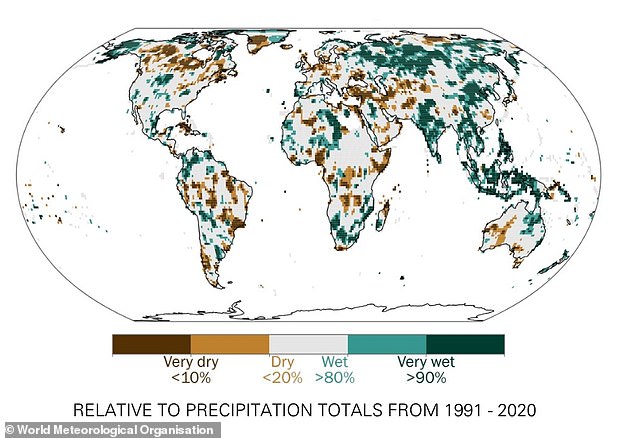
Dr. Mortlock, head of climate analytics at the University of New South Wales, noted the disproportionate impact of even small temperature increases: “Even seemingly small increases in temperature can have outsized effects on extreme weather. The frequency and intensity of bushfires, floods, cyclones, and hailstorms are all linked to the warming of the atmosphere. At the same time, more people are living in harm’s way.”
Shifting Disease Vectors and Climate Change
These shifting weather patterns are also creating conditions conducive to the outbreak of deadly diseases. Warmer, wetter weather is expanding the habitable zones for disease-carrying mosquitoes, such as the Asian and Egyptian species, pushing their range northwards into urban areas across Europe, including cities like London, Vienna, Strasbourg, and Frankfurt. While these species are not yet established in these specific cities, their northward spread in France has accelerated significantly in recent years.
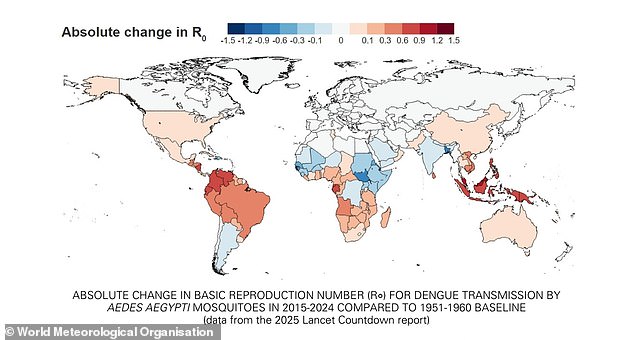
A recent study has also revealed that storms can dramatically amplify outbreaks of diseases like dengue fever. Following a cyclone in Peru in 2023, a dengue fever outbreak was observed to be ten times larger than typically expected for the region. Experts estimate that the weather conditions that triggered this amplified outbreak are now three times more likely due to climate change.
Concluding his assessment, Mr. Guterres stated, “The State of the Global Climate is in a state of emergency. Today’s report should come with a warning label: climate chaos is accelerating, and delay is deadly.”