Vast Hidden Ocean Found Deep Within Earth, Reshaping Water Origin Theories
Scientists have made a groundbreaking discovery that could fundamentally alter our understanding of Earth’s water. Deep beneath our feet, nestled within the planet’s mantle, lies a colossal reservoir of water, contained within a mineral known as ringwoodite. This subterranean “ocean” is estimated to be an astonishing three times larger than all the surface oceans combined. Located approximately 700 kilometres below the Earth’s crust, this finding challenges long-held scientific beliefs about where our planet’s water originated.
For decades, the prevailing theory suggested that Earth’s water was primarily delivered by comets bombarding the young planet. However, this new evidence, detailed in the prestigious journal Science, presents a compelling alternative: water may have been present within the Earth from its very formation, gradually seeping out from the planet’s interior over billions of years.
The Origin of Earth’s Water: A Paradigm Shift
The notion of comets as the sole architects of Earth’s oceans has been a cornerstone of scientific discourse. Yet, the identification of this immense water-bearing mineral deep within the mantle offers robust support for an internal origin.
“These mineral transformations greatly hinder the movements of rock in the mantle,” explained Professor Frank Brenker, a geoscientist at Goethe University in Frankfurt. This internal water storage mechanism has profound implications for geological processes.
Furthermore, this hidden deep-sea reservoir could provide a crucial explanation for the remarkable stability of Earth’s surface oceans over geological timescales. Steven Jacobsen, a geophysicist at Northwestern University, suggests that this vast, concealed body of water may act as a natural regulator, buffering the volume of our surface oceans and preventing dramatic fluctuations in sea levels.
“It’s strong evidence that the Earth’s water came from within,” Jacobsen stated, hinting at the possibility that a significant portion of Earth’s total water content might still be locked away within the planet’s deep interior. The question now becomes: how much more water remains trapped in these inaccessible depths?
Unveiling the Reservoir: A Symphony of Seismic Waves
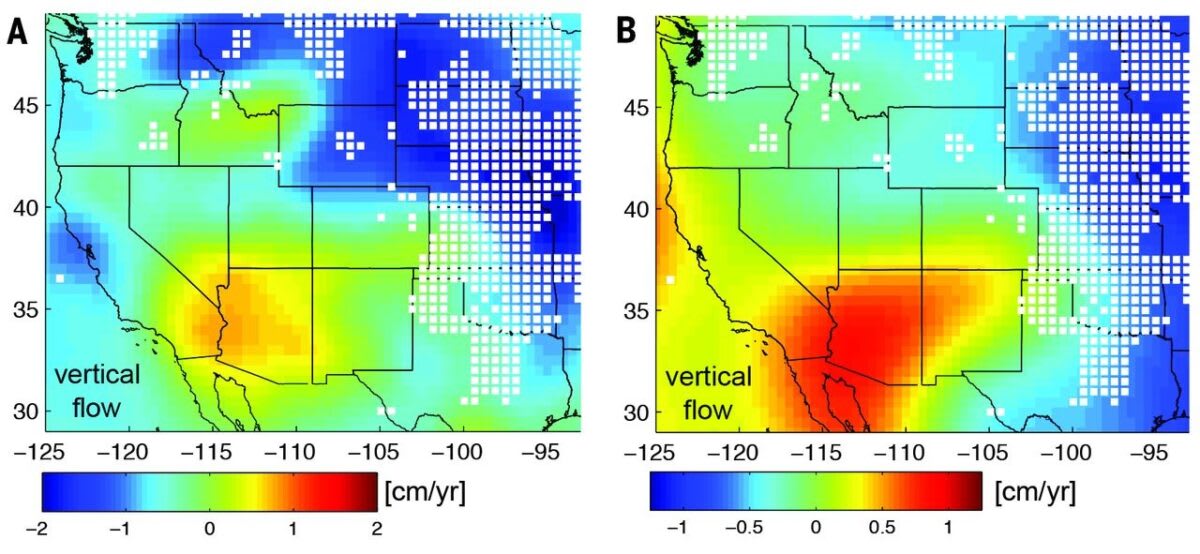
The monumental discovery was made possible through the ingenious application of seismology. Jacobsen’s team deployed a sophisticated network of over 2,000 seismometers, meticulously analysing seismic waves generated by more than 500 earthquakes.
These seismic waves, essentially vibrations from earthquakes, travel through the Earth’s interior. Their speed and behaviour are significantly influenced by the density and composition of the materials they encounter. The researchers observed a distinct slowing of these waves as they passed through specific regions of the mantle. This deceleration was a clear indicator of the presence of water-rich rocks, such as ringwoodite, confirming the existence of the vast, hidden reservoir.
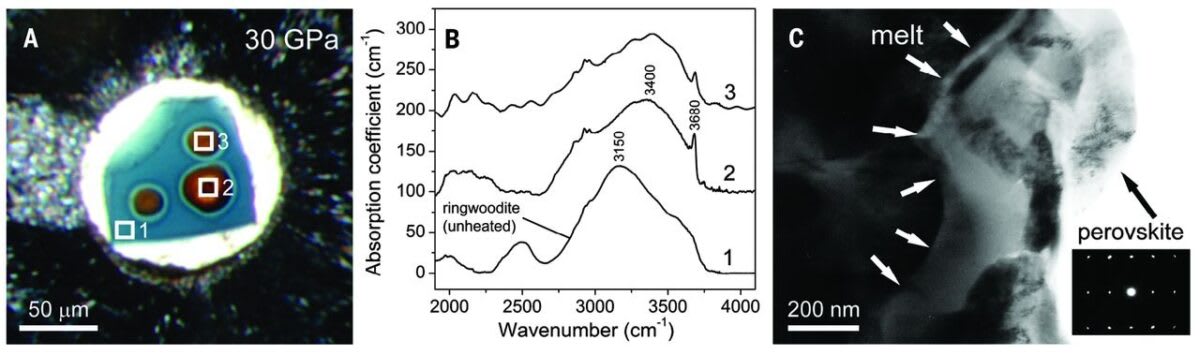
Beyond seismic data, the team conducted rigorous laboratory experiments. They painstakingly recreated the extreme conditions of high pressure and temperature found at a depth of 700 kilometres. Under these simulated mantle conditions, they confirmed that ringwoodite possesses a remarkable capacity to store substantial quantities of water. These findings align with previous research, including work by Graham Pearson, who previously identified evidence of water within ringwoodite extracted from a diamond brought to the surface by volcanic activity.
“Since our initial report of hydrous ringwoodite, we’ve found another ringwoodite crystal, also containing water, so the evidence is now very strong,” Pearson commented on the growing body of evidence.
Water’s Profound Influence Below the Crust
The implications of water being stored within the mantle extend far beyond simply its volume. This deep reservoir could play a critical role in regulating heat flow and material transport between the mantle and the Earth’s surface. Such regulation could, in turn, exert a significant influence on tectonic activity and the long-term stability of our planet’s crust.
While the researchers have identified this watery rock formation beneath the United States, their next ambitious goal is to determine the global extent of this deep water reservoir.
“We should be grateful for this deep reservoir,” Jacobsen remarked. “If it wasn’t there, it would be on the surface of the Earth, and mountain tops would be the only land poking out.”
This discovery offers a revolutionary new perspective on Earth’s inner workings, potentially reshaping our understanding of planetary formation, the intricate cycles of water through our planet, and the future evolution of Earth.