Unprecedented Footage Reveals Remarkable Social Support During Sperm Whale Birth
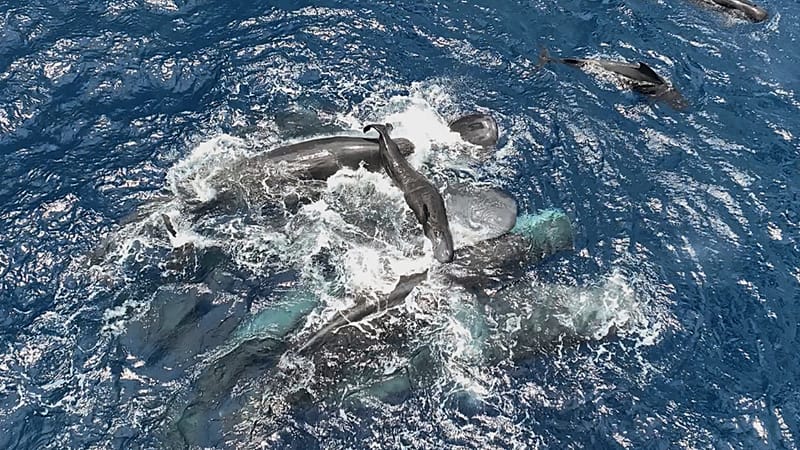
For the first time, scientists have captured extraordinary footage of a sperm whale giving birth, offering a rare glimpse into the complex social behaviours of these magnificent yet elusive marine giants. The video, recorded in 2023 off the coast of Dominica in the Caribbean, showcases an astonishing level of cooperative effort among female whales, a phenomenon rarely observed outside of primate species.
The footage reveals that during the critical moments of labour, female sperm whales from different family lines worked in unison to support the birthing mother. In a display of profound social bonding and care, they assisted in lifting the newborn calf above the water’s surface. This remarkable coordination highlights the intricate social structures of sperm whale communities, particularly during one of the most vulnerable and significant events in their lives.
“The group quite literally helps bring the calf into the world,” commented behavioural ecologist Mauricio Cantor of Oregon State University. While not involved in the current research, Cantor’s statement underscores the significance of the observed cooperative behaviour.
Studying the social interactions and cooperation of whales in their natural habitat presents a formidable challenge. These intelligent creatures spend the majority of their lives submerged, making direct observation difficult. For decades, documented accounts of sperm whale births have been scarce, largely consisting of anecdotal evidence or records from historical whaling operations. The new research, however, provides concrete visual and auditory evidence of this intricate social support system.
A Serendipitous Observation Leads to Groundbreaking Discoveries
The discovery occurred serendipitously a few years ago when a team of researchers was on a vessel off Dominica, conducting studies on whale communication. They observed an unusual gathering of eleven sperm whales, predominantly females, surfacing with their heads oriented towards each other. The whales began a series of energetic thrashing and diving manoeuvres, prompting the scientists to deploy drones and underwater microphones to document the unfolding event.
The entire birthing process, from start to finish, spanned approximately 30 minutes. Following the birth, pairs of adult whales continued to cradle the newborn calf above the water for several hours, ensuring its safety until it gained the strength and ability to swim independently.
“This was just really a special event,” shared David Gruber, a co-author of the study and affiliated with the Cetacean Translation Initiative, or Project CETI. The significance of this rare occurrence was not lost on the research team.
Analysing the Sights and Sounds of a Whale Birth
Following the observation, the scientists developed sophisticated software to meticulously analyse the recorded visual and auditory data. Their findings have been disseminated across two scientific publications released on March 26, 2026, in the esteemed journals Scientific Reports and Science.
A key revelation from the analysis was the extent of kinship and community involvement. The observations confirmed that not only mothers, sisters, and daughters, but also unrelated female whales united to provide support for the new calf. This indicates that the strong, female-led social bonds characteristic of sperm whale societies extend and are actively maintained even during the most critical life stages.
“It’s amazing to think about how, when faced with this impossible challenge, these animals come together to succeed,” stated Shane Gero, another co-author from Project CETI. His words highlight the profound implications of this discovery for our understanding of animal behaviour and social intelligence.
Unlocking the Secrets of Whale Communication
Beyond the visual spectacle, the research also shed light on the acoustic aspects of the birth. The scientists noted distinct vocalizations, including slower, longer sequences of clicks, made by the whales during key moments of the birthing process. These unique sounds are hypothesised to have played a crucial role in facilitating communication, enabling the animals to synchronise their efforts effectively for the complex task of birth.
This groundbreaking research opens up a wealth of new questions for marine biologists. How do these groups of whales coalesce? What innate mechanisms or social cues prompt them to join together for such an event? The scarcity of such footage makes definitive answers challenging to obtain in the short term. However, the current findings provide invaluable insights into the previously hidden “conversations” and social dynamics of these magnificent cetaceans.
“I think it’s just exciting to think about the social lives of these animals,” remarked biologist Susan Parks of Syracuse University, who was not involved in the study. Her enthusiasm reflects the broader scientific community’s anticipation of further discoveries that will undoubtedly emerge from this remarkable footage and the ongoing research into sperm whale behaviour. The study serves as a powerful reminder of the complex social intelligence and cooperative behaviours that exist within the marine world, often unseen and unacknowledged.