A Major Milestone for the Artemis Program
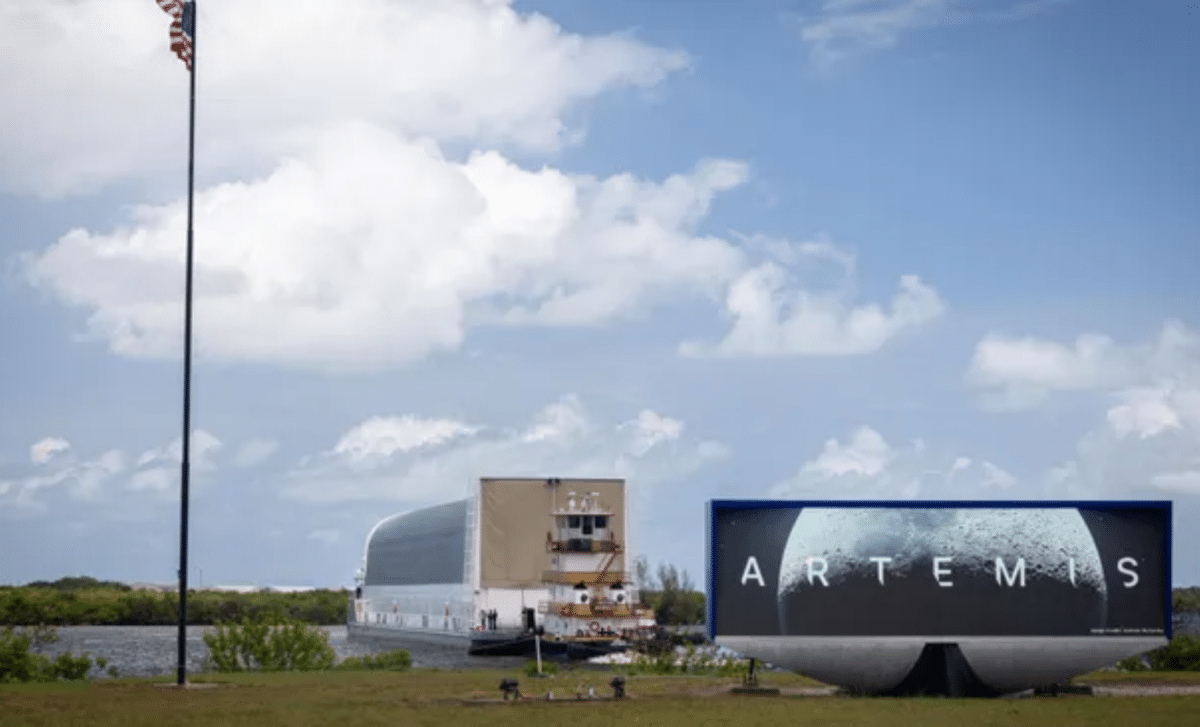
The arrival of a crucial component of NASA’s next deep space rocket marks a significant moment for the Artemis program. The upper portion of the Space Launch System (SLS) core stage, designated for Artemis 3, has reached Kennedy Space Center, bringing the agency closer to a mission that will shape the future of human space exploration.
A Long Journey Ends in Florida
After traveling approximately 900 miles aboard NASA’s Pegasus barge, the towering structure arrived in Florida following a weeklong journey from the Michoud Assembly Facility in New Orleans. This segment constitutes about 80% of the rocket’s core stage, which will eventually stand 212 feet tall once fully assembled.
Teams at Kennedy Space Center are now preparing to transfer the hardware into the iconic Vehicle Assembly Building, one of the largest structures in the world by volume. Inside, engineers will integrate the newly arrived section with its engine module, a critical step that transforms separate components into a unified launch system.
The Scale of the Operation
The scale of this operation highlights the ambition behind the Artemis program. According to reports, the SLS rocket remains the most powerful launch vehicle NASA has ever developed, designed to carry astronauts beyond low Earth orbit for the first time in decades. Each movement, each connection, and each test is part of a meticulously planned process where precision determines mission success.
Artemis 3: Not a Lunar Landing Mission
Despite being part of NASA’s lunar campaign, Artemis 3 will not actually land astronauts on the Moon. Instead, the mission will remain in Earth orbit, focusing on testing rendezvous and docking procedures between the Orion spacecraft and commercial lunar landers.
This includes vehicles developed by SpaceX and Blue Origin, namely Starship and Blue Moon. These spacecraft are central to NASA’s long-term lunar strategy, serving as the transport systems that will eventually carry astronauts from orbit down to the lunar surface.
The decision to keep Artemis 3 in orbit reflects the complexity of integrating multiple spacecraft systems developed by different companies. Docking maneuvers, life support compatibility, and operational timing must all be validated before committing to a lunar landing mission.
Timeline Shifts Highlight Technical Challenges
NASA initially aimed for a mid-2027 launch window for Artemis 3. That schedule has now shifted toward late 2027, largely due to the time required for Starship and Blue Moon to reach full operational readiness.
Such delays are not unusual in programs of this scale. Coordinating government-built infrastructure like SLS with privately developed landing systems introduces layers of technical dependency. Each component must meet strict safety and performance benchmarks before integration can proceed.
This revised timeline underscores the evolving nature of modern space exploration, where partnerships between public agencies and private companies define progress. It also reflects NASA’s cautious approach, prioritizing mission reliability over speed.
Building On Artemis 2’s Historic Flight
The progress toward Artemis 3 follows closely behind the success of Artemis 2, which launched four astronauts on April 1 and concluded with a Pacific Ocean splashdown on April 10. That mission marked the first time humans traveled beyond low Earth orbit since 1972.
During the flight, the crew reached a record-breaking distance of 252,760 miles from Earth, pushing farther into space than any humans before them. The mission demonstrated the capabilities of both the SLS rocket and the Orion spacecraft under real flight conditions.
These achievements provide the operational confidence needed to move forward. Artemis 3 will build on that foundation, shifting focus from proving systems in deep space to testing the interactions that will make lunar landings possible again.
The Next Step Toward A Human Return To The Moon
While Artemis 3 will remain in orbit, its role is pivotal. The mission serves as the bridge between initial test flights and the eventual return of astronauts to the lunar surface. That milestone is currently targeted for Artemis 4, which could launch as early as 2028.
By the time that mission takes place, NASA expects one of its commercial partners to be fully prepared to deliver astronauts to the Moon. The groundwork being laid now, through hardware arrivals, assembly operations, and orbital tests, forms the backbone of that future landing.
The arrival of the SLS core stage in Florida is not just a logistical update. It signals momentum in a program that aims to establish a sustained human presence beyond Earth, opening the door to deeper exploration of the solar system.