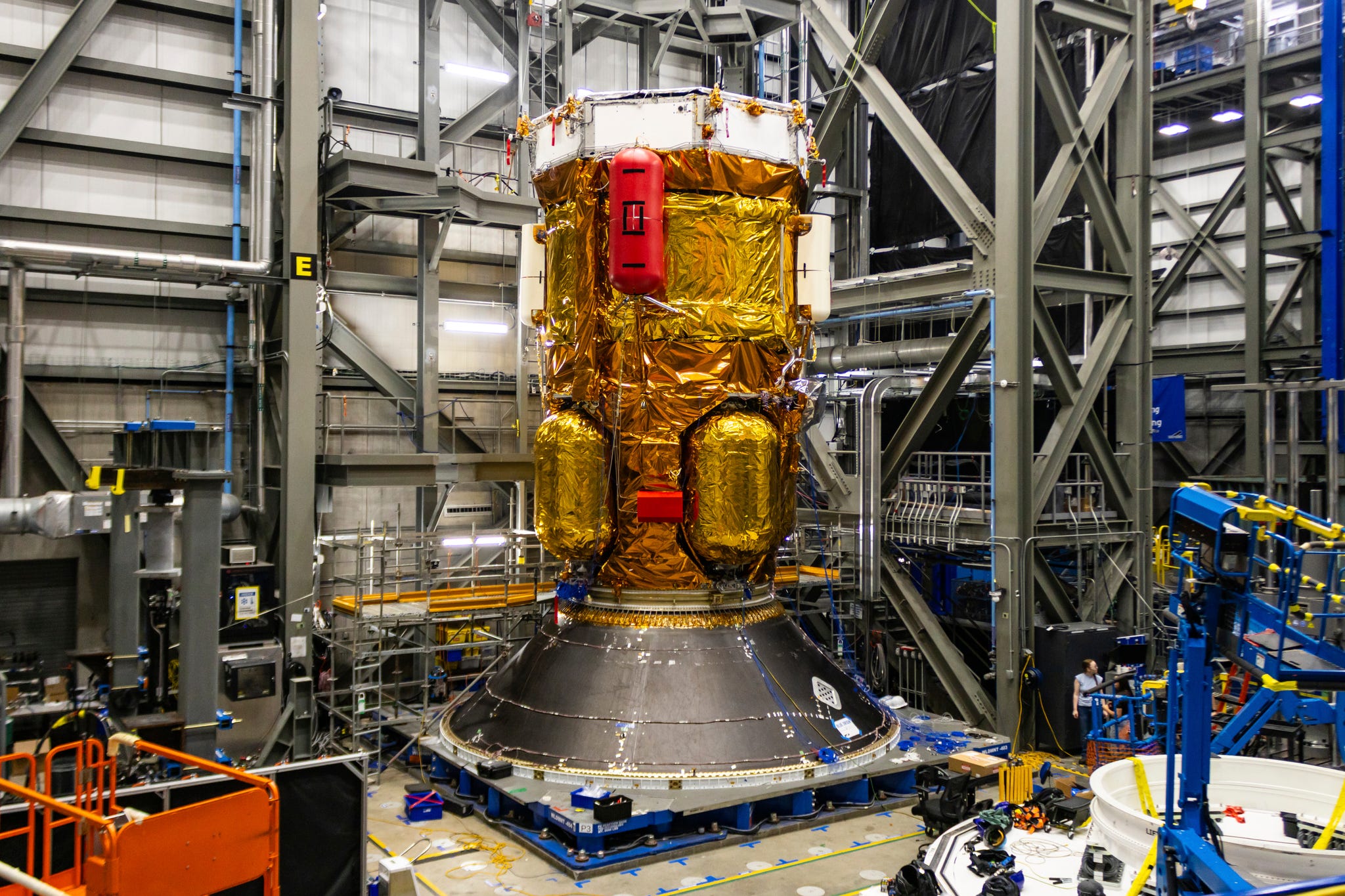
Blue Origin is making significant progress in its efforts to prepare a lunar lander for an uncrewed mission to the moon. The company, founded by billionaire Jeff Bezos, has been conducting extensive testing of its Blue Moon spacecraft at facilities in Texas and Florida. The next step for the company is a robotic landing on the moon’s south pole, which could potentially occur by the end of 2026.
This development comes just as NASA prepares for the historic Artemis II mission, which would send four astronauts around the moon. Before astronauts can return to the lunar surface, both Blue Origin and SpaceX are competing to have their respective landers ready in time for NASA’s Artemis III mission in 2027. This mission will be a crucial test of each lander’s docking capabilities in Earth orbit before the space agency sends humans back to the moon in the following year.
Everything You Need to Know About Blue Origin’s Lunar Lander
The Blue Moon spacecraft that Blue Origin is developing for lunar landings is currently undergoing its latest phase of testing as the company prepares the vehicle for an uncrewed moon mission potentially in 2026. The lander, nicknamed Endurance, recently went through a demonstration known as modal testing.
“We used sensors to measure how our lunar lander will respond to launch conditions,” Blue Origin explained in an April 27 post on Instagram. The company also mentioned plans to test both the launch vehicle separation system and communications system for the lander before performing a wet dress rehearsal involving fueling it with cryogenic propellant. The spacecraft recently returned to Blue Origin’s facility near NASA’s Kennedy Space Center for more prep work after undergoing testing at the Johnson Space Center in Houston.
Does Jeff Bezos Own Blue Origin?
Jeff Bezos, best known for founding Amazon, established Blue Origin in 2000. The company, based in Washington state, gained attention with its suborbital human spaceflights using the New Shepard spacecraft from West Texas. These missions, which featured celebrities like musician Katy Perry and actor William Shatner, have been paused for at least two years while Blue Origin focuses on its lunar program.
New Glenn Rocket to Launch Lunar Lander from Florida
Blue Origin has also developed a heavy-lift launch vehicle called the New Glenn. Standing at 320 feet tall, this rocket has launched three times from the Cape Canaveral Space Force Station in Florida and will be used to carry Blue Origin’s lunar lander to orbit. The New Glenn rocket most recently took off on April 19 to deploy broadband network satellites for cellular broadband service provider AST SpaceMobile to space. While the rocket delivered the satellites to the wrong orbit, Blue Origin managed to recover the first stage booster, which had been reused after a previous spaceflight.
Why Is Blue Origin Targeting an Uncrewed Moon Landing?
Blue Origin is preparing to send the Mark 1 variant of its Blue Moon lander on a pathfinding mission to the moon’s south pole region, where it will remain permanently. This mission, one of potentially four robotic lunar landings targeted for 2026, comes as NASA plans to increase the number of uncrewed landers carrying cargo and science instruments to the moon. In 2027, the space agency is eyeing up to 30 more uncrewed landings under its Commercial Lunar Payload Services program. These missions will help pave the way for the first astronauts to step foot on the moon since 1972 under the Artemis campaign.
Blue Origin and SpaceX Landers Could Take Artemis Astronauts to the Moon
Both Blue Origin and SpaceX are under pressure to develop lunar landers ahead of a targeted human surface mission in 2028, now known as Artemis IV. NASA’s revamped lunar program includes a new mission that involves Artemis III astronauts aboard an Orion capsule meeting and docking in 2027 in Earth orbit with one or both of those landers.
SpaceX, founded by Elon Musk, was originally awarded the contract to develop a configuration of its Starship vehicle, known as the Human Landing System, for the first Artemis mission to send astronauts to the surface. Blue Origin, however, is working on the Mark 2 version of its Blue Moon lander designed for astronauts. Whichever lander ends up being selected for Artemis IV would rendezvous with NASA astronauts aboard an Orion vehicle in lunar orbit and then ferry them to the surface. After the astronauts conduct a moon walk and a series of scientific experiments, the lander would transport them back up to Orion, which would make the journey back to Earth, according to NASA.
However, concerns have mounted that both Blue Origin’s and SpaceX’s lunar landers are behind schedule—especially after NASA’s Office of the Inspector General issued a dire report in March.