A Day Without Tea
The other day, we experienced a prolonged power cut. This was no accident. No Hebridean storm had toppled poles, nor had any foreign agents severed the cable at the bottom of the Little Minch that connects us to the National Grid.
In fact, our electricity provider referred to it as a ‘scheduled outage’ – but it was unusually long, lasting from nine in the morning until five in the evening. It was likely related to the latest round of wind turbines and the export of the volts they produce.
As a result, nothing could be cooked, no washing could be done, and I was reduced to using my smartphone for brief glimpses of the internet. Worst of all, I couldn’t have a cup of tea.
I was left with only chilled, sparkling mineral water, which wasn’t sufficiently caffeinated on a day that felt devoid of structure or purpose. As any true tea enthusiast will know, tea is more than just a beverage; it’s a ritual. We all have our own ways of making it.
My method involves a man-sized Sports Direct mug, an Earl Grey teabag from Twinings, absolutely boiling water, and a precise four-minute infusion. After adding a splash of semi-skimmed milk, I spend twenty minutes of serenity contemplating the next piece of journalism or various misfortunes.
Seven years ago, I was actually banned by the host of a café after the second time I asked for a pot of tea. The waitress brought me a pot of hot water and a dry, lifeless teabag on a saucer. I explained that this wasn’t how tea was made, and shortly after, I was excommunicated by the wild-eyed proprietor. The business folded soon after.
If you don’t use water at a rolling boil – as the saying goes, always bring the pot to the kettle, not the kettle to the pot – your brew will taste flat and dull.
There was another historic reason why the masses embraced tea in Victorian times when it became affordable: in an era of unreliable street pumps, typhoid, and cholera, tea made with boiling, sterilizing water was practically the only safe thing to drink.
It was widely believed that the commonest dream in Britain was having tea with the Queen. She also enjoyed Twinings Earl Grey with a splash of milk. Every day began with it – served with a couple of Chocolate Bath Oliver biscuits and, naturally, in monogrammed china – as she listened to Terry Wogan before rising, bathing, and dressing.
Elizabeth II took afternoon tea so seriously that her duties were often scheduled around it. Whether it was launching a ship, unveiling a plaque, walking a street, or enduring some high-profile event, she was always back at base by four in the afternoon.
Afternoon tea was her favorite meal of the day – featuring dainty octagonal sandwiches, chocolate-biscuit cake, and scones for the corgis – and an opportunity to politely entertain dignitaries she didn’t know well.
On the scale of Her Majesty’s regard, Sir Edward Heath enjoyed only occasional dine-and-sleep at Windsor, while figures like Sir Jackie Stewart or the Countess Mountbatten were warmly welcomed at Balmoral.
Afternoon tea is not the same as high tea. Even Masterchef: The Professionals has been known to confuse them.
High tea, for most people, was the evening meal in an era of hard physical work requiring a substantial midday meal, usually involving potatoes and always called ‘dinner.’ For others, it was a potato-free zone, typically involving some sort of grill or fry-up and served with bread, butter, jam, and baking all at once.
As late as 2010, if you visited places like Nairn, Montrose, or Peebles, you could still find hotels offering a good Scots high tea, but it didn’t long survive the age of Starbucks.

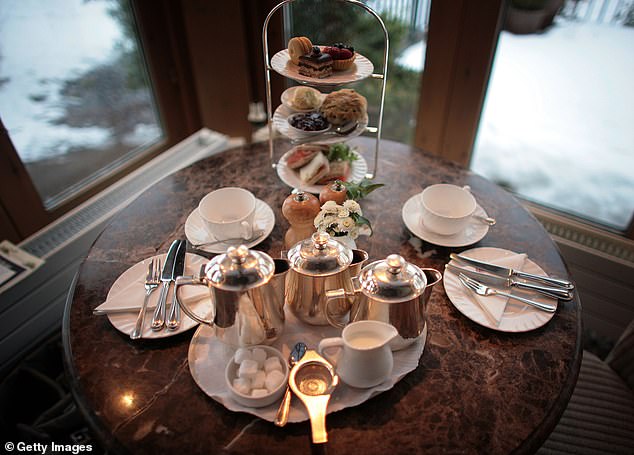
Afternoon tea is very different. Popularized in 1840 by Anna Maria Russell, the 7th Duchess of Bedford, it quickly became a cherished ritual among the gentlefolk, partly because once everything was brought in, servants could be dismissed, and one could enjoy a candid hour of delicious gossip.
You can still experience it in its ceremonial glory at the Palm Court of Edinburgh’s Balmoral Hotel. You usually need to book, but it’s surprisingly filling – at £70 a head – and on most occasions, a lady plays the harp in a gallery above.
A variant in the West Highlands and areas where Gaelic is still spoken is the strùpag – an impromptu cuppa for unexpected guests, which my grandmother’s generation could prepare with swift efficiency.
With the setting and china tailored to your importance: mugs in the kitchen for a great-nephew, Royal Albert and ‘best room’ for the minister. In less Presbyterian areas, tea and scones might be accompanied by a hearty dram or a dainty glass of sherry.
But that would be highly unusual in Lewis, where even having a drinks tray on display in your parlour is considered unseemly.
An odd exception was – or used to be – the Friday of a Free Presbyterian communion season, perhaps because the morning service that day was a ‘Question Meeting,’ which was often excessively long, and crowds were so large that it was frequently held outdoors.
Then, at some kindly household for dinner, a vast measure of the hard stuff was pressed into your hand, and one often had to be wily in disposing of it. (I hope not too many pot plants perished in my wake.)
For that matter, back in the manse, the ministers also had to be discreetly refreshed.
Every lady of the manse knew each cleric’s preferred poison and quietly delivered it on a tray to his chamber, always covered in a laundered white cloth.
But whether you’re high or low, across the length of the land and whatever the occasion or emergency, do any words in the English language put as much in perspective as that murmured, delightful intimation, ‘Let’s put the kettle on’?