
A Major Lithium Discovery in the Appalachian Mountains
A recent discovery has revealed that the Appalachian Mountains may hold a vast lithium reserve, potentially transforming the United States’ approach to mineral security and energy independence. This finding could have significant implications for the country’s ability to meet growing demands for lithium, a critical component in electric vehicles, batteries, and renewable energy systems.
The US Geological Survey (USGS) has estimated that around 2.5 million tons of lithium could be buried within the Appalachian Mountains, with major concentrations in the Carolinas and New England. This amount is enough to replace roughly 328 years of current US lithium imports, marking a major step toward strengthening America’s mineral independence. The value of this supply is projected to be approximately $64.4 billion.
This lithium could power a wide range of technologies, including:
- About 1.6 million grid-scale batteries
- Up to 130 million electric vehicles
- Roughly 180 billion laptops, enough for a thousand years of global use
- Up to 500 billion cellphones, or about 60 devices for every person on Earth
Historical Significance of the Appalachian Mountains
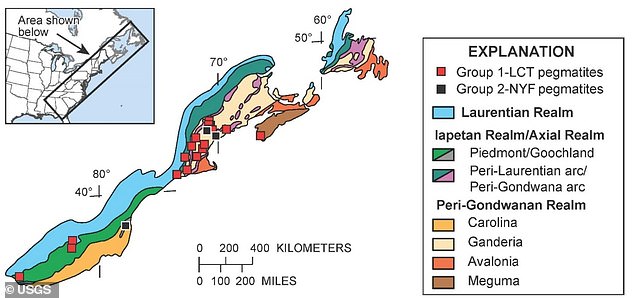
The Appalachian Mountains, formed roughly 480 million years ago, are among the oldest mountain ranges in the world. Their immense age has contributed to the formation of lithium-rich rocks through ancient tectonic collisions. These events created intense heat and pressure that produced lithium-bearing pegmatites deep within the crust.
Key Findings from the USGS Study
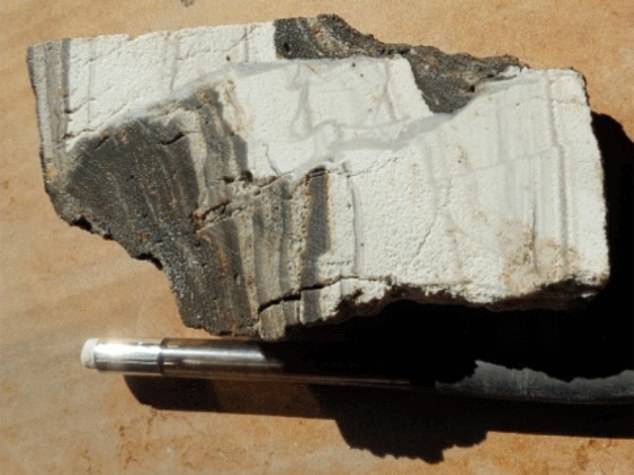
The USGS published a study this week highlighting the presence of thousands of pegmatite rock bodies in the northern Appalachian region. Pegmatites are the main type of rock where lithium is typically found, composed mainly of quartz, feldspar, and mica, with some containing lithium.
Researchers identified up to 18 separate lithium-rich districts across the region, further supporting the case for significant untapped resources. In the Carolinas, the historic Carolina tin-spodumene belt is known for lithium-rich rock containing spodumene, a key mineral used in lithium production for electric vehicle batteries, smartphones, and energy storage.
In Maine, near the town of Newry, the Plumbago North deposit contains massive spodumene crystals measuring over 33 feet long, making it one of the most promising potential lithium sources in the region. Smaller lithium-bearing rock bodies also formed there over millions of years, including during later mountain-building periods and as recently as the Jurassic era.
Diverse Lithium Minerals Found Across the Region
Across the Appalachian region, scientists have discovered several types of lithium minerals, including:
- Spodumene
- Lepidolite
These minerals are widely used in lithium-ion batteries that power electric vehicles, laptops, and phones. Other minerals such as triphylite, montebrasite, and amblygonite can also be processed into lithium used in batteries and renewable energy storage. In New Hampshire, the Grafton district is dominated by these phosphate-based lithium minerals.
Future Projections and Global Implications
The USGS projects that global lithium production capacity will double by 2029 as demand continues to surge. This makes supply security an increasingly urgent priority for technology companies. Currently, China dominates the global lithium-ion battery and electric vehicle supply chain, controlling up to 70% of processing and refining capacity and roughly 80% of battery cell production.
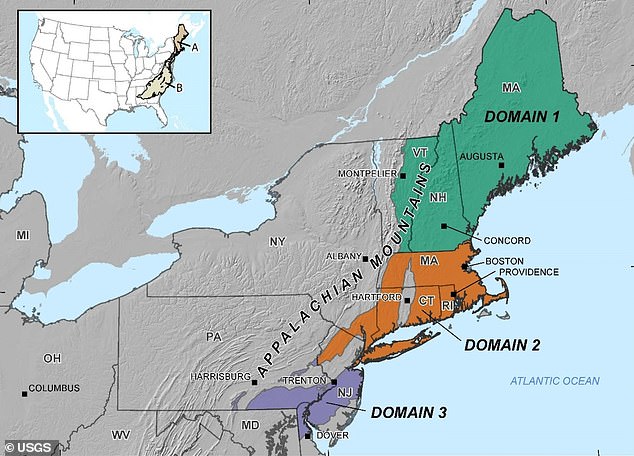
The US was once the dominant world producer of lithium, and this research highlights the abundant potential to reclaim mineral independence. Scientists have divided the lithium-rich districts into three regions—Domains 1, 2, and 3—to estimate how much lithium may still be hidden underground.
Domain 1 stands out as the most promising, with an average estimate of about 213 million tons of ore. This is more than three times the estimate for Domain 2 and about 23 times that of Domain 3. Domain 1 also showed the highest number of potential undiscovered deposits, with a 90% chance of containing at least one deposit.
By contrast, Domain 3 showed the lowest potential, with scientists estimating a 90% chance that no undiscovered deposits exist there. Domain 2 fell somewhere in between, with a 50% chance of hosting at least one deposit, though its average estimate of 0.73 deposits placed it closer to Domain 3 than Domain 1 in overall potential.