A Life Transformed by Adversity
Christina Vithoulkas knew she was paralysed as soon as she woke up. Lying in the dirt at a motocross park after hitting the top of a landing deck and “rag-dolling” 10 metres, as the Aussie thrill-seeker puts it, she tried feeling her feet but couldn’t. Her friends, they’ve told her since, heard her back break from 20 metres away.
Sitting in a wheelchair at Kingston Park Raceway on the outskirts of Brisbane almost eight years on, she recounts the life-changing moment to Wide World of Sports. There’s a great cause behind the interview. The chat, organised by Red Bull, is to promote the Wings for Life World Run, which at 9pm on Sunday AEST will see thousands of people around the globe run for those who can’t. All proceeds go to spinal cord injury research.
Vithoulkas is also at the raceway to scorch around the track in a drift car. She took up the sport after her accident ended her career as a motocross freestyler. A trailblazer and an inspiration, she is Australia’s first female para-drifter.
The accident occurred in rural South Australia in September 2018. Vithoulkas was 23 at the time. She admits she “wasn’t feeling 100 per cent on the day”. She also admits she is a “very stubborn Greek woman”. Freestyle motocross, one of the sports on show at the globe-trotting Nitro Circus, was her life, and feeling a little off was no chance of stopping her.
The gap she had to clear was 17 metres. She had cleared that distance countless times – often with her legs off the bike as she pulled off gnarly tricks. On this day, however, September 29, 2018, she landed “in a place where you don’t want to land”.
“It’s thrown my legs and myself off the bike, and I’ve landed on my head and shoulder next to my bike, basically rag-dolled for like 10 metres, and folded completely in half with my bum coming back and hitting the back of my head,” Vithoulkas recalls.
“I was unconscious for like five minutes. I’ve woken up and I’ve realised pretty quickly that I was paralysed because I had someone at my feet saying to me, ‘Can you feel this? Can you feel that?’ And as soon as I saw where they were, and they were touching my feet, and I knew I couldn’t feel them, I knew straight away that I was paralysed.”
Vithoulkas broke her T5, T6 and T7 – three of the 12 vertebrae in the thoracic spine. She is paralysed from the chest down. She also lacerated her spleen – an organ that stores and filters blood – tore ligaments in her neck and shoulder, fractured her skull, broke some ribs, and ended up with fluid in her lungs. “Just the basic stuff,” she laughs.
She remembers being airlifted to hospital not knowing if she’d get there alive. As Vithoulkas recalls the incident and opens up on life post-accident, she does so with a palpable sense of matter-of-factness and positivity.
“I’m very grateful that I accepted it straight away. I know that’s not a normal case, but for my situation, I accepted it instantly,” the 31-year-old says. “I knew straight away what I had done, I knew it was a self-inflicted accident, I knew the risks of what I was doing, so I accepted it straight away. And I just knew that I would be able to make something great from this.”
“What I valued and the most important thing was that I was alive, and I could still be with my family and friends and still create memories that made me happy, and I knew having a disability had nothing to do with the things that I valued the most. So I’m grateful I didn’t have to struggle.”
She did have “moments”, though, like the first time she put on “skinny jeans” and realised they fitted “like trackpants”, so extreme was her muscle loss. “I was like, ‘Oh my god, I’ve got skinny legs now’,” she recalls. “I had a little grieving moment, had a cry, had a sook, and then I was like, ‘Right, this is what it is’, and basically told myself, ‘This is my reality, there’s nothing I can change about it, so just accept it’.”
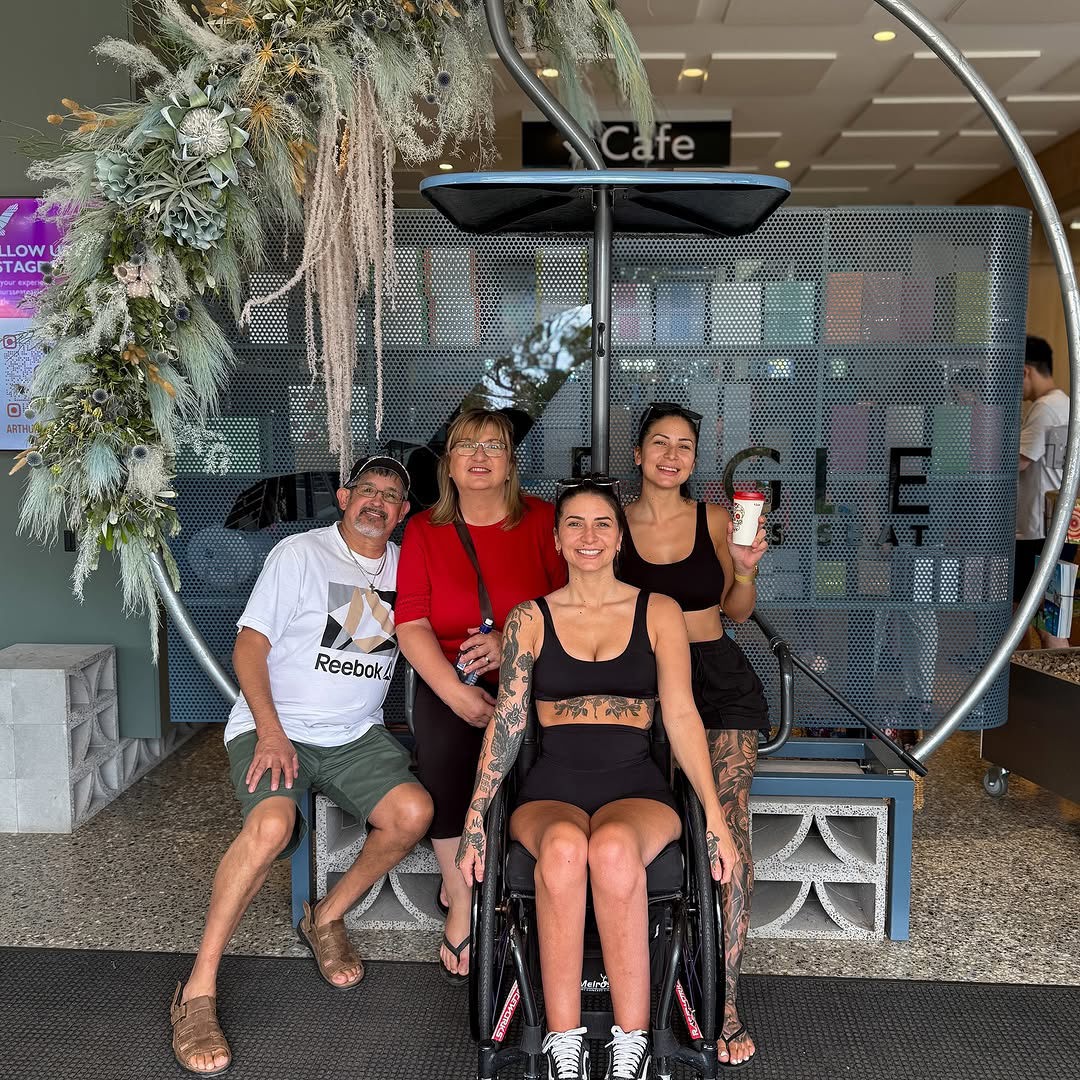
Vithoulkas, an Instagram influencer with just shy of 200,000 followers, went as far as uploading a selfie with her unrecognisable legs in view. “You do that enough that you kind of manifest your own reality, so I manifested my own reality,” she says. “I was like, ‘I can decide, I’ve got the power to choose whether to be upset about something or make the most of the situation’.”
“Being depressed and mental health is a very big issue that we have [in society], and it’s very hard to wake up depressed, it’s very hard to be suffering. So I feel as much as it is hard to put in the work to try to do things that are gonna help with my mental health, I feel like it’s easier to do that than wake up depressed every day.”
She relies on certain cues when she finds herself in a slump. “I’m like, ‘Right, start speaking more positive to myself, complain less about things that are out of my control, and what am I gonna do that is gonna make me happy? Get sunlight, socialise’.”
Lying in her hospital bed, Vithoulkas had an epiphany. “You know how they say before you die your life flashes before your eyes?” she recalls. “It was like that but it lasted a few days, and I felt a whole sense of appreciation for all the amazing, really memorable moments that I’ve had in my life, and core memories, that I was just happy and had my heart filled with joy. And I realised I have no regrets.”
For Vithoulkas, drifting is empowering. She’s not in a wheelchair when she’s drifting. Instead, she’s in a drift car tearing around a track with her friends, skidding, weaving and accelerating, “not feeling at any sort of disadvantage”.
“If I got my legs back and I was able to ride again, I think I would be enjoying drifting more,” she says. “It’s more fun because you’re tandeming with your mates and you’ve got your mates door to door next to you. I love it.”
Vithoulkas is heavily tattooed. One of her tattoos, inked into her right arm, reads 666 – known as the devil’s number – or 999. “When people are facing me, they see 666. I feel like so many people I meet sympathise with me. They feel sorry for me and they look at me and the disability as something bad,” she says. “But for me it’s 999. It’s like a lucky number. I’ve completely flipped that way of looking at a disability, and for me it’s 999, the complete opposite. My disability is the biggest blessing in my life.”