The Science Behind Feeling Unsteady Near Heights
For many people, the fear of heights is a common experience. However, recent scientific findings suggest that the reason we feel unsteady near a drop may have more to do with our feet than our head. This discovery offers new insights into how our nervous system reacts to height and why some individuals handle it better than others.
When we stand near a drop, the nervous system triggers a process known as ‘upregulation’—essentially turning up the volume on sensory signals from our feet. This heightened sensitivity can lead to sensations such as buzzing, tingling, or even a feeling of heaviness in the soles of the feet. According to Professor Michelle Spear, an expert in anatomy from the University of Bristol, this phenomenon could explain why some people are more comfortable at heights than others.
Professor Spear explained that when we approach a drop, the brain starts to increase the processing of signals related to posture and foot placement. For some, this works in the background to improve balance, while for others, it becomes a distracting level of awareness. She told the Daily Mail: ‘The brain appears to “turn up the volume” on sensory signals involved in posture and foot placement. What is usually background processing can therefore become consciously noticeable.’
Common Symptoms of Fear of Heights
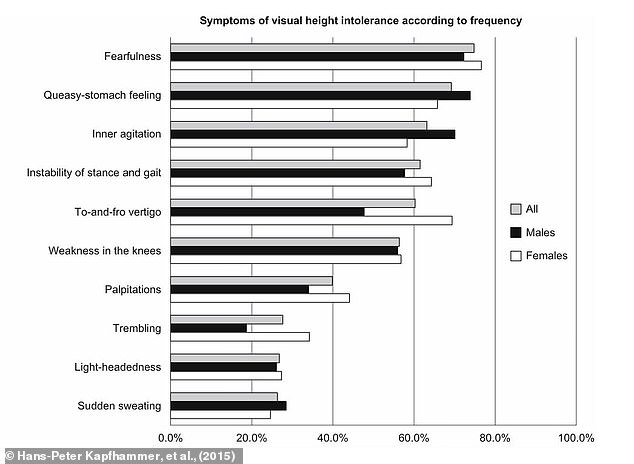
Fear of heights is exceptionally common, with around a quarter of people experiencing some level of discomfort. Studies have also shown that most people exhibit measurable changes in balance and posture when they come close to a drop. Professor Spear noted that the nervous system constantly processes vast amounts of sensory information, but much of it goes unnoticed. To prevent overwhelm, much of this data is filtered out or tuned down. However, when needed, the central nervous system can amplify certain channels.
She added: ‘The nervous system appears to respond to height by increasing vigilance around balance and foot placement. Sensory input from the feet becomes more important, posture stiffens slightly, and movements become more cautious and deliberate.’

Understanding the Physical Reactions
The soles of the feet are covered in a dense layer of specialized receptors that track changes in touch, vibration, and weight distribution. These sensors play a crucial role in maintaining balance and posture. Normally, they operate quietly in the background, allowing us to walk or shift our weight without conscious thought. However, when near a large drop, the risk of falling increases significantly, prompting the body to pay more attention to these signals.
Professor Spear suggests this reaction may be an evolutionary adaptation. ‘Humans evolved in environments where falls carried significant risk, whether moving across uneven ground, climbing, or navigating rocky and elevated terrain. From an evolutionary perspective, a system that encouraged careful movement near a drop would have been advantageous.’

How People React Differently
These changes occur automatically, regardless of whether we want them to or not, but some people seem to notice the change more than others. Greater awareness of pressure and balance can be beneficial for activities like climbing, and experienced climbers often develop a highly attuned sense for weight distribution.
However, excessive sensory awareness can become distracting or provoke anxiety, which hinders fluid movement. Professor Spear says the ‘upregulated’ signals from the feet can feel like a buzzing or tingling in the soles. Others report a sensation of heaviness, as though their feet are being drawn to the ground, while some feel a sense of unsteadiness and the need to remain still.
For some, the feeling manifests as a reluctance to move forward or get closer to the edge. It’s important to note that this is distinct from vertigo, which arises from a disturbance in the inner ear that creates a false sense of movement.
Professor Spear explains that the difference may lie in how people process sensory information. ‘Some individuals appear more sensitive to subtle proprioceptive and tactile feedback, while others filter these signals more effectively below the level of conscious awareness. Attention also plays a role: once someone notices the sensation, the brain becomes more likely to detect it again in future.’