The Future of AI and the Singularity
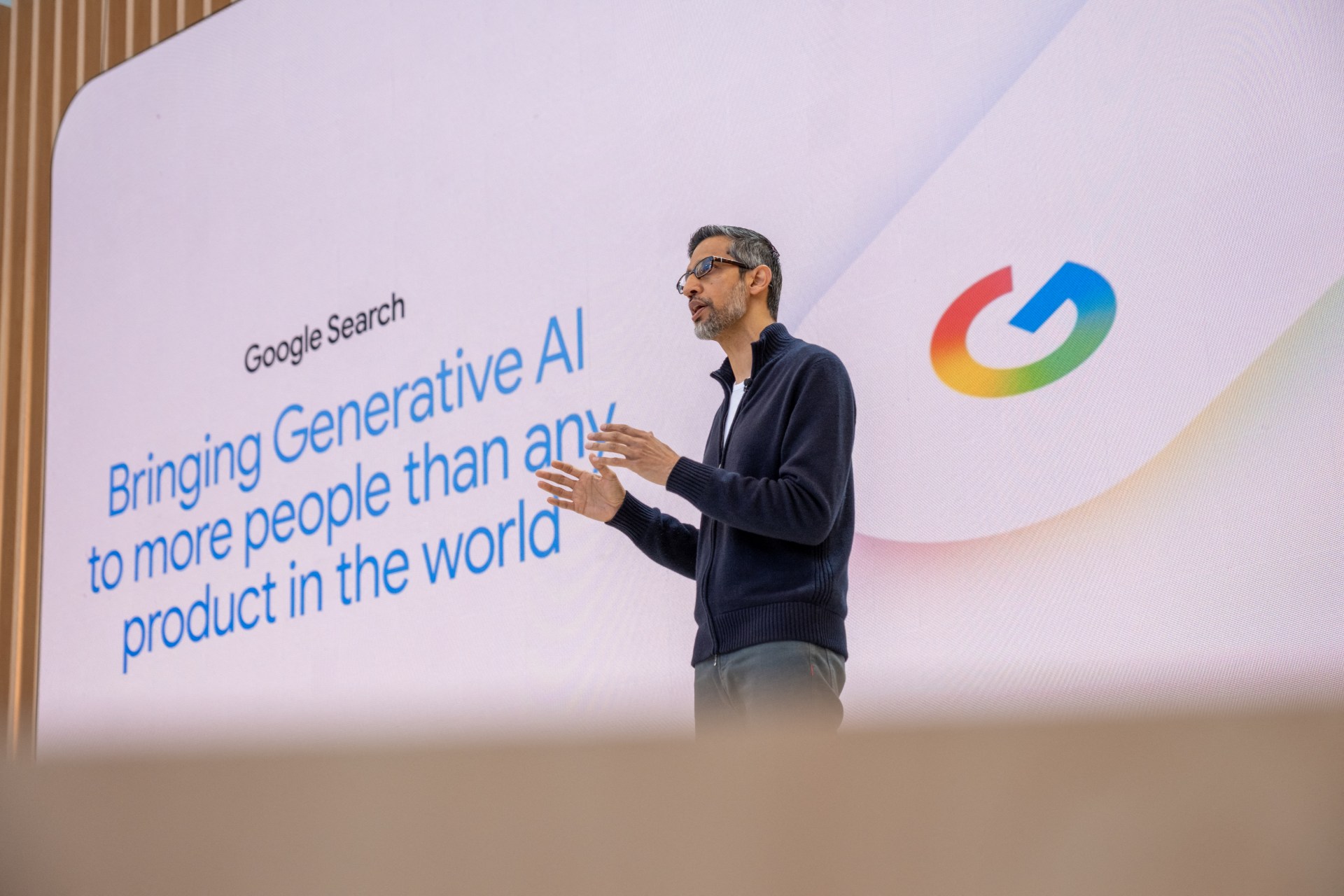
Beep beep boop. Beep beep – boop. This could be how we’ll all talk one day if Google’s predictions about humanity’s future come true. Well, kind of. At Google I/O, the tech giant’s annual developer conference in Mountain View, California, attendees were taken aback when Demis Hassabis, CEO of Google’s AI lab, DeepMind, said: “When we look back at this time, I think we will realise that we were standing in the foothills of the singularity.”
This statement was met with gasps from the audience, including Lizzie Dorfman, Google’s product lead for science AI. But what exactly is the ‘singularity’?
The singularity is a theoretical moment when AI—technology that currently generates Love Island fruit videos—becomes smarter than humans. This would open up a world where people could augment themselves with millions of times more computational power than their brains naturally possess.
“Singularity means, mathematically, that you spew off into infinity all of a sudden,” says Dorfman. “It will be the inflection point where we move into a different regime of how quickly we can do the work that would have historically taken years or even decades, now only taking months or even shorter.”
The Role of AI in Scientific Research
Dorfman, who has been with Google for nearly two decades, has already seen this in action. Most science isn’t pouring colourful liquids into beakers—it’s coding tests on powerful computers, often using AI tools.
“What is the slowest, most laborious part of what we do? That’s what we were trying to focus on,” she says. “I’ve watched scientists go, ‘I used to have to code this myself, and now I have this tool, I tell it what I want it to do, and then I go to sleep. When I wake up in the morning, it’s explored 1,000 different things.’”
The future is ‘exciting’ to people like Dorfman because the singularity means people could try out ’10 different things’ in a flash.
Google Unveils New Gadgets
Google unveiled a raft of new shiny gadgets at its conference last week. For the first time in 25 years, Google is overhauling its search bar—those little white boxes where you once typed simple things like ‘movie times.’
Soon, AI will do the Googling for you. An intelligent search box will expand as you type and ask follow-up questions on the search page. These features will be powered by a new AI model, Gemini 3.5 Flash. It will also let users build graphics when Googling complex things—when we gave it a whirl by asking how cats see, it generated an interactive diagram of a feline eye.
Gemini will even appear in your glasses. A new model of the smart specs, Android XR, will come with a camera, a microphone and speakers, allowing people to ask Gemini about their surroundings or to order coffee online from a cafe.
The Future of Delivery
We also saw a live demo of Wing, the delivery unit of Google’s parent company, Alphabet. These buzzy drones lowered packages filled with Google-branded badges to us on a hook. A Google employee told us that the company wants to eventually roll out Wing more broadly—it’s already being trialled in some suburbs of Ireland and as a service for NHS hospitals.
Mapping the Human Brain
Mapping the brain is no easy feat. It took a decade for scientists to sketch out the poppy seed-sized brain of a fruit fly, its electrical wiring and neurons stretching the length of four blue whales. The human brain is made of billions of nerve cells alone, and there are thousands of cells that we still have no clue about what they do.
Dorfman says that, when you know how every part of a car engine works, you know what to do when it breaks down in the middle of the road. So having a map of the brain could help us treat neurodegenerative diseases like Alzheimer’s and Parkinson’s, or mental health conditions like depression.
The Technology Behind Brain Mapping
This is why Dorfman has spent the better part of a decade working on the technology that can map things a billionth of a metre in size. “You fix the brain in resin to make it hard, then slice it thin—a couple of nanometres—and image it in a microscope,” she says. “Our team takes all the data and structures it in three dimensions.”
Researchers want to map the 75 million neurons that make up a mouse brain next. “Then, one day, a human brain, which has about 80 billion neurons,” Dorfman says.
The Irony of Using AI to Understand Humanity
The irony that scientists are using machines, like Gemini for Science, to understand what makes people human isn’t lost on Dorfman. She points to a study that saw people living with epilepsy have their brains scanned while listening to a podcast. The researchers fed the podcast to an AI, comparing how the brain hears a word to how AI processes one.
Both humans and AI ‘predicted’ the next words in similar ways—so maybe the singularity isn’t all that far off then.

The Road Ahead
“I think there are many more opportunities that look like that,” Dorfman adds. As we continue to push the boundaries of AI, the line between human and machine becomes increasingly blurred. The future holds endless possibilities, and with it, the potential to revolutionize not just technology, but our understanding of ourselves.