The Power of Art in Healing from Domestic Violence
Elizabeth, whose surname is withheld for privacy, hadn’t touched a paintbrush in years. For a long time, her focus was on protecting herself and her three children from the overwhelming burden of domestic violence. However, she has now found a way to express her experiences through art in her first paintings since leaving that difficult chapter behind.
Her artwork, titled Journey to Freedom, reflects the lingering darkness of her past but also the strength she has gained. “I haven’t completely eliminated the darkness in the pictures because it never fully goes away,” Elizabeth said. “But you learn to survive and you learn to move forward.”
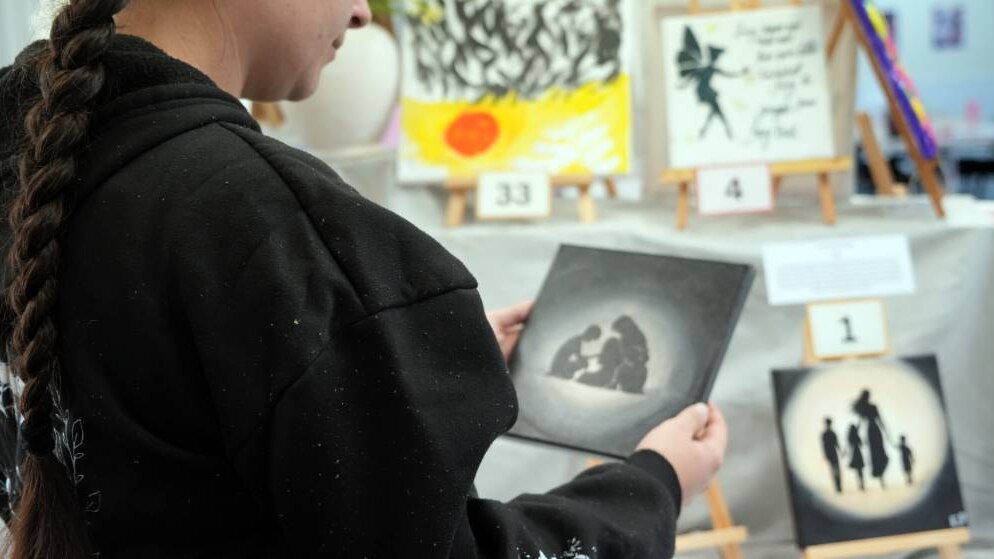
Her work was recognized as the Most Inspiring Artwork at a domestic violence art showcase held at a women’s centre in Toowoomba, west of Brisbane. Over 80 artworks were displayed, created by women and children who have experienced domestic and family violence. One piece, submitted by an 11-year-old girl, features a sad face with two hearts. The description reads: “I’ve seen my mum and dad fighting and it made me sad. I did this picture to tell my mum and other mums not to cry. That they are amazing and loved.”
Sharing the ‘Lost Voices’ of Victim-Survivors
In Queensland, more than half of all assaults reported in 2022-2023 were categorized as family and domestic violence. Nationally, one in four women has experienced physical or sexual violence from a partner or family member, according to the Australian Bureau of Statistics. Beyond these statistics, the true impact of domestic violence is often reflected in the stories of those who have survived it.
Belinda Vadalma, from the Women’s Wellness Centre, emphasized that “it’s safe to say” that everyone has been affected by family and domestic violence, even if it wasn’t directly. “Whether it be through a loved one or a friend, someone they know, or experienced it themselves,” Ms Vadalma said. In Toowoomba, between 60 and 70 women accessed the Women’s Wellness Centre, run by Mercy Community Services each month. “We see women come in just broken,” she said. “But they find the strength to rise up after some terrible, terrible things. Not only that, but they do it while taking care of their children.”
Ms Vadalma highlighted that it was one of the counsellors who came up with the idea for the art showcase. The purpose was to honor the voices often lost amid the reporting of perpetrators and court cases, especially those of children. “The bravery that it takes for some of these people to submit their artworks,” she said. “We like to keep their story safe and sacred because that’s theirs, and they’ve given us the privilege to share their stories.”
Art as a Healing Process
Kerry, who chose to use a pseudonym, created her artwork in a place of “grief, rage and profound disillusionment” after the end of her court case. “My abuser walked away with everything he wanted while I was left carrying the unbearable weight of abandonment and just utter defeat,” she said. Her piece, Flayed, represents how she felt “stripped raw by institutional failure.”
“My file was lost during the investigation for various reasons, and requests for support just disappeared into silence,” she explained. “My piece speaks to the loneliness of surviving violence, only to be further wounded by the systems surrounding it.”
Creating the piece for the showcase was a healing process for Kerry. “I decided to put paint onto paper so that people could look at it and have an insight into my experience,” she said. “It’s incredibly powerful to be seen, to be heard, and to be felt. As a survivor, it’s that tiny piece that allows you to just move forward and close that door behind you.”
A Message of Strength and Resilience
Across the room, slips of paper are strung to the branches of a rotten tree trunk. The words include phrases like, “No-one else will want you or have you.” “I didn’t throw it at you, I threw it in your direction.” “If you hadn’t of spoke [sic] to the police with lies, there wouldn’t be a DVO.” These lines were all said to the anonymous creator by her abuser.
At the bottom of the trunk, purple flowers bloom from the soil. The description reads: “The words no longer control or intimidate me. They are not a reflection on me but on his behaviour. I may have the scars, like the decayed trunk … but I have my spark back, blooming and growing like the flowers.”
“No-one deserves to live in fear.” This message, shared through art, highlights the resilience of survivors and the power of creative expression in overcoming trauma.