Australia’s Universities Face Global Ranking Decline
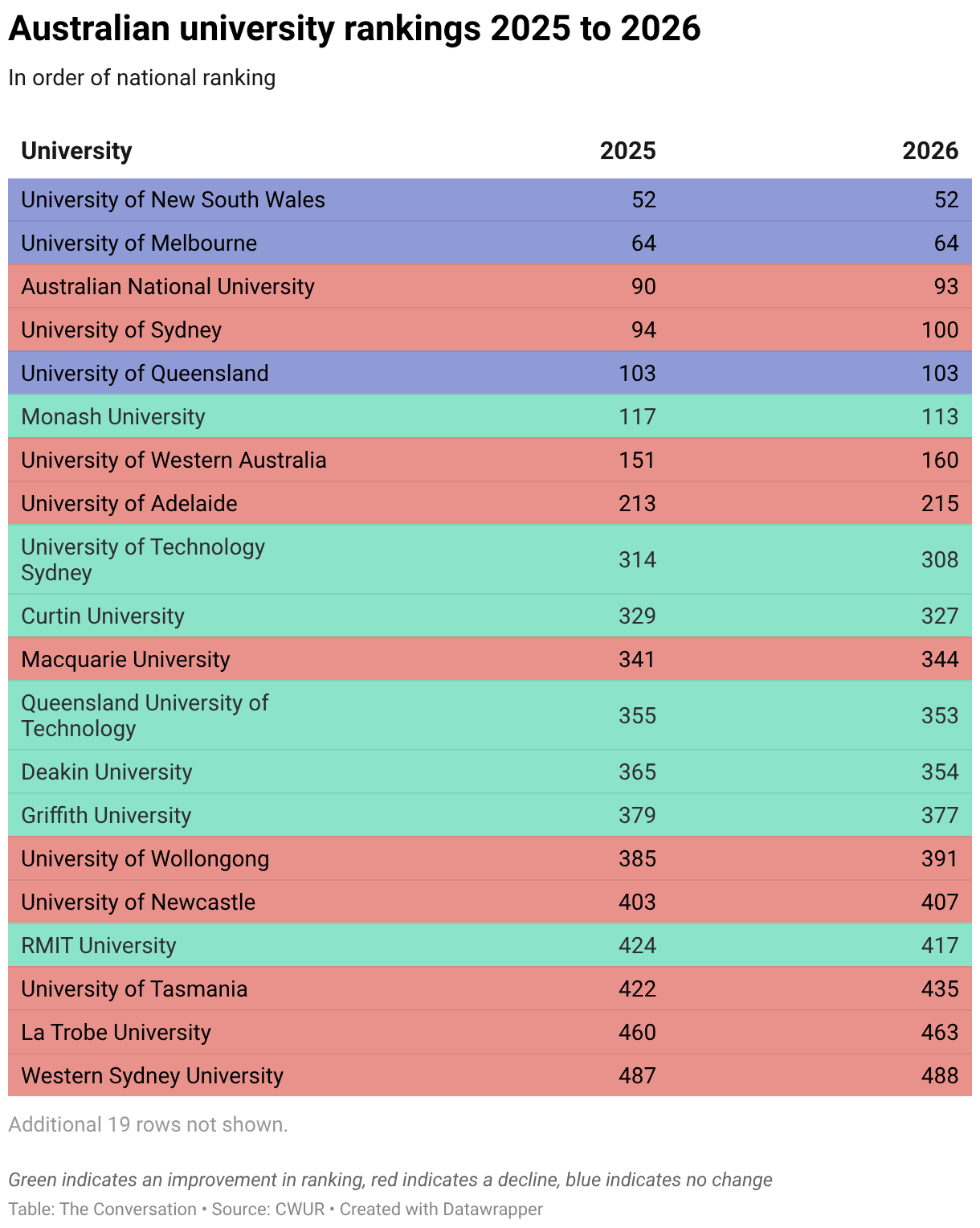
More than half of Australia’s universities have seen a drop in global rankings this week. While individual results can fluctuate, the decline reported by the Centre for World University Rankings suggests that the drop in Australia’s standing across various ranking systems is more than just a temporary blip.
The president of the Centre for World University Rankings, Nadim Mahassen, warned that Australian universities are struggling to deliver high-quality education, attract and retain talent, and produce quality research at scale. He emphasized that this is not just an academic issue but one that undermines Australia’s long-term future.
This decline comes after a high-profile opinion piece by academic Kylie Moore-Gilbert, who shared her concerns about the current state of higher education. She advised her teenage stepdaughter to think twice before pursuing a university degree, citing the burden of debt and the poor campus experience many students face. According to Moore-Gilbert, students are now being graded on their ability to write the best AI prompts rather than their academic understanding.
Understanding University Rankings
Global university rankings aim to evaluate institutions using a single framework. However, each ranking system has its own focus and methodology. The Centre for World University Rankings measured over 20,000 universities globally based on four factors: education, employability of graduates, number of faculty members with top academic distinctions, and research output.
Of the 39 Australian universities included in the rankings, 14 improved their rank compared to last year, four remained the same, and 21 dropped. Four Australian institutions made it into the top 100, but the Australian National University and the University of Sydney fell slightly, to positions 93 and 100 respectively. The University of New South Wales and the University of Melbourne maintained their top spots for Australian universities at 52 and 64.
June marks the start of global “rankings season,” so we will soon see if these trends continue. Other prominent global rankings include those by QS Quacquarelli Symonds, Shanghai Ranking, and the Times Higher Education.
A Drop That Isn’t a Shock
Last year, similar downward trends were observed in Australia’s rankings, which some university commentators described as a “wake-up call” for the sector. This year’s decline, however, is harder to ignore. As media reports noted, universities have “tumbled” in rankings following a “scandal-plagued year.” This follows an increased tendency to label the Australian higher education sector as being in “crisis.”
This label is linked to criticisms that universities are being run like profit-focused businesses instead of institutions dedicated to education, research, and civic engagement. Mahassen also highlighted that the poor results reflect years of inadequate funding and the “devaluation of science and education as public goods.”
Federal funding for the sector (excluding HECS/HELP) has declined over recent decades, from 0.9% of GDP in 1995 to 0.6% of GDP in 2021.
Ongoing Concerns
Universities have been making headlines for the wrong reasons in recent years. Concerns about executive behavior and pay have become regular stories. Additionally, a year-long Senate inquiry into university governance revealed a lack of transparency regarding spending on services such as consultancies.
Labor senator Tony Sheldon criticized universities for taking money out of taxpayers’ pockets without improving services for students. These issues have been compounded by threatened and actual cuts to operations and jobs at many universities. Underpayment cases and precarious work conditions for academics have further exacerbated the situation.
As the late professor Graeme Turner argued in his 2025 book, the Australian university system is “broken and urgently needs fixing.”
What Are Students Paying For?
Some Australian undergraduates are taking on significant levels of debt to attend university. The Job-ready Graduates scheme, introduced under the Morrison government in 2021, restructured university fees. It lowered costs in areas like teaching and nursing while dramatically increasing the cost of humanities degrees. Despite widespread criticism, the Labor government has not scrapped the scheme. Arts degrees now cost more than A$50,000.
These high costs come amid moves to reduce in-person lectures and tutorials at some universities. They also coincide with universities grappling with the rise of AI and its implications for assessments, cheating, and student learning.
No wonder some are questioning whether an expensive university education is worth it.
The International Student Factor
It is not only domestic undergraduate fees and poor executive management that contribute to the challenges facing Australian universities. Rankings play a crucial role in international student recruitment. Prospective students closely examine the research and teaching reputations of universities. A drop in rankings could lead students to look elsewhere in the competitive global market for the international student dollar.
International students are a crucial funding source for Australian universities. For example, in 2024, Western Sydney University used 24 cents from every dollar an international student pays to subsidize domestic students, research, and student services. Overall, higher education expenditure on research and development reached $16.4 billion in 2024, with over half coming from international education earnings.
As the Group of Eight notes, inadequate research funding from other sources has led to reliance on international student fee revenue to cross-subsidise research. Any loss of income due to a drop in international student enrollments could impact Australia’s economy broadly.
What Now?
Despite the turmoil surrounding universities, surveys show that Australians continue to have higher confidence in universities than in many other institutions, including the federal government. Public opposition to proposed cuts to the ANU School of Music last year demonstrates this support.
This suggests there is some community goodwill towards universities, but it cannot be taken for granted. Nor can universities themselves be taken for granted. As Mahassen stated, this is not just an academic problem. If our universities are not functioning well, it spills out into society, the economy, and beyond.
Kylie Message works for the Australian National University, which dropped in the rankings discussed in this piece.