The Real EV Problem Has Never Been Summer
Electric vehicles are designed to perform optimally under ideal conditions. Warm batteries, moderate temperatures, and predictable driving patterns allow manufacturers to showcase impressive charging speeds and range figures. However, the real challenge begins when winter arrives. Cold temperatures can reduce battery efficiency, slow charging performance, and create uncertainty for drivers who rely on public charging infrastructure.
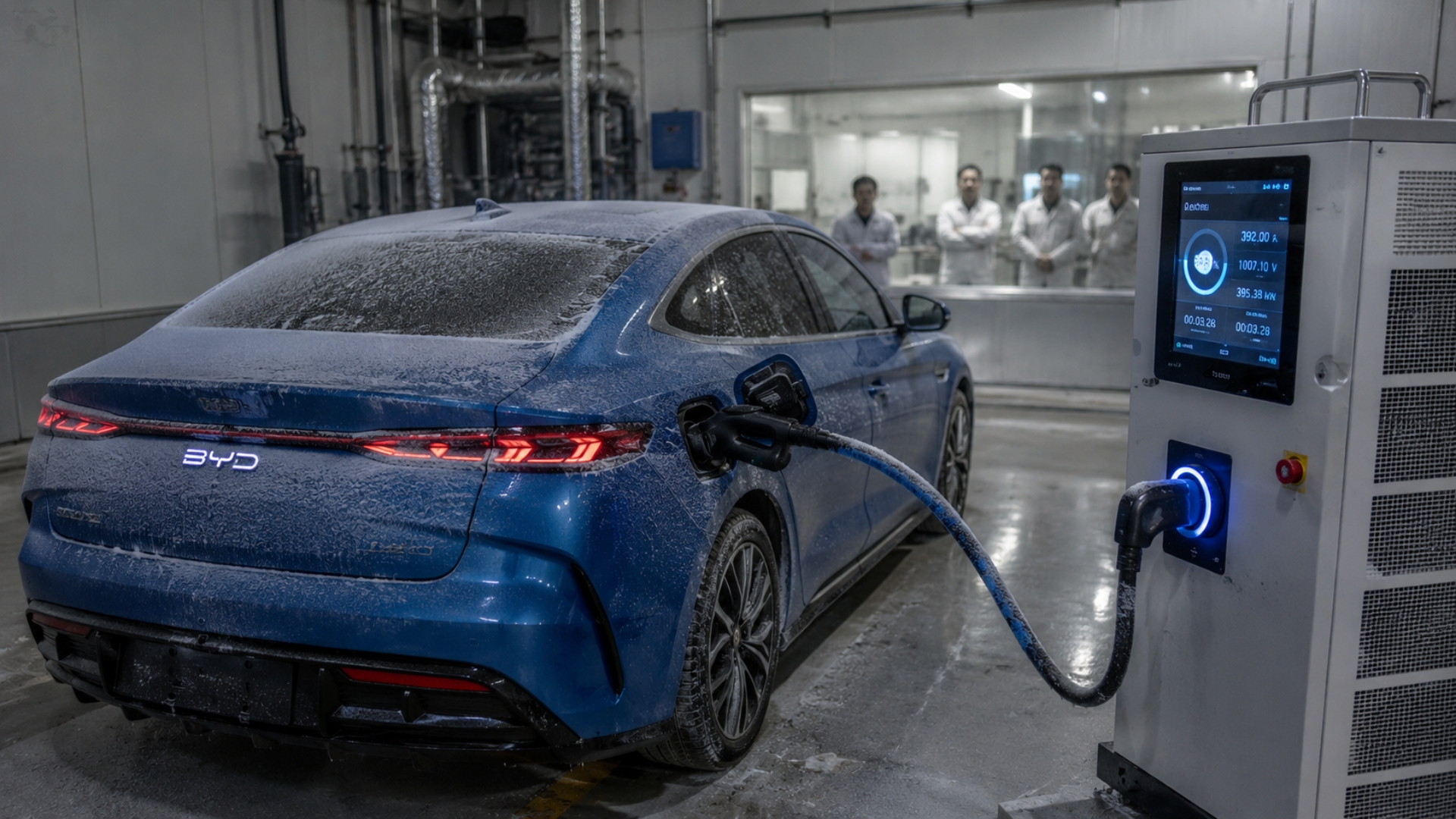
This is why BYD’s recent cold-weather charging demonstration stands out. Testing an EV in temperatures around -22°F (-30°C) targets one of the industry’s most persistent weaknesses and one of the most common concerns among potential buyers in northern markets.
Cold Weather Remains a Major EV Challenge
Battery chemistry does not particularly enjoy extreme cold. When temperatures drop, the movement of lithium ions inside battery cells slows down. The result can be reduced energy efficiency, slower charging rates, and longer waiting times at charging stations. Even vehicles with advanced thermal management systems can experience noticeable performance losses during severe winter conditions.
This has become a key battleground as EV adoption expands beyond mild-climate regions. Drivers in Scandinavia, Canada, northern China, and large parts of the United States regularly experience temperatures that place significant demands on battery systems. A vehicle that performs well in California may face a very different reality during a Canadian winter.
Charging Speed Is Becoming More Important Than Range
For years, automakers focused heavily on range figures. Longer range remains important, but the industry is increasingly recognizing that charging convenience often has a greater impact on ownership experience. A vehicle that can rapidly recover energy during a short charging stop may feel more practical than one that simply carries a larger battery.
Cold-weather charging performance sits at the center of that discussion. If an EV can maintain strong charging speeds despite extreme temperatures, it reduces one of the biggest frustrations associated with winter ownership. Faster charging means shorter stops, more predictable journeys, and greater confidence for drivers traveling long distances.
That is why demonstrations like BYD’s attract attention far beyond simple engineering curiosity.
BYD Is Leveraging Its Battery Expertise
BYD occupies a unique position within the EV industry. Unlike many automakers, the Chinese manufacturer develops and produces much of its battery technology internally. Its Blade Battery architecture has become one of the company’s most important competitive advantages, helping BYD expand rapidly both inside China and increasingly in international markets.
The company’s investment in battery development allows it to focus not only on energy density and cost but also on thermal management and charging performance. Those areas are becoming increasingly important as buyers move beyond basic questions about whether EVs work and begin evaluating how well they work under difficult real-world conditions.
The Pressure on Legacy Automakers Continues to Grow
Cold-weather charging tests also highlight a broader trend within the automotive industry. Chinese manufacturers are no longer competing solely on price. Increasingly, they are using technology demonstrations to establish credibility in areas traditionally dominated by established global brands.
That shift has significant implications. European, American, Korean, and Japanese manufacturers still possess major strengths, including extensive service networks, strong brand recognition, engineering heritage, and established customer trust. However, those advantages face growing pressure when competitors begin delivering competitive technology alongside aggressive pricing.
The challenge for legacy automakers is no longer simply defending market share. It is maintaining a technological edge in an increasingly crowded EV landscape.
Real-World Validation Still Matters
Laboratory testing and climate-chamber demonstrations are useful, but they are not the final answer. Real-world winter driving introduces additional variables, including wind, road conditions, battery state of charge, charging infrastructure reliability, and driver behavior. A successful controlled test does not automatically guarantee identical results in every ownership scenario.
Nevertheless, these demonstrations provide valuable insight into where battery technology is heading. Manufacturers understand that solving cold-weather performance is critical if EVs are to achieve widespread adoption in regions with harsh winters.
The Next EV Arms Race Is Already Underway
The electric vehicle market is entering a new phase. Early competition focused on proving that EVs could deliver sufficient range and acceptable performance. Today’s competition is increasingly about refinement, efficiency, charging speed, software integration, and real-world usability.
BYD’s extreme cold-weather charging demonstration fits squarely within that evolution. The headline is not simply that a battery charged at -22°F. The bigger story is that automakers now recognize winter performance as a crucial measure of technological maturity.
Buyers want electric vehicles that work reliably not only on perfect spring days but also during the harshest conditions they are likely to encounter. If companies like BYD continue improving charging performance in extreme environments, the conversation around EV ownership may gradually shift from “Can I live with an EV?” to a much simpler question: “Which EV does it best?”