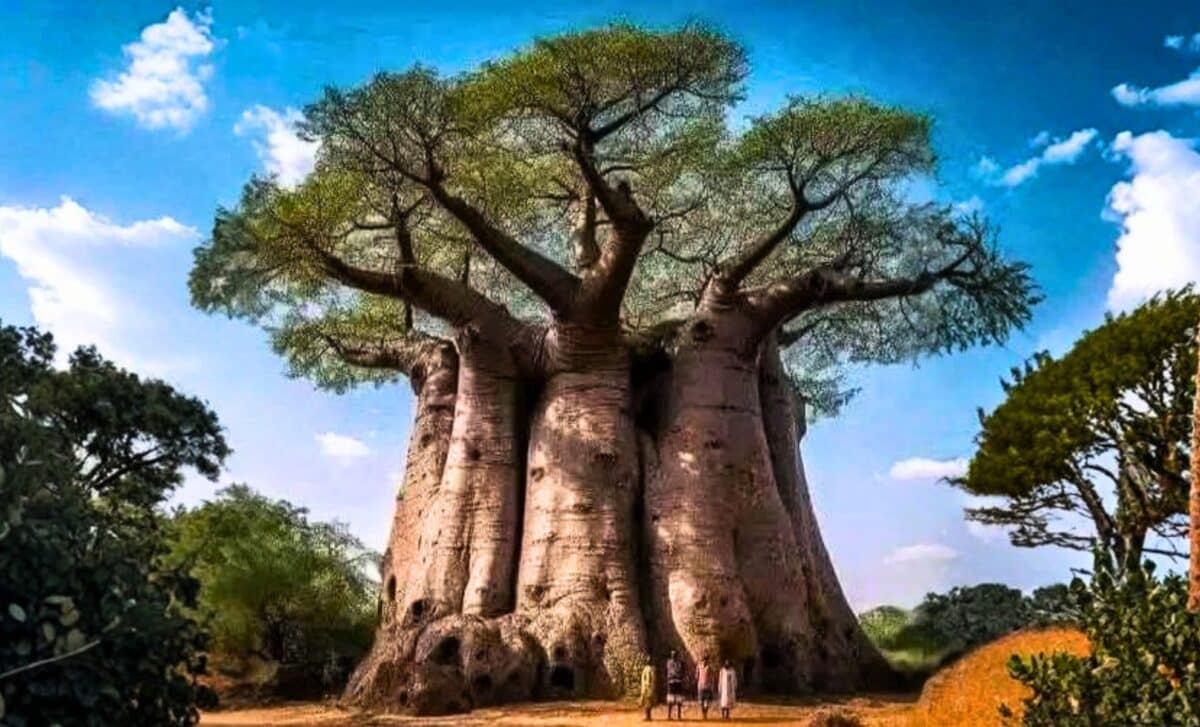
A baobab can hold so much water in its swollen trunk that its shape visibly changes with the rainy season. In Africa’s dry savannah, where the climate can be extremely arid, that ability helps explain why the tree became a symbol of life in landscapes where few other large plants can thrive.
Baobabs, known scientifically as Adansonia, are not just old-looking trees with massive trunks. They are a small group of extraordinary species spread across Africa, Madagascar, and Australia, with some African specimens dated to between 1,100 and 2,500 years old. Their story is one of survival, size, and a surprising fragility: some of the largest known baobabs of the 21st century have broken apart or died.
A Tree Built Around Water Storage
The best-known species is Adansonia digitata, the African baobab. It grows widely across the arid parts of Africa and is found in 32 African countries. In these dry regions, the tree’s enormous trunk is more than a landmark. It works as a reservoir, storing tremendous amounts of water and swelling during the rainy season.
The wider baobab family includes eight species. Six are native to Madagascar, the Indian Ocean island off south-east Africa, while one species grows in north-west Australia. The Royal Botanic Gardens, Kew describes the giant baobab as a tree of dry regions, a fitting description for a plant so strongly associated with arid landscapes and seasonal water stress.
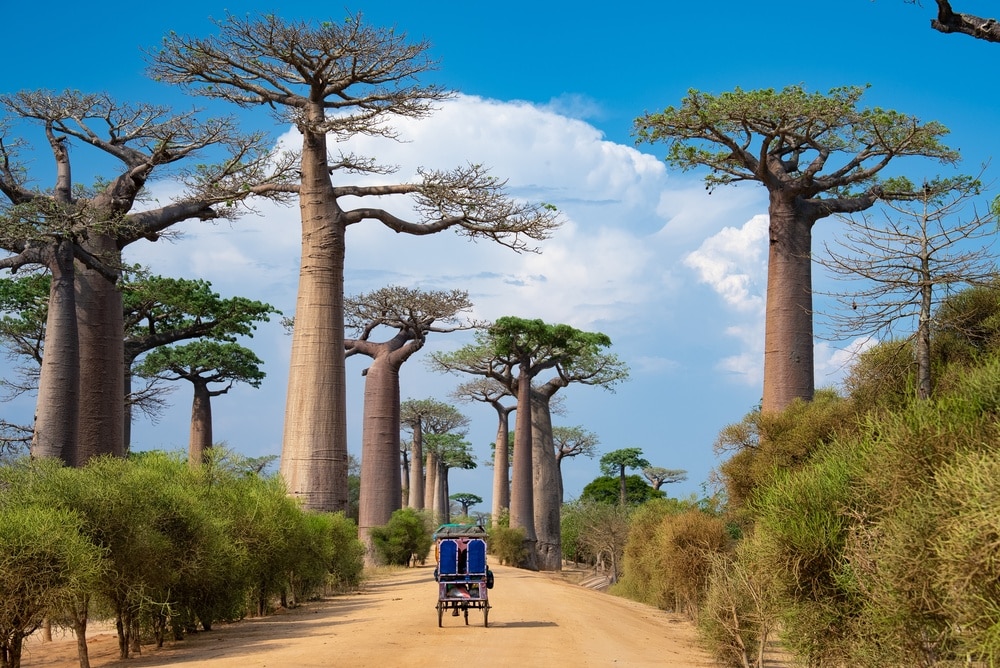
The scale of mature baobabs can be hard to imagine. Some reach up to 30 meters high and up to 50 meters in circumference, while their swollen trunks make them useful to animals and people. In savannah communities, baobabs have provided shelter, food, and water, and many people made their homes near them because the trees could support life where other resources were limited.
Their presence also connects natural history with human history. The source material notes that baobabs loom among ancient mounds, with remains around them described as early medieval or Portuguese. The details are limited, but the point is clear enough: these trees have often stood in places where people lived, traveled, gathered, or left traces behind.
Sagole Now Holds the Living Baobab Record
The largest known living baobab is the Sagole Big Tree, a specimen of African baobab in Masisi, Vhembe, South Africa, near the border with Zimbabwe. According to Guinness World Records, Sagole’s most recent measurements give it a base covering 60.6 square meters, a height of 19.8 meters, and a total wood and bark volume of 414 cubic meters.
That record is about volume, not height or weight. Sagole is enormous, but its aboveground dry mass is estimated at 54 tonnes, which is relatively low for a tree with such a large trunk. The reason is that baobab wood is unusually light, so a tree can have a vast body without matching the mass of denser giant trees.
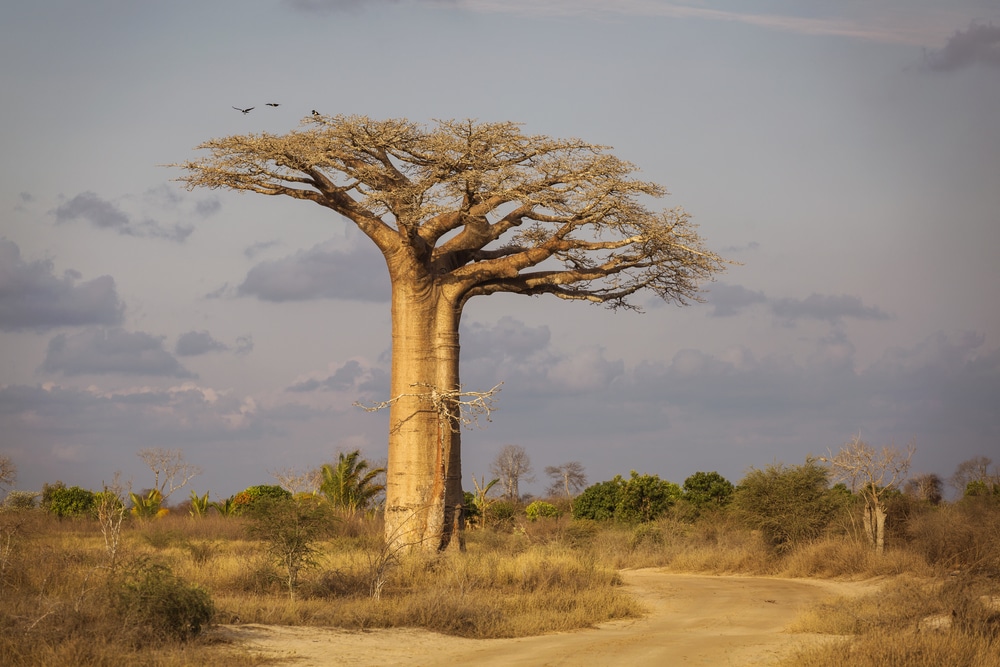
Sagole’s position at the top also reflects loss. It is the largest known living baobab now because other giants that were larger or comparable by volume have collapsed in recent years. That makes the record less like a fixed monument and more like a snapshot of which huge trees are still standing.
Larger Giants Fell in Madagascar and South Africa
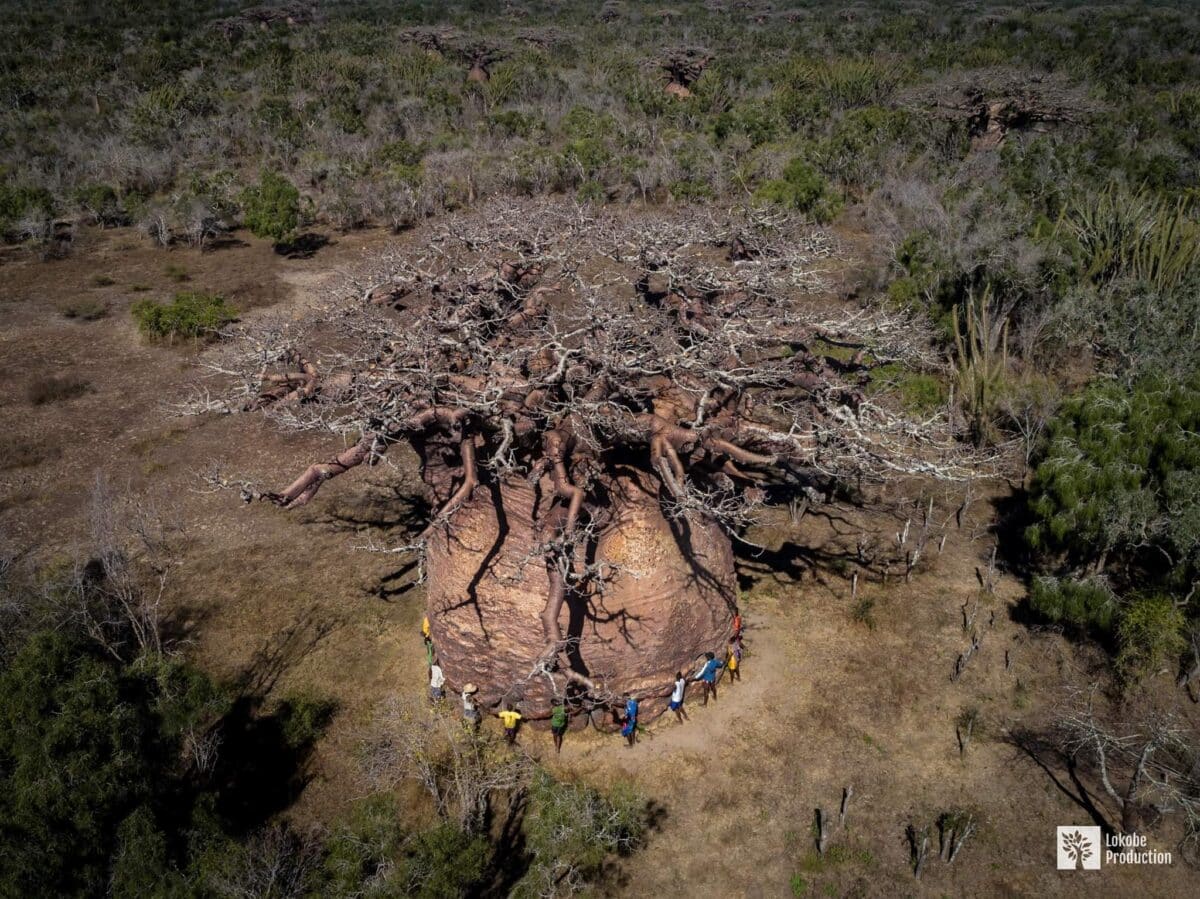
Until 2018, the largest living baobab was the sacred Tsitakakoike Baobab, a specimen of the endangered species Adansonia grandidieri. It grew near Andombiro in the Ambiky Forest of south-west Madagascar. The tree was stout and compact, with a cylindrical trunk and a base covering 59.6 square meters.
Tsitakakoike was shorter than Sagole, standing 14.6 meters tall, but its total volume was larger at 455 cubic meters. Of that, 380 cubic meters came from the trunk and 75 cubic meters came from the canopy. Its aboveground dry mass was estimated at about 59 tonnes, again showing the gap between the tree’s immense volume and its relatively low dry weight.
In February 2018, Tsitakakoike partially broke and collapsed, leaving about 40 percent of the tree still standing. The remaining part was expected to collapse soon after, though the provided source material does not confirm what happened later. Its fall removed it from the top position among living baobabs and made Sagole the largest known living specimen by volume.
Another giant African baobab, the Platland Tree, also known as the Sunland Tree, grew in Modjadjiskloof, South Africa. During the 21st century, it had a base covering 67.9 square meters, a height of 18.9 meters, and a total wood and bark volume of 448 cubic meters. A large portion of the Platland Tree collapsed and died in 2016, two years before Tsitakakoike’s collapse.
The pattern matters because baobabs are often treated as symbols of endurance. Research published in Nature Plants examined some of the oldest and largest African baobabs in the context of collapse and death. The source material does not provide every cause or next step, but it does show that even the most massive baobabs can fail structurally after centuries of survival.
Huge Trees Made From Feather-Light Wood
One of the strangest facts about baobabs is that their wood is among the lightest of any tree. Balsa is widely known among model aeroplane makers as one of the lightest and softest woods, with an average density of about 0.15 grams per cubic centimeter. Baobab wood is even lighter, averaging about 0.13 grams per cubic centimeter.
That number helps explain why volume is so important in measuring the largest baobabs. The Platland baobab had an estimated aboveground dry mass of only 58 tonnes, despite its huge base and trunk volume. Tsitakakoike’s dry mass was about 59 tonnes, even though its total volume reached 455 cubic meters before the 2018 collapse.
The contrast with Australia’s giant gum trees, or Eucalyptus, is useful. Giant gum trees are considered the largest hardwood trees in terms of mass, while baobabs stand apart because of their enormous swollen trunks, water storage, and very low wood density. A baobab’s size is therefore not simply a matter of heavy timber. It is a matter of volume, structure, and adaptation to dry landscapes.
The Sagole Big Tree remains the largest known living baobab, with a measured wood and bark volume of 414 cubic meters.