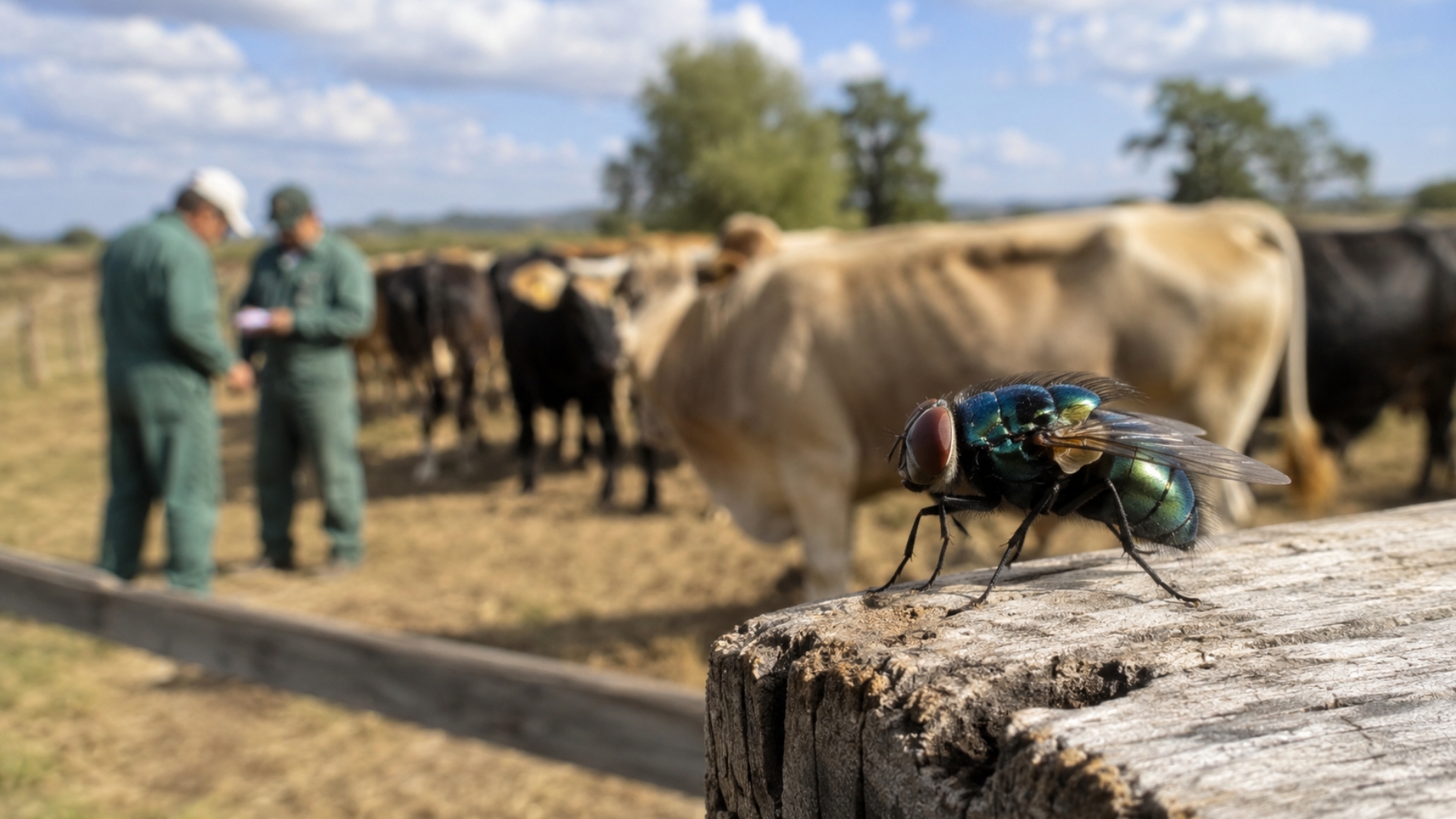
A Parasite Few People Have Heard Of Is Triggering Alarm
Few insects have caused as much concern among livestock producers as the New World screwworm.
Unlike most flies, whose larvae feed on dead or decaying tissue, the New World screwworm targets living animals. Female flies lay eggs in open wounds, scratches, or natural body openings. Once the eggs hatch, the larvae burrow into living flesh, feeding as they grow and expanding the wound in the process.
The parasite can affect cattle, horses, sheep, goats, wildlife, pets, and in rare cases even humans. Left untreated, severe infestations can lead to infection, serious injury, and death.
For decades, the insect was considered one of North America’s greatest agricultural threats. Then it seemingly disappeared.
Now officials are working to make sure it does not return in force.
What Makes the Screwworm Different
The New World screwworm, Cochliomyia hominivorax, is not a worm at all. It is a blow fly whose larvae earned their name because they appear to screw themselves deeper into tissue as they feed.
Female flies can deposit hundreds of eggs at a time. Within a day, larvae emerge and begin consuming living flesh. As the wound enlarges, it attracts additional flies, creating a cycle that can rapidly worsen the infestation.
This behavior separates the screwworm from many other fly species that typically consume dead tissue. Because the larvae require living flesh to develop, they can inflict significant damage on otherwise healthy animals.
Livestock producers have long feared the parasite because even a small wound can become a point of entry. Tick bites, branding wounds, castration sites, injuries from fencing, and other minor skin damage can all provide opportunities for infestation.
One of Agriculture’s Greatest Eradication Success Stories
The screwworm was once widespread across the southern United States.
By the middle of the twentieth century, it was costing livestock producers millions of dollars annually while causing enormous suffering to affected animals. The breakthrough came through an innovative strategy known as the Sterile Insect Technique.
Scientists began breeding vast numbers of male screwworm flies, sterilizing them with radiation, and releasing them into the wild. Because female screwworms generally mate only once, mating with a sterile male prevented reproduction and gradually collapsed wild populations.
The approach proved remarkably successful. The parasite was eradicated from the United States in the 1960s and later pushed south through Mexico and much of Central America. A long-running international program then focused on maintaining a biological barrier near Panama to prevent the pest from moving north again.
Why Officials Are Concerned Again
Recent outbreaks have changed the picture.
Beginning in 2023, New World screwworm infestations spread northward through parts of Central America and Mexico. Researchers and animal-health authorities warned that the parasite was moving beyond areas where it had previously been contained.
The concern is not simply that individual animals may become infected. Large outbreaks can create enormous economic consequences for livestock industries, disrupt animal movement, increase veterinary costs, and threaten wildlife populations.
Scientific assessments have suggested that suitable habitat for the parasite extends across large areas of North America, making prevention and rapid response particularly important.
Wildlife Could Be Affected Too
Although cattle often receive the most attention, the screwworm is not exclusively a livestock problem.
The parasite can infest deer, feral hogs, carnivores, birds, and numerous other wildlife species. Because wild animals move freely across landscapes, they can complicate efforts to monitor and contain outbreaks.
Wildlife agencies note that infestations can be difficult to detect in free-ranging animals until populations are already affected. That is one reason conservation officials monitor developments closely whenever the parasite spreads into new regions.
The issue highlights how animal health, agriculture, and wildlife conservation are often closely connected. A disease or parasite affecting one group can quickly become a wider ecological challenge.
The Fight Now Depends on Surveillance and Prevention
The good news is that the screwworm is neither new nor poorly understood.
Decades of research have provided officials with effective tools, particularly sterile-fly releases and coordinated surveillance programs. Veterinary authorities, ranchers, wildlife managers, and governments already know many of the steps needed to detect and contain outbreaks.
The challenge is maintaining enough resources and international cooperation to stay ahead of the parasite as it spreads northward.
Recent responses have included increased surveillance, movement controls for livestock, expansion of sterile-fly production programs, and renewed investment in eradication efforts. Experts generally agree that early detection remains one of the most important defenses.
Why This Story Matters Beyond Farming
The New World screwworm is a reminder that some of the most serious wildlife and agricultural threats are not large predators or invasive mammals, but tiny organisms capable of moving across borders unnoticed.
For many people, the parasite may sound like a problem confined to ranches and cattle operations. In reality, it sits at the intersection of wildlife management, animal welfare, food security, veterinary medicine, and international cooperation.
The battle against the screwworm was once considered one of the greatest successes in pest control. Whether that success can be maintained may depend on how effectively authorities, scientists, and livestock producers respond to the parasite’s latest advance.
The insect itself has not changed. What matters now is whether the systems built to stop it remain strong enough to keep it from regaining a foothold.