New COVID-19 Variant, BA.3.2, Emerges with Significant Immune Evasion Potential
A new, heavily mutated COVID-19 variant, designated BA.3.2, is quietly making its way across the United States, drawing the attention of health authorities. First identified in South Africa in November 2024, scientists are expressing concern about its potential to significantly bypass existing immune defences, including the protection offered by the 2025-2026 COVID-19 vaccine formulations.
The key to this concern lies in the variant’s spike protein. This is the critical component that vaccines train our immune systems to recognise and combat. BA.3.2 boasts approximately 75 mutations on its spike protein, a number that renders it almost unrecognisable to the immune system compared to earlier strains. This extensive genetic alteration suggests it presents a substantially novel challenge.
Early Detection and Spread
As of mid-March 2026, BA.3.2 has been detected in a growing number of locations across the US. This includes six international travellers, three aeroplane wastewater samples, over two dozen individual patients, and at 260 wastewater sites spanning 29 states and Puerto Rico. While these figures represent a small fraction – roughly half a percent – of all recent virus sequences, the widespread detection is notable.
Wastewater surveillance has proven to be an early warning system, often flagging the presence of a virus in a community weeks before it appears in clinical settings. In the case of BA.3.2, this method proved instrumental, detecting the variant in sewage systems long before doctors began seeing positive cases in patients.
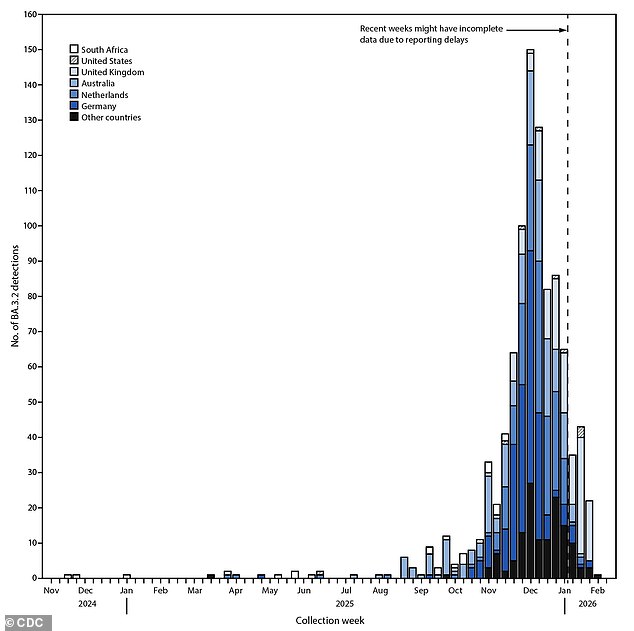
In Europe, BA.3.2 began to show an upward trend in detections during the autumn of the previous year, eventually accounting for around 30 percent of cases in countries such as Denmark, Germany, and the Netherlands. While it has not yet become the dominant strain in the US, its ability to circulate alongside other, more prevalent variants indicates a period of sustained mutation and adaptation.
Interestingly, initial laboratory studies suggest BA.3.2 may not bind as effectively to human cells as some other variants. This potential weakness could be a factor limiting its rapid proliferation, at least for now.
CDC’s Monitoring Strategies
The Centers for Disease Control and Prevention (CDC) is actively tracking the spread of BA.3.2 through a multi-pronged approach:
- International Traveller Testing: Screening individuals arriving from overseas provides an early indication of new variants entering the country.
- Airplane Wastewater Sampling: Analysing wastewater from aircraft offers another avenue for detecting novel strains before they become widespread.
- Nationwide Wastewater Surveillance: A comprehensive system monitoring approximately 1,450 sewer sites across the country provides continuous insight into community transmission levels and variant prevalence.
These robust surveillance systems were instrumental in identifying the arrival of BA.3.2 in the US in June 2025, months before it was clinically diagnosed in hospitals.

Timeline of BA.3.2 Detection
The initial detection of BA.3.2 traces back to a five-year-old boy in South Africa in November 2024. Subsequently, it was identified in Mozambique and several European nations in early 2025. While initial detections were sporadic, they began to increase in September 2025, reaching a peak in December.
The variant’s first confirmed entry into the United States occurred on June 27, 2025, when a traveller arriving from the Netherlands tested positive at San Francisco International Airport. Reports of detections began to rise in September 2025. However, health officials acknowledge that in many parts of the world, sophisticated surveillance tools are lacking, meaning these recorded detections likely underestimate the true geographic reach of the variant’s spread.
US wastewater surveillance systems picked up BA.3.2 in Rhode Island in November 2025, several months prior to any reported clinical cases. The first patients were identified in early January 2026, comprising two hospitalised older adults with pre-existing health conditions and a young child. Fortunately, all individuals recovered. By February 2026, BA.3.2 had been identified in a small number of international travellers, a few clinical patients, and over 130 wastewater samples across two dozen states.
Understanding Variant Tracking
The CDC employs three primary data sources to monitor COVID-19 variants:
- National Laboratory Testing: This involves analysing genetic sequences from positive cases identified across the country.
- Airport Surveillance: This includes voluntary nasal swabs from arriving travellers and the analysis of wastewater from airplanes.
- Nationwide Wastewater Surveillance: This system offers a broad overview of community-level viral presence.
When a BA.3.2 sample is identified, scientists meticulously analyse its genetic code. This analysis involves comparing the variant’s genetic makeup to that of current vaccines to pinpoint specific changes. Advanced software is used to align these genetic sequences, creating evolutionary “family trees” that illustrate the relationships between different viral strains.
Each detection is meticulously logged with its location and date. This data allows the CDC to map the variant’s initial points of entry and track its rate of spread, providing public health officials with a real-time understanding of how the variant is evolving and moving.
Genetic Differences and Vaccine Efficacy
The BA.3.2 variant is genetically distinct from the JN.1 family of variants that have been dominant in the US since early 2024. The significant number of mutations on its spike protein – approximately 70 to 75 compared to the vaccine strain – is a key differentiator. Of these mutations, around 20 are located in the critical region responsible for binding to human cells, while another 35 are in a nearby area that aids in cell entry and immune evasion. The remaining changes are distributed across other parts of the spike protein.
While the current COVID-19 vaccine, updated for the 2025-26 season, demonstrates good efficacy against the prevalent JN.1 strains, its performance against BA.3.2 is a subject of ongoing investigation. In a laboratory study that evaluated seven different variants, the vaccine showed its weakest performance against BA.3.2. This suggests that while the vaccine may still offer protection against severe illness, its ability to neutralise this particular variant could be reduced. Real-world data will be crucial in confirming the extent of this impact.
COVID-19’s Evolving Landscape
COVID-19 has transitioned from a constant viral threat to a more predictable, seasonal public health concern, akin to influenza and respiratory syncytial virus (RSV). Unlike the severe waves of disease experienced in 2020 and 2021, which led to thousands of daily deaths, the virus now follows a more discernible pattern.
Thanks to the widespread availability of highly effective vaccines and antiviral treatments like Paxlovid, outbreaks tend to be shorter and less severe. Similar to the flu, COVID-19 cases typically surge during the colder months, from late autumn through early spring, when increased indoor gatherings facilitate virus transmission. Summer months generally see a decline in case numbers.
The majority of the population now possesses some level of immunity, acquired through vaccination, prior infection, or a combination of both. While this protection does not prevent everyone from contracting the virus, it significantly reduces the likelihood of severe illness and hospitalisation for most individuals.