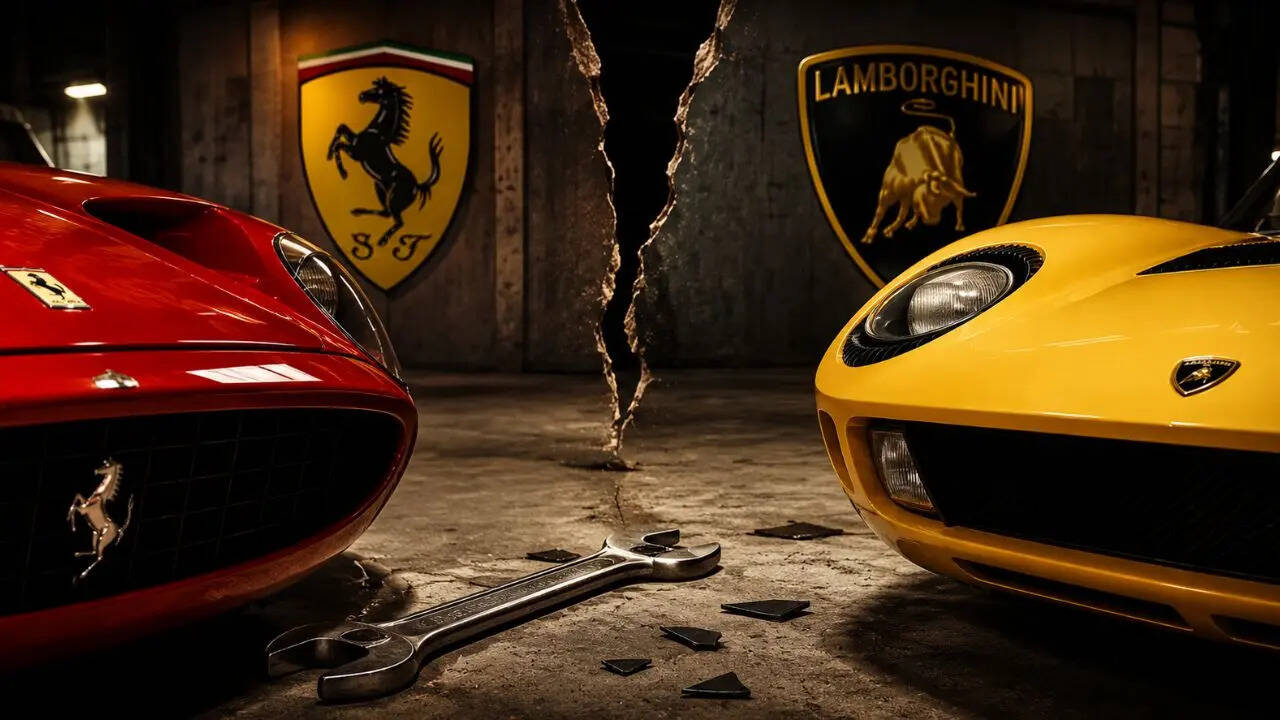
The Origin of a Rivalry
Most people are familiar with the general story of Ferruccio Lamborghini’s decision to create his own car company. He was upset with Enzo Ferrari after a disagreement over a part, and he decided to build a competitor. However, this simplified version often overlooks the specific incident that truly pushed Lamborghini to take action.
Lamborghini discovered that a crucial component in his Ferrari, a clutch part, was manufactured by his own company for tractors. He realized that the part cost less than 2 cents to make, yet Ferrari charged him around USD 1.60 for it — an amount that is equivalent to about USD 18 today. This marked the beginning of a significant conflict that would eventually lead to the creation of Lamborghini as a brand.
A Meeting That Changed Everything
By 1962, Lamborghini was not just a man with a grudge; he was one of Italy’s wealthiest industrialists. His company, Lamborghini Trattori, was successful in selling farm equipment, and he owned multiple Ferraris. When the clutch in his car began to malfunction, he didn’t go to a dealer. Instead, he had his own mechanics disassemble the car.
It was during this process that Lamborghini found the problematic part. He recognized it immediately as something his factory had been producing for years. He knew its manufacturing cost and market value, which led to a shocking realization — Ferrari had charged him 1,000 lire for a part that he sold for just 10 lire.
He went to Maranello to confront Ferrari, not to start a fight, but to present a better engineering solution. According to Valentino Balboni, who worked as Lamborghini’s chief test driver, Lamborghini told Ferrari: “You build your beautiful cars with my tractor parts.” Ferrari responded with a dismissive remark, claiming that a tractor manufacturer had no business telling him how to build sports cars. The meeting ended quickly, but for Lamborghini, it was just the beginning.
The Birth of a New Company
Instead of returning home to complain, Lamborghini took action. He bought land and started building a factory just 30 kilometers from Maranello. He brought in engineers, some of whom had previously worked at Ferrari, and gave them a clear directive: to create a purpose-built grand touring car with an entirely new engine.
The result was the 350 GT, which was unveiled at the Turin Motor Show in 1964. It featured a 3.5-liter V12 engine developed entirely in-house. Notably, there were no issues with the clutch, which had been a problem in his Ferrari.
Ferrari initially dismissed the effort as a vanity project. However, this changed when Lamborghini introduced the Miura in 1966. The industry’s perception of Lamborghini shifted rapidly, and the rivalry between the two brands became undeniable.
The Miscalculation That Shaped the Industry
Ferrari’s biggest mistake wasn’t the harsh words he used. Many business disagreements don’t lead to such dramatic outcomes. What Ferrari failed to recognize was the strength of the person standing across from him. Lamborghini had the capital, a functioning factory, decades of mechanical expertise, and a network of engineers ready to support him. Ferrari saw a tractor manufacturer and underestimated his potential.
Lamborghini eventually sold his car company in 1972 due to financial difficulties following two serious accidents during customer demonstrations. He returned to his estate in Emilia-Romagna and largely stepped away from the industry. Over the years, the company changed hands multiple times before Audi acquired it in 1998. However, the foundation for Lamborghini’s legacy — including its factory location, V12 engine design, and competitive positioning against Ferrari — was established during that critical 18-month period between the meeting in Maranello and the debut in Turin.
One overpriced part and a dismissive response were all it took for Ferrari to inadvertently create his most formidable rival.