A Unique Deep-Sea Habitat
In 2009, a team of researchers on the Clayoquot Slope off Vancouver Island made a remarkable discovery: a large whale skeleton resting on the seafloor. Most of its soft tissue had already decomposed, leaving behind a rare opportunity to observe the transformation of a whale fall over time. The carcass was found at a depth of 1,288 meters, and scientists recognized the significance of this event. Over the next 15 years, they returned to the same location, documenting what happened next. Their findings, published in Frontiers in Marine Science, reveal a deep-sea habitat that has resisted fading.
The whale, likely a blue or fin whale, had already progressed through the early stages of decomposition when it was discovered. The study focuses on what followed, particularly the sulphophilic stage, which is now known to have persisted for at least 21 years. Researchers believe this phase could continue for another decade, challenging previous assumptions that this stage would end more quickly.
Tracking Changes with Precision
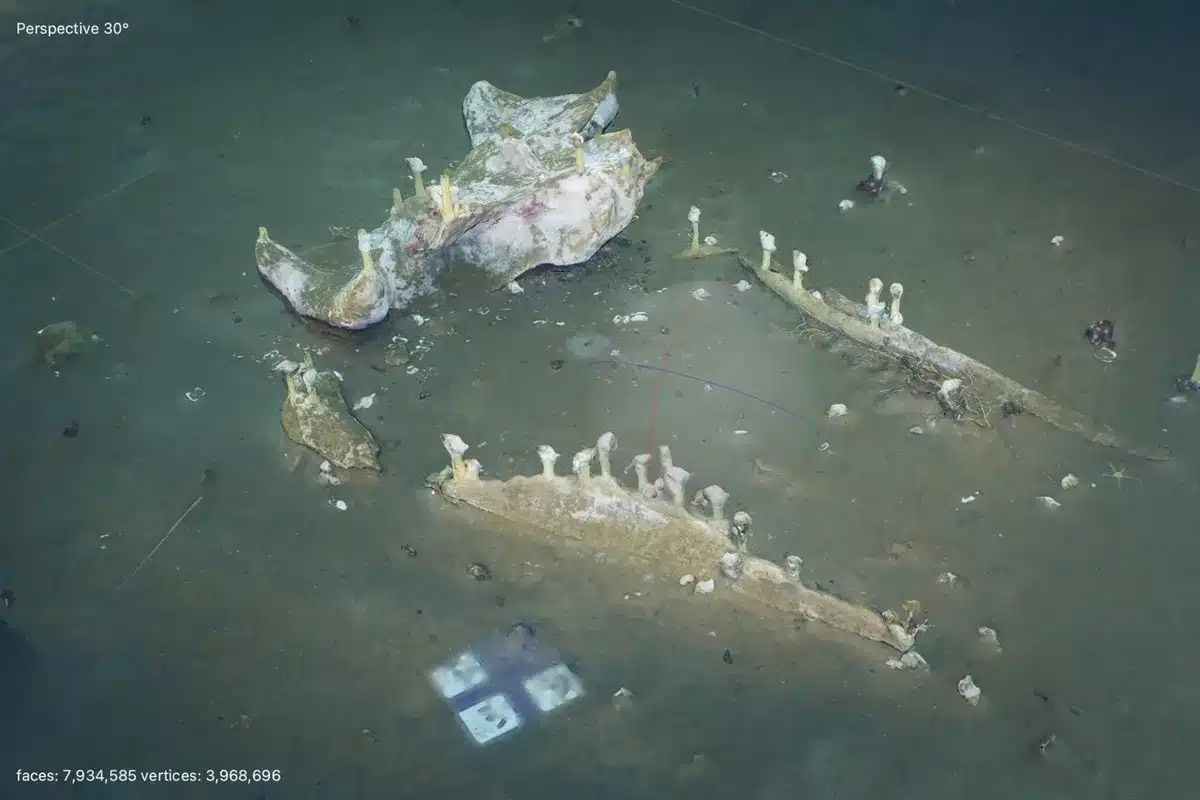
Fabio De Leo from the University of Victoria highlighted the uniqueness of this study, noting that unlike previous whale fall studies, the team was able to return to the same location and conduct surveys using cm-scale precision photogrammetry. This technique allowed them to create detailed 3D models of the skeleton and measure changes over time.
Between 2012 and 2024, the research team, led by Ocean Networks Canada and the University of Hawaii at Manoa, used remotely operated vehicles to survey the site four times. From these video surveys, they built high-resolution 3D models and measured bone loss with centimeter precision.
The skull and 23 caudal vertebrae remained largely intact. Between 2012 and 2023, the vertebrae shortened by an average of just 1.4 percent. The mandibles eroded more, with one fragment losing 7.8 percent of its length. The authors noted that the cranium and vertebrae are expected to persist for at least another decade.
While the bones showed minimal change, the organisms living on them evolved. In 2009, Osedax worms, commonly known as zombie worms, were present. By the final survey, however, none remained. The researchers suggest that these worms may have run out of accessible resources or been displaced by spreading microbial mats.
The Rise of Sulphophilic Communities
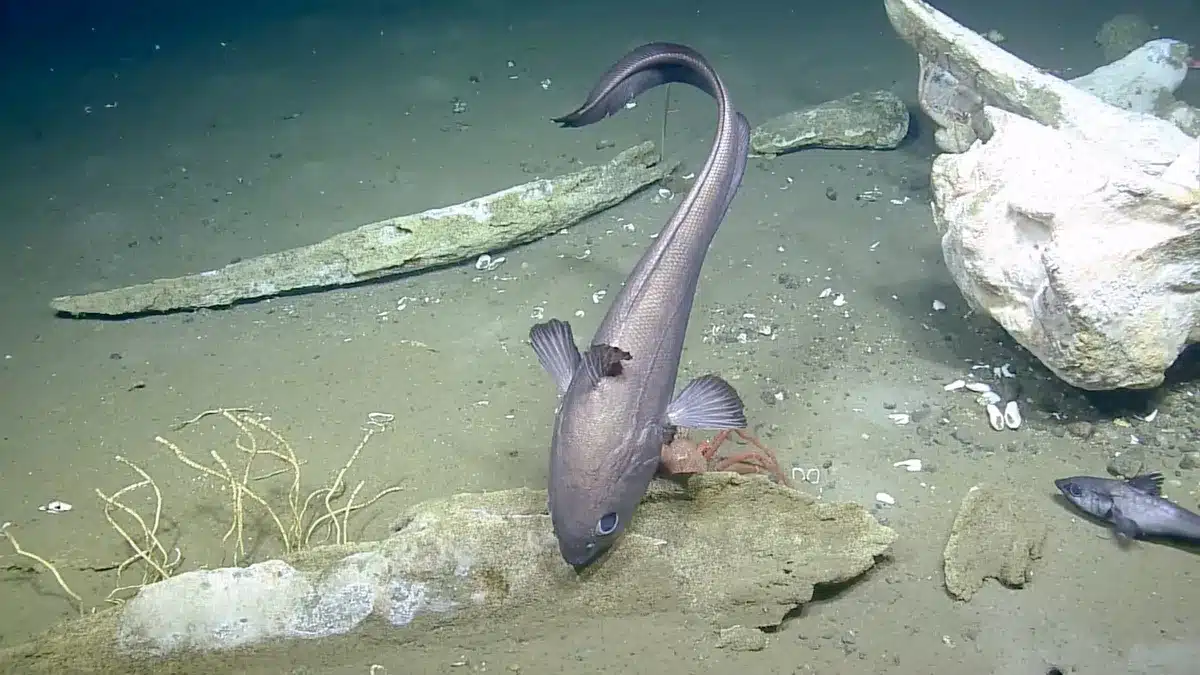
What replaced the Osedax worms was a full sulphophilic community, including 33 vestimentiferan tube worms (Lamellibrachia cf. barhami), live vesicomyid clams, provannid gastropods, and more than 100 empty clam shells.
Bacterial mats, which play a crucial role in the sulphophilic stage, grew thicker over time. Between 2012 and 2023, bacterial mat coverage expanded significantly. On the vertebrae, it increased from 39.9 percent to 48.6 percent. On the skull bones, it rose from 27.0 percent to 30.7 percent. This growth indicates that the sulphophilic stage was still active during the study.
Expanding Low-Oxygen Zones
The Clayoquot Slope site lies within a persistent low-oxygen region known as an Oxygen Minimum Zone. Dissolved oxygen levels there average 0.46 milliliters per liter. However, researchers note that such zones are expanding and becoming shallower in the Northeast Pacific due to climate change. In some areas, the oxygen layer has deepened by as much as 3 meters per year.
If oxygen levels drop below 0.33 milliliters per liter, a threshold observed for Osedax survival elsewhere, these bone-eating worms may fail to colonize new whale falls. Losing Osedax could disrupt the entire bone breakdown process and reduce species diversity at whale falls. Fortunately, the Clayoquot site remains above this critical oxygen line, and the absence of Osedax there is not attributed to oxygen stress.
Long-Term Implications
The sulphophilic stage at this whale fall has lasted more than two decades, aligning with timelines observed off southern California. The lipid-rich skull and vertebrae continue to degrade slowly. Bacterial mats are still spreading, and chemosynthetic fauna remain. The study, published in Frontiers in Marine Science, suggests that this deep-sea community will continue feeding on the bones for years to come.