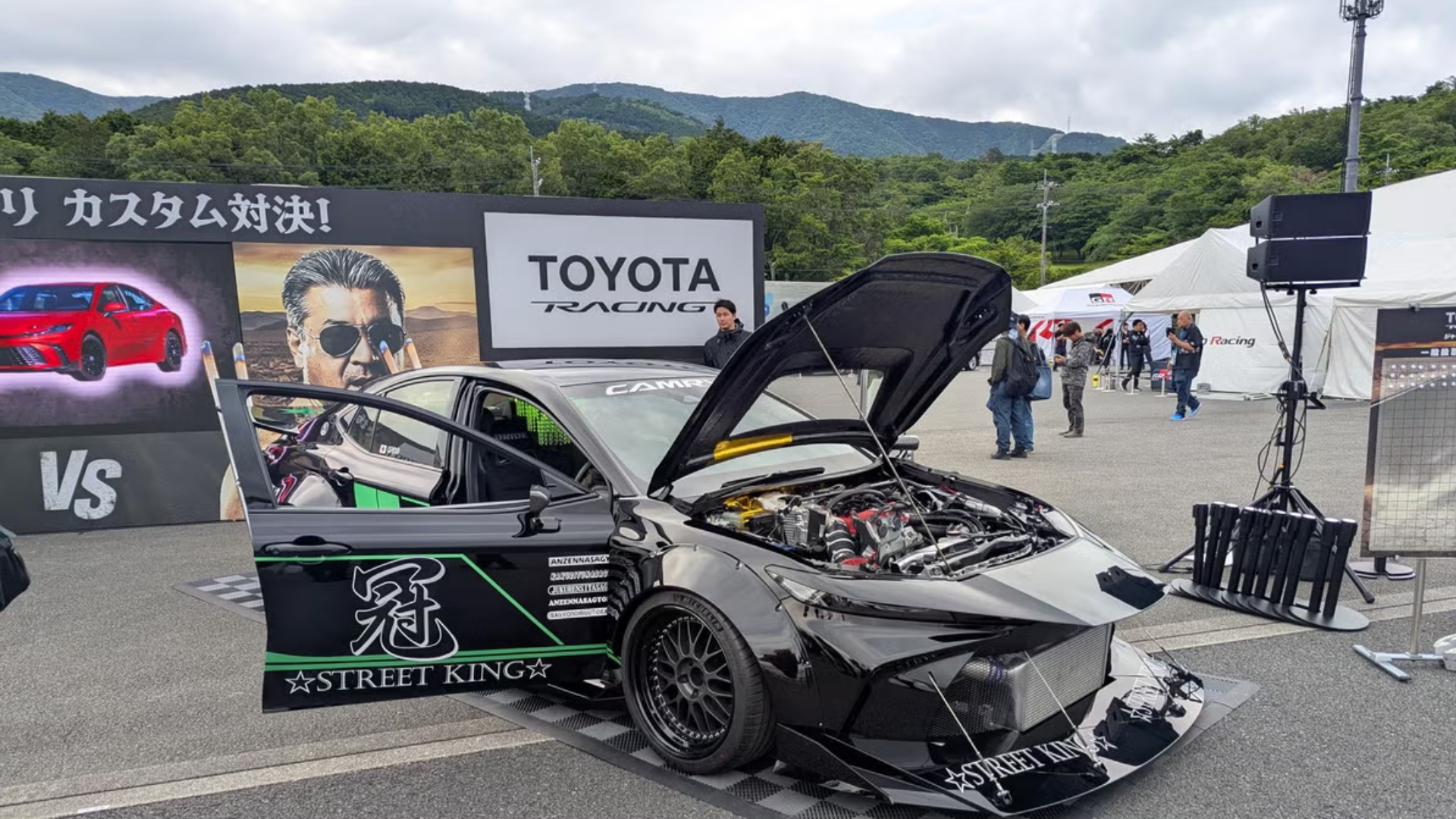
The Camry Is Not Supposed to Be Exciting
For decades, the Toyota Camry has been one of the automotive industry’s ultimate rational choices.
It has earned a reputation through reliability, comfort, efficiency, and practicality rather than outright performance. Millions of buyers have chosen the Camry precisely because it avoids unnecessary drama.
Which is why Toyota’s twin-engine Camry project remains so fascinating.
At first glance, it sounds like something created in a tuning garage rather than by one of the world’s largest automakers. Yet the project was very real and far more ambitious than simply installing a larger engine.
Toyota essentially built a Camry unlike anything that had come before it.
Two Engines, One Goal
The concept was remarkably straightforward.
If one engine produces a certain amount of power, why not use two?
Engineers installed one powertrain at the front of the vehicle and another at the rear, creating a machine capable of producing roughly 700 horsepower combined. Each engine powered its respective axle, effectively transforming the family sedan into an all-wheel-drive performance experiment with extraordinary output.
The result was something that barely resembled the Camry found in dealership showrooms.
Instead, it became a rolling demonstration of engineering creativity.
A Product of a Different Era
Automotive manufacturers once embraced unusual experimental projects more frequently than they do today.
These vehicles often served as technology showcases, marketing exercises, or proof-of-concept engineering programs designed to attract attention while pushing technical boundaries.
The twin-engine Camry belonged firmly within that tradition.
It was never intended to become a mainstream production model. Instead, it demonstrated what could happen when engineers were given freedom to pursue an unconventional idea without the constraints normally associated with mass-market vehicle development.
Those kinds of projects often produce some of the most memorable vehicles in automotive history.
Why Dual-Engine Cars Are So Rare
The idea sounds appealing on paper.
In practice, dual-engine vehicles create enormous engineering challenges.
Synchronizing power delivery, managing weight distribution, packaging components, maintaining reliability, and ensuring predictable handling all become significantly more complicated when a vehicle relies on two separate powertrains.
Modern manufacturers can often achieve similar performance levels more efficiently through advanced all-wheel-drive systems, turbocharging, hybridization, or electrification.
That reality helps explain why twin-engine road cars remain exceptionally rare.
The complexity simply outweighs the benefits in most circumstances.
Toyota’s Performance Side Is Often Overlooked
The project also serves as a reminder that Toyota’s history extends well beyond practical transportation.
While the company is best known globally for dependable family vehicles, it has repeatedly demonstrated a willingness to experiment with performance-oriented engineering.
Models such as the Supra, GR Yaris, GR Corolla, MR2, Celica GT-Four, and various racing programs reveal a side of Toyota that enthusiasts sometimes feel is underappreciated.
The twin-engine Camry represents one of the most extreme examples of that mindset.
It was a project driven not by necessity, but by curiosity.
Today’s Toyota Might Approach the Challenge Differently
If engineers attempted a similar project today, the result would likely look very different.
Modern performance development increasingly revolves around electrification. Rather than adding a second gasoline engine, manufacturers can now achieve remarkable power levels through electric motors, sophisticated torque-vectoring systems, and hybrid technologies.
In many ways, modern high-performance hybrids accomplish goals that earlier twin-engine concepts were trying to reach.
They deliver extraordinary power while maintaining greater control, efficiency, and packaging flexibility.
Technology has evolved, but the pursuit of performance remains unchanged.
Why the Twin-Engine Camry Still Matters
The appeal of the 700-horsepower Camry is not rooted solely in performance figures.
Plenty of modern vehicles exceed that output.
What makes the project memorable is its sheer audacity. It took one of the world’s most sensible automobiles and transformed it into something completely unexpected.
That contrast is what keeps enthusiasts talking about it years later.
The Camry was never intended to be a supercar killer, a Nürburgring weapon, or a track-focused exotic. It was designed to transport families comfortably and reliably.
Toyota’s engineers temporarily ignored all of that.
The result was one of the most entertaining “what if?” experiments the company has ever produced, a reminder that even the most practical vehicles can become extraordinary when creativity takes priority over convention.
This article was created by an external editorial team for the Misha Charoudin brand. It was not personally written by Misha Charoudin.