A Galaxy That Challenges Cosmic Expectations
A massive galaxy, observed just 400 million years after the Big Bang, is raising questions among astronomers. Named EGS-z11-R0, it appears far more developed than expected for its age, as if it had more time to evolve than the universe’s timeline allows. This discovery has sparked discussions about how galaxies form and grow in the early universe.
The galaxy was identified using NASA’s James Webb Space Telescope (JWST), which has been instrumental in uncovering hidden cosmic phenomena. Its unusual characteristics have led to debates about whether current models of galaxy evolution are missing key elements.
The research team, led by Giulia Rodighiero, found this object while analyzing public JWST data. They were searching for dust-obscured systems that might have been overlooked in previous studies. Among the galaxies they examined, only one stood out—EGS-z11-R0. This makes it a rare find, suggesting that such galaxies may be either extremely uncommon or simply hard to detect with existing techniques.
Dusty and Early: A Puzzle for Scientists
EGS-z11-R0 gets its deep red color from thick clouds of dust that absorb blue light from young stars. This effect is visible in its ultraviolet light profile, which appears flatter than expected. The presence of so much dust at such an early stage in the universe’s history is unexpected.
Dust typically forms over many generations of stars, which means that EGS-z11-R0 must have undergone significant star formation activity in a very short time. Pieter van Dokkum, an astrophysicist at Yale University, describes the timeline as “astonishing,” noting that similar timeframes exist in the evolution of long-lived species like sharks and turtles.
Signs of an Advanced System
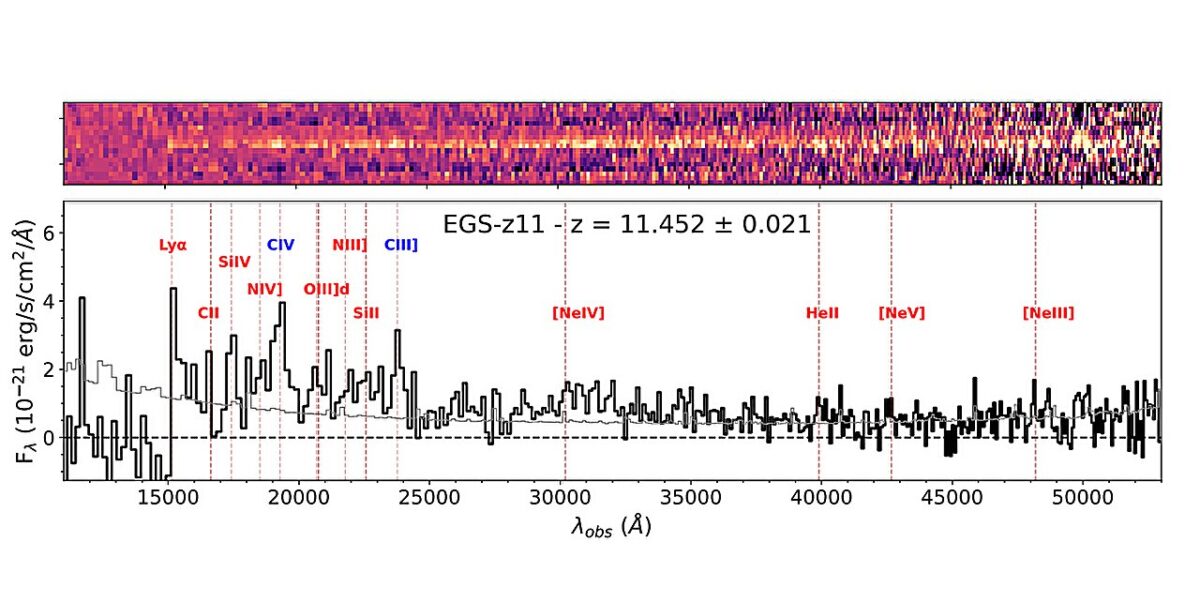
According to a preprint study, the team also detected carbon in the galaxy’s spectrum, another indicator of advanced evolution. Carbon is formed inside stars and spreads through explosive events like supernovae, meaning several stellar cycles must have already occurred.
This suggests that EGS-z11-R0 has gone through intense periods of star formation and destruction earlier than expected. The presence of both dust and carbon indicates a complex history that challenges current understanding of early galaxy development.
Red and Blue Monsters: Different Stages of the Same Story
EGS-z11-R0 is part of a growing group of galaxies spotted by the JWST, often referred to as “monster galaxies.” These objects stand out due to their extreme properties, such as mass, brightness, or level of evolution at such an early cosmic time. Some are described as “blue,” meaning they shine brightly with little dust and are dominated by young, hot stars. Others, like this one, appear heavily reddened, their light filtered and dimmed by thick layers of dust.
Giulia Rodighiero explains that these galaxies may be connected by the same evolutionary story, but we catch them at different stages. She notes that blue galaxies are easier to detect, which could lead to a skewed view of what we observe.
An Outlier in the Cosmic Landscape
At this stage, EGS-z11-R0 appears to be an outlier, standing apart even among the unusual galaxies uncovered by the Webb Telescope. Its combination of mass, dust content, and early appearance makes it difficult to place within existing categories, which is why it draws so much attention.
Researchers suggest that future observations using the JWST, along with deeper mid-infrared, submillimeter, and radio studies, will be crucial in determining how common these early dust-rich galaxies are and their role in the earliest phases of galaxy and black-hole growth.
This discovery highlights the complexity of the early universe and the need for continued exploration and analysis. As scientists delve deeper into these findings, new insights into the formation of galaxies and the evolution of the cosmos may emerge.