The Mystery of the North Sea Pockmarks
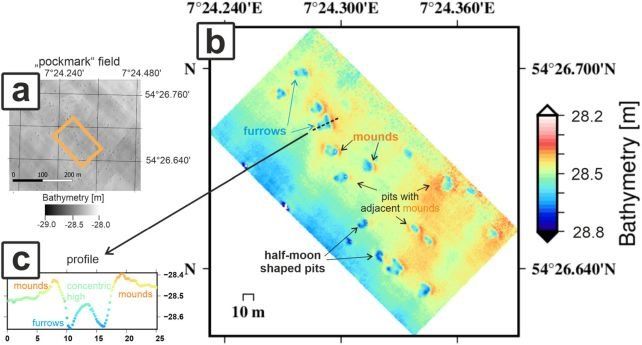
Oceanographers have finally uncovered the cause behind the thousands of small holes scattered across the floor of the North Sea, a mystery that has puzzled scientists for years. These peculiar pockmarks were first discovered in the 2010s and initially attributed to methane gas escaping from beneath the seabed. Similar phenomena had been observed globally since the 1970s, particularly off the coast of Canada.
However, the depressions found in the North Sea presented a unique challenge for researchers. According to geoscientist Jens Schneider von Deimling of Kiel University, writing in the Nature journal, these marks had left scientists baffled. Previous studies suggested that the marks would “emerge and disappear within a couple of months,” adding to the enigma.
It turns out that the cause of these pockmarks is not related to methane at all. In fact, there was likely not enough methane beneath that area of the North Sea to create such formations. Instead, the answer lies in the activities of deep-sea animals.
The Role of Porpoises and Sand Eels
The pits are the result of the natural behavior of porpoises and sand eels in the region. Porpoises forage through the seafloor sediment, disturbing the nests of sand eels that live below. This disturbance causes the sand eels to either emerge from their holes or be consumed by the porpoises, leaving behind the characteristic pits.
Using a combination of seafloor mapping, behavioral studies of marine life, and satellite imagery of the seabed, scientists were able to determine that these pits are often located near porpoise feeding sites. This connection between the animals’ habitat and the formation of the pockmarks was a significant breakthrough.
A New Understanding of Natural Processes
“Our results show for the first time that these depressions occur in direct connection with the habitat and behaviour of porpoises and sand eels and are not formed by rising fluids,” said Schneider von Deimling.
He emphasized that the high-resolution data collected by the research team provides a new interpretation for the formation of tens of thousands of pits on the North Sea seafloor. Furthermore, he predicts that similar mechanisms may be responsible for similar formations around the globe, though they have gone unnoticed until now.
This discovery highlights how animals can play a crucial role in shaping the natural world. In this case, porpoises and sand eels have inadvertently created an extensive network of pockmarks on the ocean floor.
Broader Implications
This finding adds to a growing body of evidence showing that marine life can significantly influence geological features. It also underscores the importance of studying animal behavior in understanding environmental processes.
As researchers continue to explore the depths of the ocean, more discoveries like this are likely to emerge, shedding light on the complex interactions between marine life and the seafloor.