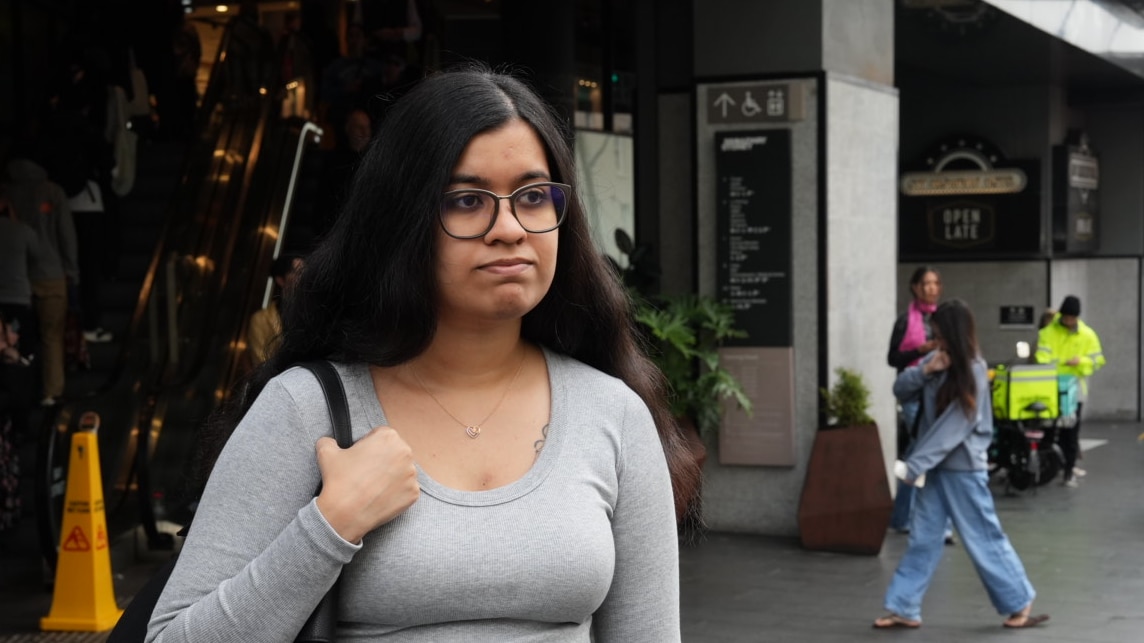
A routine lunch break at Sydney’s Broadway Shopping Centre took a terrifying turn for retail worker Shivanya Biswajeet in March when a stranger issued a chilling warning: “Move, I have a knife.” The man vanished into the weekend throng before Ms Biswajeet could fully process the encounter. However, upon returning to her store, she discovered the threat was not isolated. A colleague had a similar, unsettling experience with the same individual.
“It looks like he stole some of our socks … and when she went to go check on that fitting room after he left, she found an empty [kitchen] knife packet,” Ms Biswajeet recounted. The discovery escalated her fear. “That’s when I started to really get scared … this guy is probably walking around with a knife, he could hurt someone.”
The pair immediately contacted security, who advised them to also alert the police. While awaiting officers, Ms Biswajeet described feeling a palpable sense of anxiety within the store, “worried this guy is still roaming around.” She expressed disappointment that mall security didn’t gather “basic questions” about the man’s description or location, which she believed would have aided their own surveillance efforts.
“The fact that all they did was just tell us to call police, and they didn’t even bother to check what this guy looked like, whether he’s still in the mall in the first place. That sort of concerned me,” Ms Biswajeet stated. She felt a lack of clarity on how the individual could be tracked or identified without crucial details, questioning, “Even if they can’t interfere, at least they’d know who the guy is, where they are.” She observed that upon the police’s arrival, security personnel remained outside the store and did not engage directly with her or her colleague.
A spokesperson for Mirvac, the owner of Broadway, confirmed that their security team “monitored the situation” until the police arrived. They emphasised that “The safety of our customers and the community is our highest priority” and thanked NSW Police and their security team for their “rapid response,” acknowledging the retail team member’s “alertness” in contributing to a swift resolution. Glad Group, the security contractor for Mirvac and Scentre Group (Westfield’s parent company), stated that the report of the man’s behaviour was “acted on immediately” by their team.
The Shadow of Bondi Junction: A Push for Enhanced Shop Violence Control
This unnerving incident at Broadway occurred less than two months after the NSW Coroner handed down findings on the tragic 2024 stabbing rampage at Westfield Bondi Junction. That horrific event saw six people lose their lives and ten others injured, with security guards Faraz Tahir killed and Muhammad Taha seriously wounded. The inquest highlighted the primary role of security officers in Australia as “observing, reporting, and escalating incidents as they occur,” noting they “are not trained to engage with or attempt to detain offenders.”
The proceedings delved into preventing future tragedies, acknowledging the “extensive impact of the events… on those who were present at [Westfield Bondi Junction], including civilian shoppers, workers and those who responded to assist.”
In response to these ongoing concerns, the NSW branch of the SDA retail workers’ union reported that its members frequently face workplace safety issues, including physical violence and verbal abuse, with over a quarter feeling unsafe at work. Bernie Smith, SDA state secretary, described the Westfield Bondi incident as a “traumatic incident that reverberated throughout the retail industry and across our community,” stressing the need for inquest findings to translate into tangible improvements for retail worker safety.
This push for action is gaining momentum. Just last week, Victoria Police apprehended a man allegedly carrying a knife in a shopping centre in Forest Hill. The SDA is actively advocating for major retailers and shopping centres to implement comprehensive violence control plans. These plans would ideally include:
- Rigorous risk assessments.
- Specialised training for staff.
- Robust reporting systems.
- Increased onsite security presence.
- Improved coordination and communication channels with law enforcement.
NSW Police confirmed that a man was charged with shoplifting and stalking or intimidation with intent to cause fear or physical harm following the Broadway incident, where he allegedly “behaved in an intimidating way” towards another man. While no injuries were reported, the individual was issued a community corrections order and fined. Ms Biswajeet later learned from police that only scissors were found on the man’s person, leading her to reflect, “For all we know, he probably threw away the knife somewhere.” She expressed uncertainty about what security could have done had the situation escalated into a life-threatening scenario.
A spokesperson for Glad Group reiterated that their guards attended the scene, monitored the individual, and managed the surrounding area, with police arriving shortly after to resolve the incident. “The safety of customers and staff in the centre was our priority,” they stated.
The ‘Sliding Door Moment’ and Reporting Protocols
Ms Biswajeet noted that her team typically contacted security to report suspicious behaviour like theft. “I actually knew I … really wanted to call the police, but I just wanted to confirm by calling security first,” she admitted.
Former counter-terrorism detective Peter Moroney described such encounters as “sliding door moments” where the decision of who to report to is critical and context-dependent. He explained that some individuals instinctively call Triple Zero (000), while others, particularly retail workers, may be trained to contact centre management first.
The parent company of Ms Biswajeet’s store has its own safety program, “Calm, Warn, Act,” designed to manage aggressive customer behaviour. This program mandates that team members seek third-party assistance when faced with threatening or violent conduct, with the reporting channel – whether it be shopping centre security, police, or emergency services – depending on the nature and immediacy of the threat. In situations posing an immediate risk to safety or a serious emergency, staff are directed to call 000.
Mr Moroney suggested that in active armed offender (AAO) situations, shopping centres could implement lockdowns before police arrival to “deny and delay” the threat. He stated, “I would expect in that case the security guards should have grabbed information around what we call ‘person, object, planning’; who is the person, what’s the object, where were they sighted?” He concluded that the appropriate course of action depends on “individual facts” and the “options available to [people reporting danger],” adding, “I think [the Broadway workers] have certainly done the right thing and reported it to security.”
Promoting ‘Escape. Hide. Tell’ and Industry Collaboration
A key recommendation from the Bondi Junction inquest was for the NSW government to actively promote the “Escape. Hide. Tell” public service message for AAO events. This guidance advises individuals to move away from danger, remain concealed, and call 000 once it is safe to do so. The state coroner also encouraged “operators and owners of Crowded Places to disseminate the messaging amongst staff, retailers, and attendees.” This recommendation is currently under consideration by relevant authorities, according to the state police minister’s office.
Angus Nardi, chief executive of the Shopping Centre Council of Australia (SCCA), affirmed the industry’s close collaboration with police on security threats. Mirvac is a member of the SCCA. “The SCCA has a longstanding engagement on relevant policy and law reform on community safety issues, including knife crime,” Mr Nardi said. The council actively highlights the “unacceptable nature of aggression, threats and abuse” directed at retail workers and has partnered with Crime Stoppers on a national campaign encouraging the public to report suspicious behaviour.
The Mirvac spokesperson added that Broadway adheres to industry guidelines and conducts regular scenario training to ensure effective response capabilities. “As per the Escape, Hide, Tell guidelines, in the event of an attack, anyone involved should contact police once it is safe to do so,” they stated. Mr Moroney cautioned that the effectiveness of public awareness campaigns like “Escape. Hide. Tell” can be diminished if “the majority of shoppers don’t know about it.”