Bringing Beloved Belongings Back to Life: The Rise of Repair Cafes in Australia
On a damp Saturday morning in a quiet corner of Australia, a different kind of community gathering was in full swing. Far from the usual hustle and bustle, the basement of a local community centre hummed with a quiet determination. Volunteers, armed with an eclectic mix of skills and a passion for giving things a second chance, were welcoming a steady stream of residents and their beloved, but broken, possessions. Old lamps with frayed cords, blunt kitchen knives needing a keen edge, temperamental sound mixers, and even stubborn zippers were all on the agenda. This wasn’t a typical garage sale; it was a Repair Cafe, a cornerstone of a growing global movement championing a refreshingly old-fashioned idea: fixing things instead of binning them.
This burgeoning anticonsumerist ethos is gaining serious traction, offering a vital alternative to the throwaway culture that has dominated the global economy for decades. As the cost of living continues to bite, with rising prices impacting everything from groceries to petrol, the appeal of repairing rather than replacing is becoming increasingly compelling for many Australians.
The concept of the Repair Cafe, which first took root in the Netherlands back in 2009, has blossomed into an international phenomenon. What began as a single, local initiative has burgeoned into a global non-profit organisation boasting over 59,000 members. Across the globe, an estimated 4,000 Repair Cafes operate, collectively breathing new life into close to 850,000 items annually.
“We absolutely need to shift our mindset. The current economic model is unsustainable,” states Martine Postma, the visionary founder of Repair Cafe. “While individual Repair Cafes might not solve the world’s problems overnight, they serve as a powerful and visible signal that fundamental change is required at a much broader level.”
More Than Just Mending: Building Community Through Repair
The New Paltz Repair Cafe, located in a picturesque Hudson Valley college town, exemplifies the dual purpose of these events. On a recent Saturday, around 50 attendees brought approximately 85 items, a diverse collection ranging from an antique fan requiring a delicate rewiring job to beloved garments like shirts, pants, and jackets in need of repair. Even cherished stuffed animals and antique family photographs requiring restoration found their way to the experts. Jewellery, too, with its delicate beads and clasps, was brought in for attention.
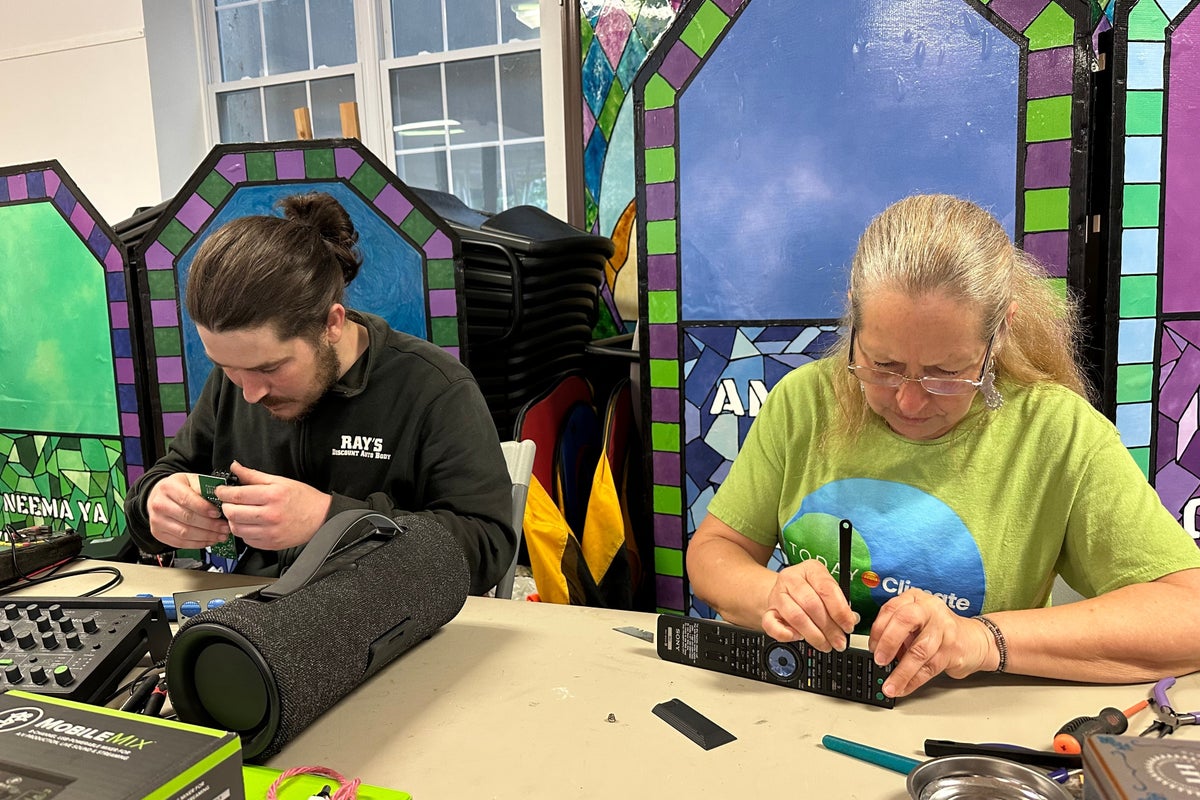
At long tables, reminiscent of school cafeterias, skilled volunteers patiently guided attendees, sharing their technical expertise and demystifying the repair process. The core message is clear: a flaw doesn’t automatically relegate an item to the landfill.
“People might initially come for purely practical or financial reasons, or perhaps due to a strong sentimental attachment,” explains Holly Shader, one of the event organisers. “But what often develops is something far richer. It’s an opportunity for people to collaborate, to extend the lifespan of their possessions, and, crucially, to forge genuine connections with one another. Relationships are built here, over shared tasks and the satisfaction of a job well done.”
The dedication of the volunteers is evident. In New Paltz, the experts successfully repaired 71 of the brought-in items. Four items required further specialist attention, while 10 were deemed beyond economical repair. The volunteers themselves are driven by the intrinsic reward of fixing things in a low-pressure, community-focused environment, with the added bonus of networking and sharing knowledge.
“I genuinely enjoy the hands-on work, meeting lovely people, and showing them how to bring something back to life,” shares contractor Patrick L. Murphy, a regular volunteer. “It’s incredibly rewarding to see the look on someone’s face when their item is fixed.”
A Growing Movement: Beyond Repair Cafes
The spirit of Repair Cafes is mirrored in a broader surge of initiatives dedicated to rethinking consumption. The “Buy Nothing Project,” the “right to repair” legislative movement, and the proliferation of tool libraries are all part of this interconnected web, all advocating for repairing, sharing, and gifting over the relentless cycle of buying and selling.
Originating in Washington state in 2013, the Buy Nothing Project has cultivated a significant online presence through its app and social media platforms. It functions as a global network of gift economies, connecting individuals within local communities who are keen to give away items they no longer need with those who are looking for them.
Liesl Clark, the founder, reports that the network has expanded dramatically, now encompassing at least 12.5 million people on Facebook. This exponential growth signifies not only a powerful social movement but also a growing capacity to influence corporate and governmental practices.
“What began as a social experiment has evolved into a vital safety net for millions,” Clark observes. “People are realising that they don’t always need to rely on massive online retailers for their needs. There’s a vibrant, tangible culture of resourcefulness right within their own communities. Our aim is to fundamentally alter how the world consumes.”
Clark further elaborates on the project’s origins: “It started as a social, economic, and environmental experiment. When people come together to fix something, a unique conversation emerges. We’re finding that these collaborative efforts transcend many existing social barriers.”
Reclaiming Lost Skills: The Importance of Repair
Peter Counter, an engineer currently researching Repair Cafes for his doctorate at the University for the Creative Arts in Farnham, England, highlights a concerning trend. He notes that in our modern, disposable society, the ability to repair everyday household items – a skill once commonplace – has largely diminished.
“The notion of being able to fix your own belongings has faded because these practical skills are no longer being passed down through generations,” Counter explains. “In many cases, it’s become more financially expedient to simply purchase a new item rather than attempt a repair.”
However, Counter points out that community-based repair initiatives are thriving precisely because they are powered by volunteers. This volunteer effort makes them financially viable, even when the cost of necessary spare parts is factored in.
The “right to repair” movement is another critical piece of this puzzle, aiming to empower consumers by granting them the autonomy to fix their own products. This movement advocates for manufacturers to provide access to the necessary tools, parts, and repair instructions, thereby ending the practice of forcing consumers to rely solely on the manufacturer for all repairs. Campaigns in 2023 saw a push for legislative action across various states, with several jurisdictions successfully passing laws mandating greater access for consumers and independent repair shops.
Complementing these efforts, tool libraries are emerging in communities across the country. These innovative libraries operate on a principle similar to traditional book libraries, allowing members to borrow expensive tools for a nominal fee, making DIY repairs and projects more accessible to everyone.
A Cherished Clock’s Comeback: The Joy of Restoration
Back in New Paltz, Paula Weinstein, a sprightly 79-year-old, brought in a treasured 1930s Hammond clock. She entrusted it to Bob Morton, an 82-year-old retired IBM electrical engineer. Morton, a grandfather of three, finds immense satisfaction in utilising his lifelong skills to keep his mind sharp and to assist others.
“I feel incredibly fortunate to still have my faculties,” Morton shared. “This is a wonderful opportunity to put them to good use and help people.”
Weinstein echoed his sentiment, expressing her delight, “It’s truly wonderful to see older items being restored and given a new lease on life.”
After several hours of meticulous, collaborative work, the hands of Weinstein’s antique clock began to move. “Yes, it’s working!” she exclaimed, her voice filled with joy. “Oh, my goodness, thank you so much!”
Morton, with a satisfied smile, simply replied, “I’m glad I persisted with it.” This small victory, the ticking of an old clock, symbolises the larger triumph of community, skill-sharing, and the enduring value of repair in an increasingly disposable world.