The Internet’s Latest Brain Teaser: A Simple Sum That Stumped Many
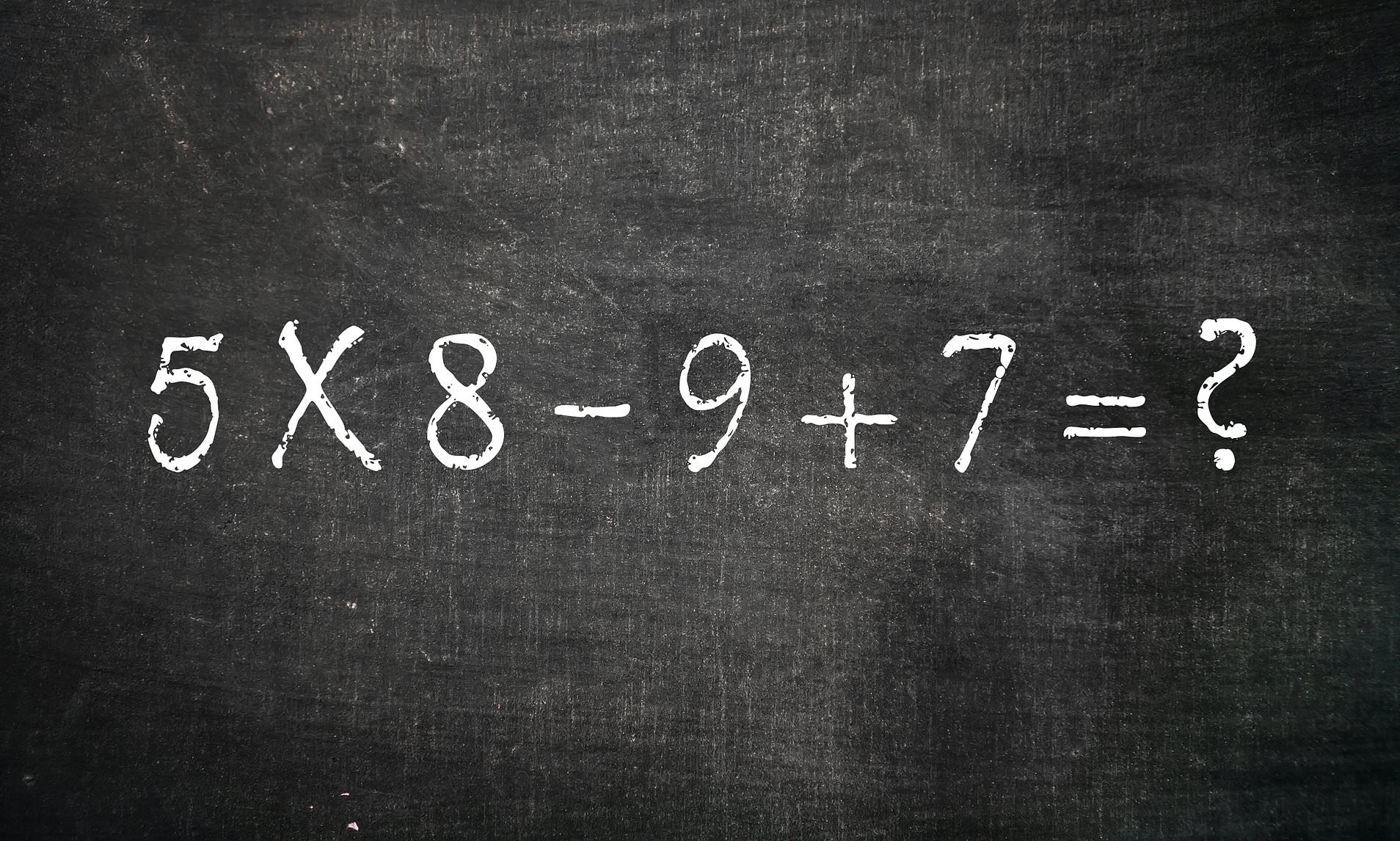
A seemingly simple mathematical equation has recently sparked a lot of debate online, as people tried to recall the basics of arithmetic. The tricky problem was shared on a platform known for its engaging content, where users often post puzzles designed to challenge their minds.
These types of brain teasers are not only fun but also beneficial for keeping the mind sharp and improving problem-solving abilities. One such puzzle involves solving the equation 5×8-9+7. While it may look straightforward at first glance, the correct approach requires a clear understanding of the rules that govern how equations are solved.
Understanding the Order of Operations
When faced with a complex equation like this, there is a specific rule that helps determine the correct sequence of operations. This rule, commonly taught in elementary schools, is often remembered through an acronym. Do you remember what it is?
The acronym PEMDAS stands for Parentheses, Exponents, Multiplication, Division, Addition, and Subtraction. It outlines the order in which different operations should be performed when solving an equation. In the given example, there are no parentheses or exponents, so the first step is to handle multiplication.
So, starting with 5×8, we get 40. This simplifies the equation to 40-9+7. Next, since there is no division involved, we move on to addition and subtraction. However, it’s important to note that in PEMDAS, addition and subtraction are treated equally, meaning they should be solved from left to right.
Solving the Equation Step by Step
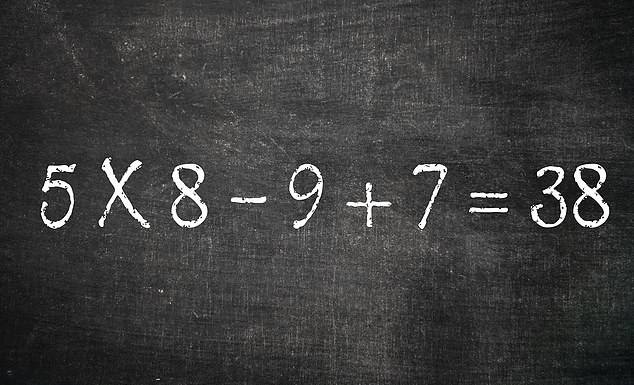
Following the correct order, the next step is to subtract 9 from 40, resulting in 31. Then, adding 7 to 31 gives us the final answer: 38. If you arrived at this result, congratulations—you’ve successfully applied the order of operations!
However, if you found yourself confused or got a different answer, you’re not alone. Many people tend to make a common mistake by performing addition before subtraction simply because of the order in which they appear in the acronym. This can lead to an incorrect result.
For instance, someone might start by calculating 9+7=16, then subtract that from 40, leading to 24. While this approach seems logical, it overlooks the crucial detail that addition and subtraction should be handled sequentially from left to right.
Why This Puzzle Matters
This type of brain teaser serves as a reminder of the importance of revisiting fundamental concepts. Even simple mathematical problems can become challenging when the rules are not clearly recalled. These exercises not only test knowledge but also encourage critical thinking and attention to detail.
Whether you got the answer right or not, the key takeaway is that these puzzles are designed to engage and stimulate the mind. They provide a fun way to keep cognitive skills sharp and reinforce the value of learning and applying basic mathematical principles.
So, the next time you come across a similar problem, take a moment to recall the order of operations and see if you can solve it quickly and accurately. Who knows, you might just surprise yourself!