A National Movement for Reading
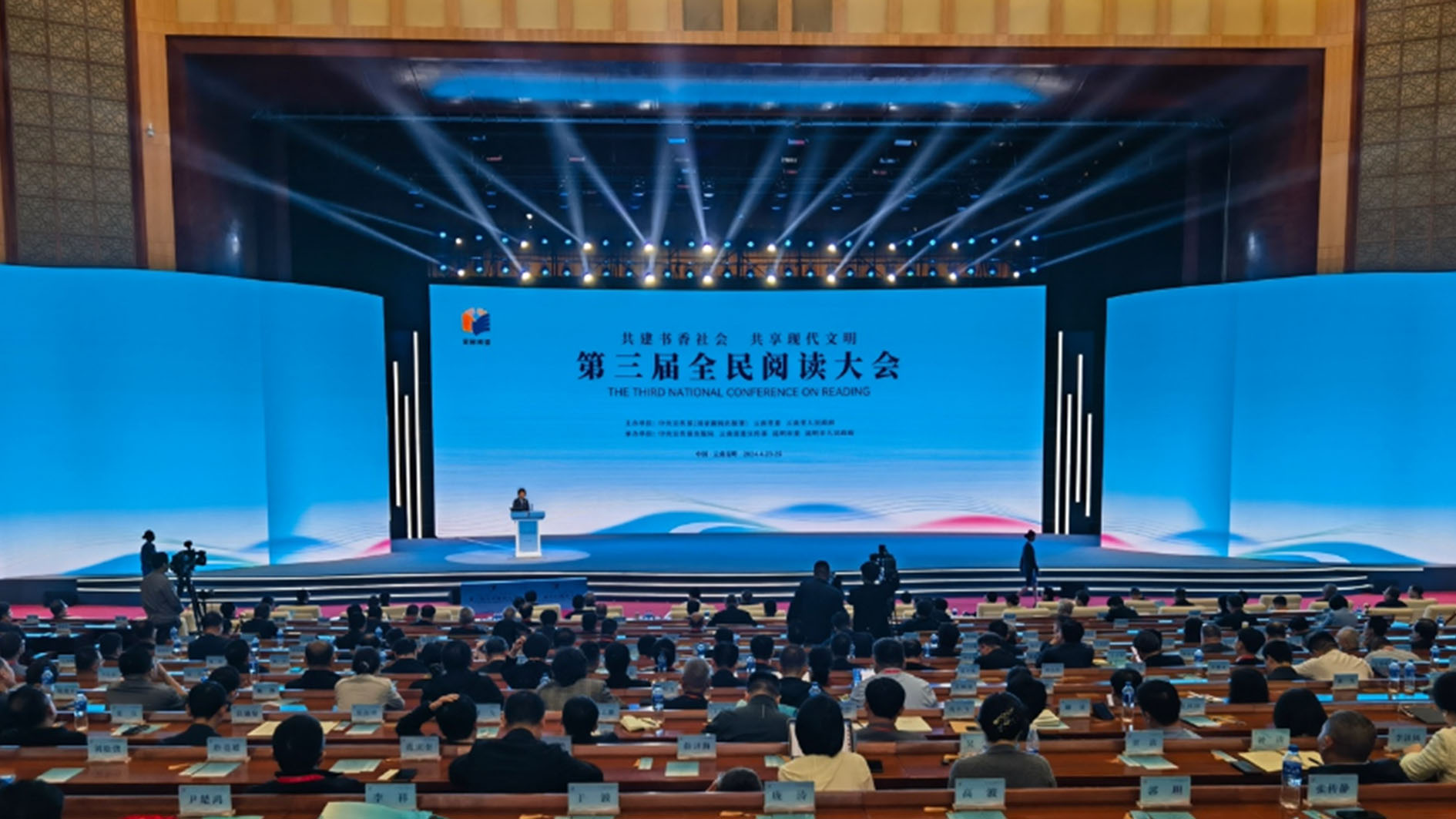
As spring blossoms across China, so does the spirit of reading. This year, the country’s first national reading week and the fifth national reading conference kicked off together, marking a significant step in the nation’s quest to cultivate a culture of book lovers.
Over the next week, various reading events will take place throughout the country. These include lectures, book fairs, salons, and book donations, all aimed at encouraging the public to embrace reading.
China, with its rich history spanning more than five millennia, has always placed great importance on reading and learning. Today, the Chinese government has elevated nationwide reading to a national strategy, integrating it into the 15th Five-Year Plan and highlighting it in government work reports for 13 consecutive years.
The government views the creation of a reading-friendly society as essential for enhancing people’s cultural refinement and the nation’s social progress. It also plays a crucial role in fostering the country’s overall innovation and creativity.
Reading Everywhere
China has consistently invested in building a robust reading infrastructure. By the end of 2025, there were 3,253 public libraries offering free access across the country. Many of these libraries are conveniently located near people’s homes. For example, the library of Lixia District in Jinan, Shandong Province, has established 100 community library branches, serving over one million readers.
Beyond public libraries, diverse reading spaces have become part of the urban landscape. Since 2022, 111 free public reading rooms have emerged in Nanchang, Jiangxi Province. These spaces are found in neighborhoods, town centers, industrial parks, subway and high-speed rail stations, and even tourist spots.
Statistics reveal that China now has more than 40,000 new-type urban reading spaces, bringing reading services closer to people than ever before.
Reading venues across the country are becoming increasingly user-friendly. In Wanzai ancient town, Jiangxi, books borrowed from bedside tables in guesthouses can be returned at the city library. “It’s just like bike-sharing,” said Jiao Yang, founder of a local guesthouse.
In Xuzhou, Jiangsu Province, local reading spaces have introduced thoughtful services for older adults, including magnifying and reading glasses.
China has also introduced its first-ever administrative regulation dedicated to nationwide reading, which took effect in February. The regulation outlines measures to boost reading promotions, improve the quality of reading services, and strengthen support systems, providing a solid legal basis for building a society that loves reading.
Thanks to years of efforts to promote nationwide reading, the national comprehensive reading rate increased from 76.3 percent in 2012 to 82.1 percent in 2024, creating a strong foundation for fostering a reading culture.
Books Over Bots
In an era marked by rapid digital and technological change, knowledge is evolving at an unprecedented pace, making reading more important than ever. Yet, with AI recommending books, narrating audiobooks, and serving as a reading companion, what remains the true value of reading?
At the launch of the Hangzhou branch of the nationwide reading week in Zhejiang Province, Chinese novelist Mai Jia reflected on an irony: for over a century after the first car was built, people still embraced running—inefficient but a way to maintain their health.
He then turned to the AI-powered present. Just as people chose to run in the age of cars, he said, one day, they will make time to turn off their screens and return to books.
At the same event, writer Zhang Kangkang suggested that readers turn to reliable social media accounts to choose books that can truly resolve their inner confusion and help them grow. When it comes to reading methods, she advocated spending long, uninterrupted hours reading substantial books, while fragmented time can be spent browsing posts or listening to audiobooks.
Jin Yuanpu, a professor at the School of Liberal Arts at Renmin University of China in Beijing, believes that generative AI is becoming an assistant to readers in tasks such as searching for background information, raising insightful questions, and expanding understanding.
“But it cannot think for us,” he said. “It cannot replace children’s foundational learning, nor can it substitute for innovative research across various fields, or the arduous exploration of human academic endeavors.”
“AI’s deep thinking is AI’s, not yours,” said Chen Manqi, a researcher at the Chinese Academy of Social Sciences.
“Only through reading can one gain independent, deep thinking. Only the thoughts that settle in your mind through reading are truly yours,” she said.