The Threat of Big Lif in Vanuatu
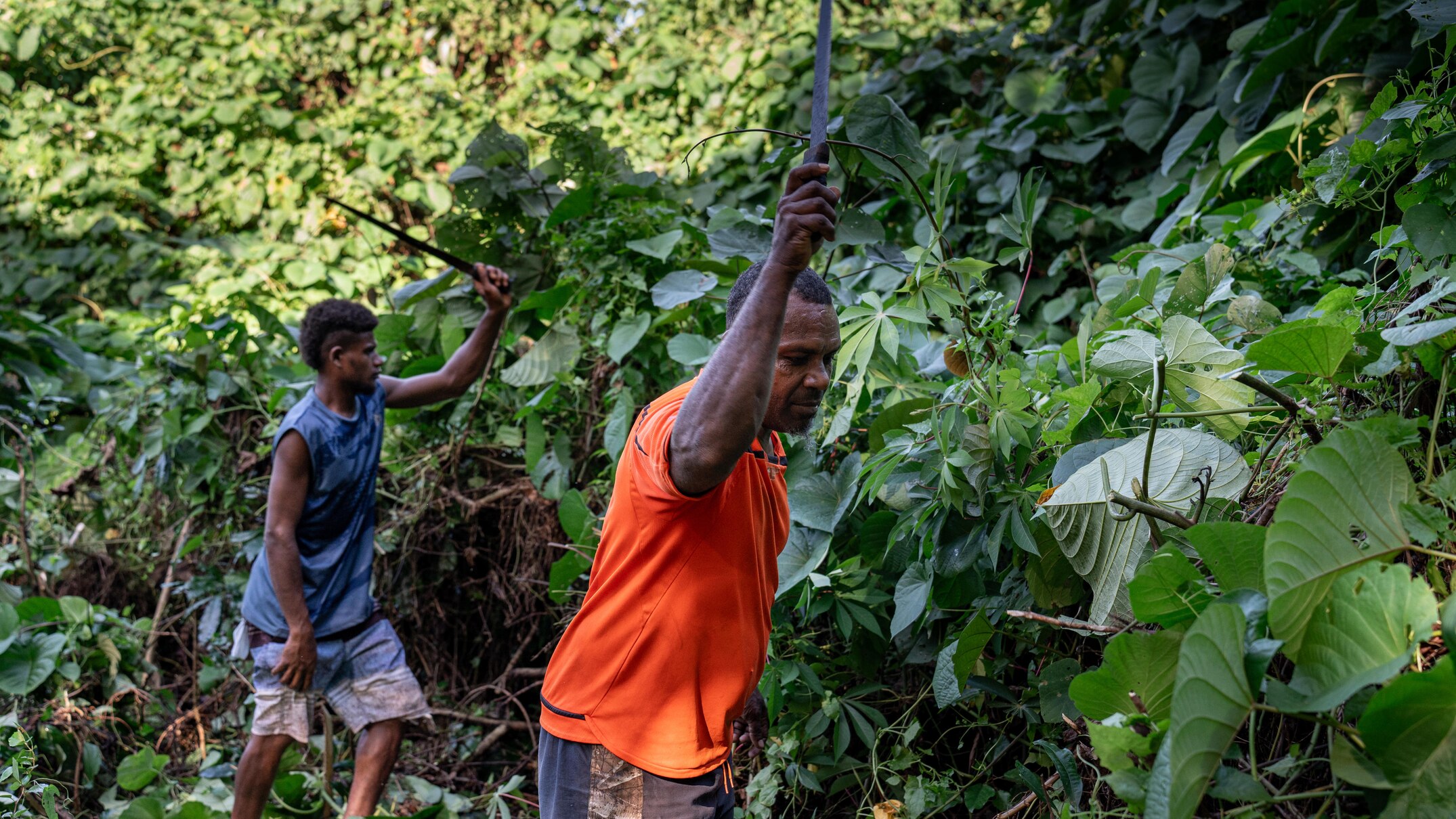
Vanuatu’s tropical rainforests are under threat from an invasive species known as “big lif,” or merremia. According to local legends, this plant was introduced during World War II to help camouflage Allied operations. Its large leaves and thick vines create a dense cover that suffocates the forest, making it one of the most significant causes of deforestation in the region.
James Carter, the project manager at the South Pacific World War II museum in Luganville, highlights the destructive nature of big lif. “It’s unbelievably destructive,” he says. “Big lif literally strangles existing vegetation and invades the forest.”
Despite its widespread presence, the people of Kole village on Santo Island have made progress in managing the invasive species through a pioneering carbon project. This initiative allows villagers to earn money by generating carbon credits through their conservation efforts, including planting trees to replace big lif.
A Community Effort for Conservation
Chief Skip Ser of Kole village emphasizes the impact of big lif on the environment. “Big lif really destroys many trees and also destroys the forest,” he explains. His father established the Loru conservation area in 1993, protecting over 200 hectares for future generations. “The thing that I love the most in the forest is the environment there,” Chief Skip says.
However, managing big lif is a full-time job for the residents of Kole village. It is both difficult and costly, requiring constant effort to keep the invasive species at bay.
Historical Context: Camouflage in World War II
During World War II, Santo Island served as the largest US supply base in the South Pacific. In 1942, as Japanese forces advanced towards Australia, the Americans recognized the strategic importance of Santo and the New Hebrides (now Vanuatu) as a key location for building a massive supply base.
Mr. Carter notes that in just 21 days, Allied forces constructed an airstrip in the jungle, allowing B7 bombers to land, refuel, rearm, and return to Guadalcanal. “They saw the importance of Santo and the New Hebrides as being the perfect point where they could build a massive supply base,” he says.
There is a theory that big lif was introduced during the war to camouflage American ground structures. However, Mr. Carter acknowledges that there is no concrete evidence to support this claim. “It’s an interesting one because there are two weeds—big lif and mile-a-minute. It’s believed that one was brought to Vanuatu during the war by the Americans to camouflage their ground structures, which makes a lot of sense. But then it depends on your research sources as to which one that was.”
Despite the lack of evidence, Mr. Carter does not doubt that big lif was used as camouflage. “I remember when we went looking for a Royal New Zealand Air Force Corsair a few years back, and we got to the spot where the local guys said, ‘It’s here,’ and we’re going, ‘Where? We can’t see anything.’ They said, ‘Hang on,’ and they got out with their bush knives, and they cut their way through all the big lif, dragged it all off, and there was the aircraft.”
Addressing the Challenges of Big Lif
Despite decades of conservation efforts, Chief Skip acknowledges that it has been a losing battle against big lif. “If we are not careful, then we’ll lose everything, all resources inside our land,” he says. To address this issue, he focused solely on managing big lif through targeted strategies.
Working with Glarinda Andre, a director from NGO Live and Learn Vanuatu, Chief Skip established the Loru Forest Carbon Project. This initiative allows the village to earn money from its conservation efforts through the sale of carbon credits. These credits can be sold to polluting companies to offset their emissions via carbon trading markets.
Funded by Climate Resilient by Nature, an Australian government initiative, in collaboration with World Wildlife Fund (WWF) Australia, the project has shown promising results. The team found that cutting down big lif and replanting native trees was effective in reducing its presence.
Empowerment Through Conservation
Since the project was launched in 2012, the village has started to see progress in reducing the problem with big lif. Chief Skip and his community have even established their own nursery to grow native fruit trees. “One of the best ways to destroy merremia is to grow a forestry plot,” he says.
Ms. Andre highlights the positive impact of the program on the community. “Through the program, women have been empowered to manage business finances, children now have access to education, and youth in the communities have been trained as rangers.” She adds that households have been able to purchase water tanks to improve water security, and the program brings many benefits to the people.
Looking Ahead
The inclusion of big lif management in the project is the first of its kind in Vanuatu. Chief Skip hopes other communities will follow suit as environmental pressures continue to grow. “We have sea level rise, pollution, and I think it’s very important to stop this climate change,” he says. “We have to look after the trees, look after the birds, then in the future, our children can have enough resources or can see what we are achieving.”