The Universal Right-Hand Preference
Pick up a pen. Open a jar. Wave goodbye. Chances are, you just used your right hand without thinking about it. So did roughly nine out of ten people reading this sentence, and so did nine out of ten people who lived a thousand years ago, ten thousand years ago, and very likely further back than that. No other primate on Earth shows anything close to that kind of consistency.
Chimpanzees, gorillas, and monkeys show individual hand preferences, but ask a whole population which hand they favor, and the results scatter. Humans don’t scatter. We skew right, overwhelmingly and universally, and for a long time nobody could convincingly explain why.
A study published in April 2026 in PLOS Biology offers the most rigorous answer yet. The culprits, according to researchers at the University of Oxford and the University of Reading, are two of the most consequential changes in human evolutionary history: the shift to walking upright on two legs, and the dramatic expansion of the brain.
2,025 Primates, One Outlier
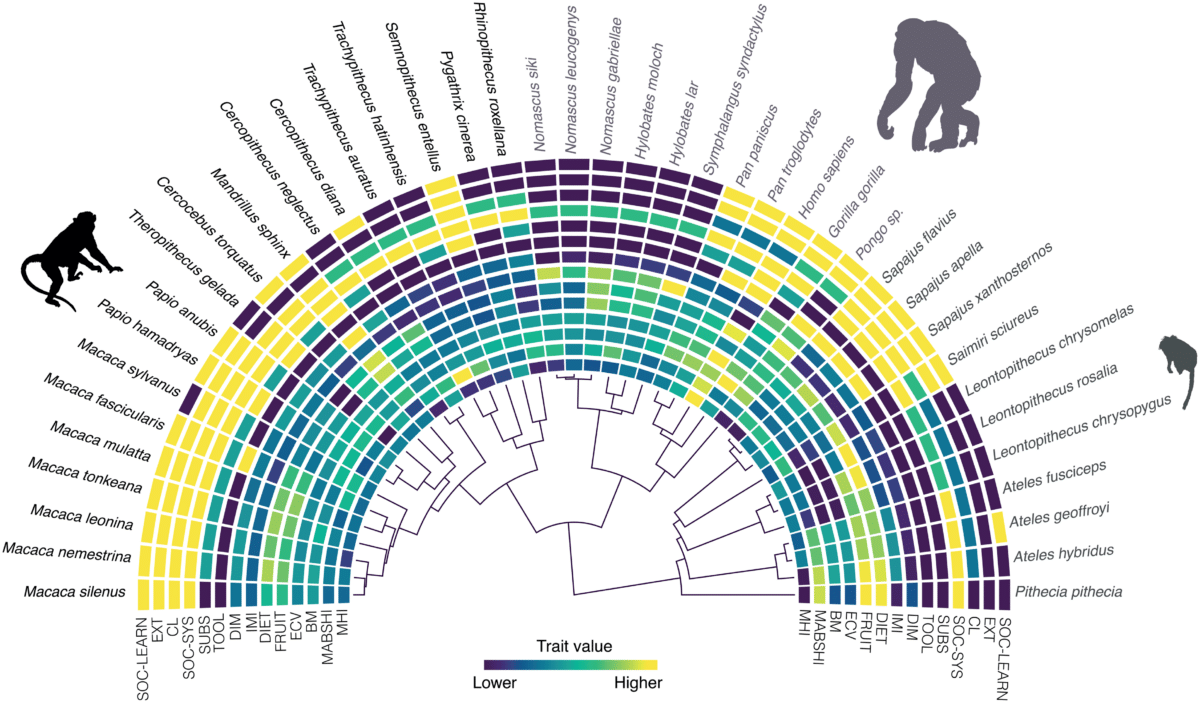
The team, led by Dr. Thomas A. Püschel and Rachel M. Hurwitz of Oxford’s School of Anthropology and Museum Ethnography, built their case from a dataset of 2,025 individual monkeys and apes spanning 41 anthropoid species. Using Bayesian phylogenetic modeling, a statistical method that accounts for how closely different species are related on the evolutionary tree, they tested multiple competing theories at once: diet, body size, habitat, tool use, social structure, brain size, and locomotion patterns.
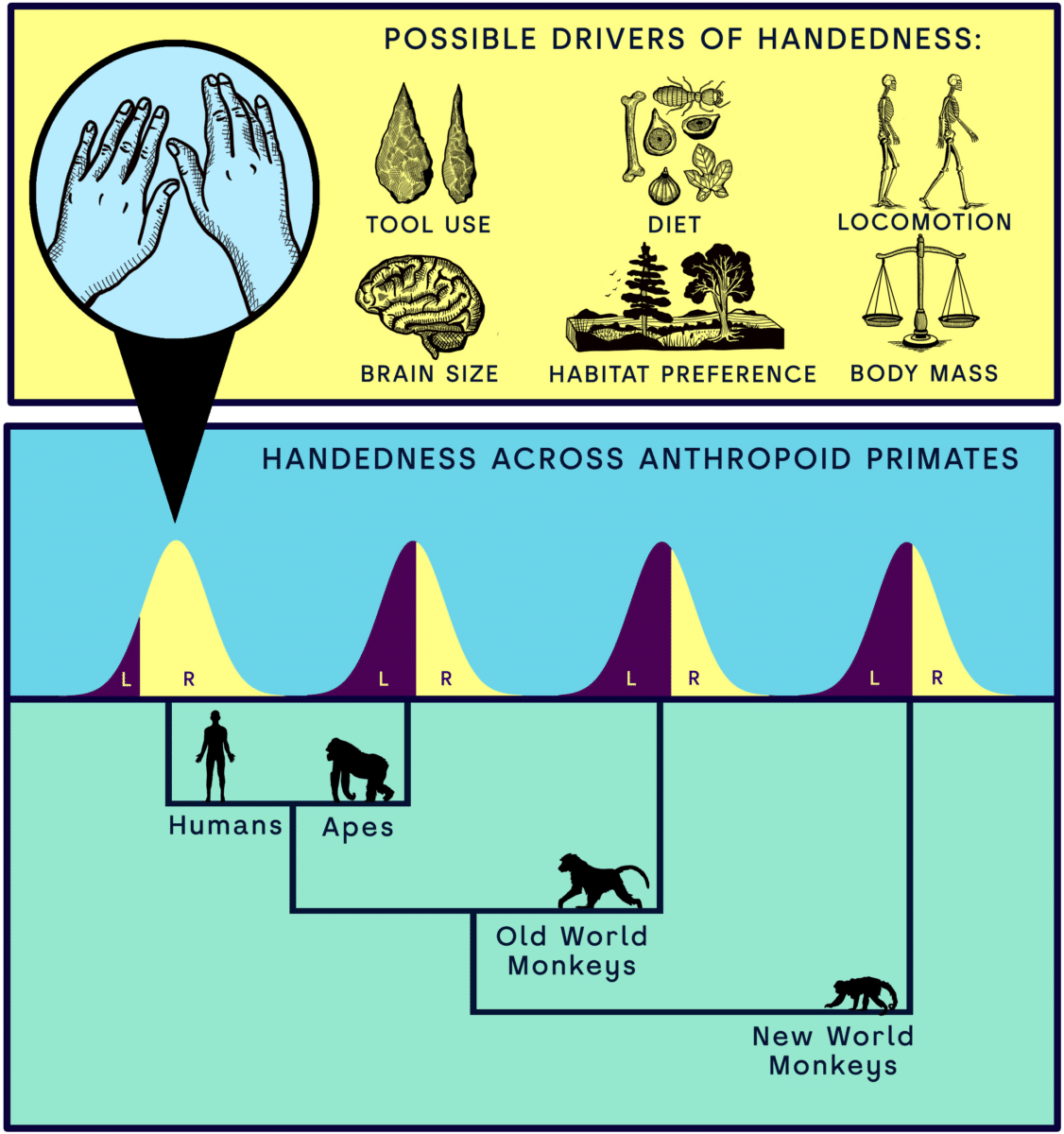
When the models ran without controlling for any specific traits, Homo sapiens stood out immediately as an evolutionary outlier. Humans showed not only the strongest rightward hand bias in the dataset, but also the most consistent individual hand preferences of any species studied. Then the researchers added two variables: endocranial volume, a proxy for brain size, and the intermembral index, which compares arm length to leg length and serves as a reliable anatomical marker of bipedal locomotion. Humans have an unusually low intermembral index because our legs are considerably longer than our arms, a signature of a body built for walking upright rather than moving on all fours.
With those two factors included, humans were no longer an outlier. The model’s predicted handedness value for our species matched the observed value almost exactly.
The Right Hand Rose Slowly, Then Sharply
One of the study’s more precise contributions is a timeline. The researchers used their models to generate estimated handedness scores for extinct hominin species, and the results trace a clear arc across human prehistory.
Handedness strength, the consistency with which an individual favors one hand regardless of which one it is, appears to have been high across hominins from early in the lineage. Even Ardipithecus ramidus and Australopithecus afarensis, species that lived millions of years before modern humans, likely showed strong individual hand preferences, not unlike those seen in great apes today.
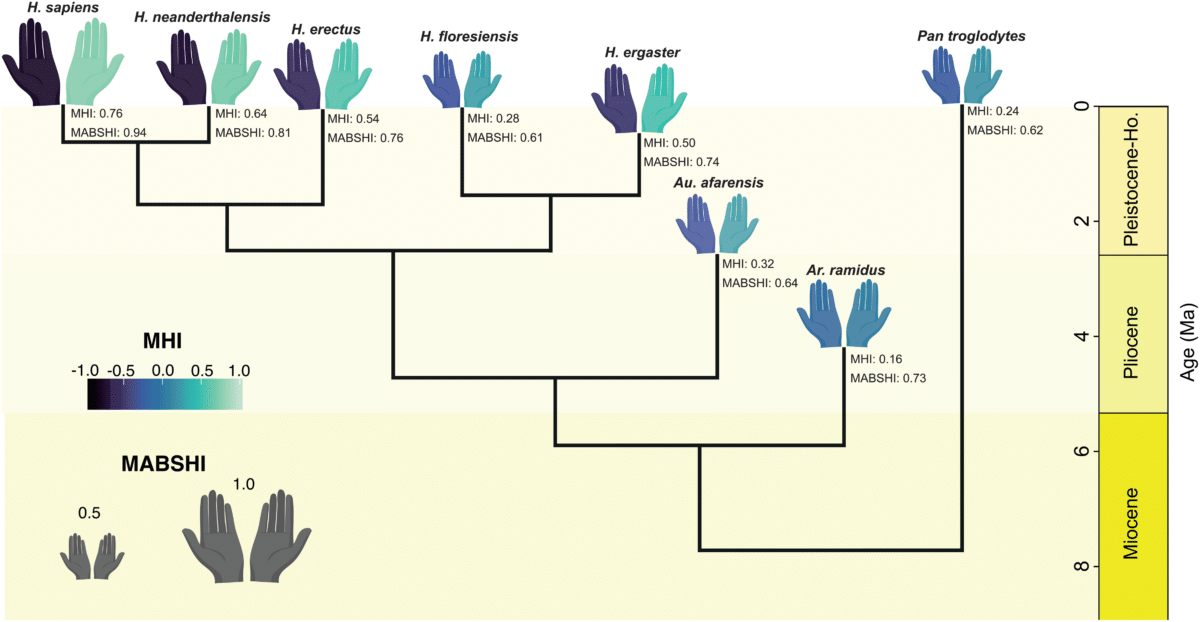
Handedness direction, the specific population-wide tilt toward the right, is a different story. That pattern strengthened gradually and then more sharply with the emergence of the genus Homo. The predicted right-hand bias scores move in a steady progression: Ardipithecus ramidus at 0.16, Australopithecus afarensis at 0.32, Homo ergaster at 0.50, Homo erectus at 0.54, Homo neanderthalensis at 0.64. Modern humans sit at 0.76. The steepest increases line up with the period of significant brain expansion that defines the Homo lineage.
The authors propose that the two evolutionary forces operated in sequence rather than simultaneously. Walking upright came first, freeing the hands from locomotion entirely and creating new selective pressure for more specialized, asymmetric use. Later, as the hominin brain grew larger and its architecture became more complex, hemispheric specialization deepened, and the population-wide preference for the right hand intensified with it.
The Hobbit That Didn’t Fit, and Then Did
One species disrupted the pattern in a way the researchers found instructive rather than inconvenient. Homo floresiensis, the small-bodied hominin discovered on the Indonesian island of Flores and sometimes called the “hobbit” because of its diminutive size, produced a predicted right-hand bias of just 0.28, closer to Australopithecus than to its fellow members of the genus Homo.
The researchers said this fits the model’s logic precisely. Homo floresiensis had a relatively small brain and retained skeletal features associated with climbing, including long feet and curved toe bones, suggesting a locomotor repertoire that blended upright walking with arboreal movement rather than committing fully to bipedalism. Both of the traits that drive strong directional handedness in the model were weaker in this species, and so, the model predicted, was its right-hand bias.
Every Theory in One Room
Previous research had examined individual theories for human handedness in isolation. Dr. Püschel described this study as the first to test multiple major hypotheses within a single unified framework, using the same dataset and the same modeling approach across all of them.
The study found no single existing hypothesis performed meaningfully better than any other when humans were excluded from the analysis. Most proposed explanations, the researchers reported, only appeared significant when Homo sapiens was included, suggesting that many theories about handedness had been shaped too narrowly around human data rather than tested against the broader primate pattern.