A Conservation Success Story Still Facing a Deadly Threat
Few North American birds have come as close to extinction as the California condor.
By 1987, only 27 individuals remained alive. Conservationists made the controversial decision to capture every surviving bird and begin an intensive captive-breeding program. The move was risky, but it ultimately saved the species from disappearing forever.
Today, hundreds of California condors fly across parts of California, Arizona, Utah, and Mexico. Their recovery is often celebrated as one of the world’s most ambitious wildlife restoration efforts.
Yet despite decades of progress, a single threat continues to undermine that success: lead poisoning.
The Largest Bird in North America
The California condor is an extraordinary species.
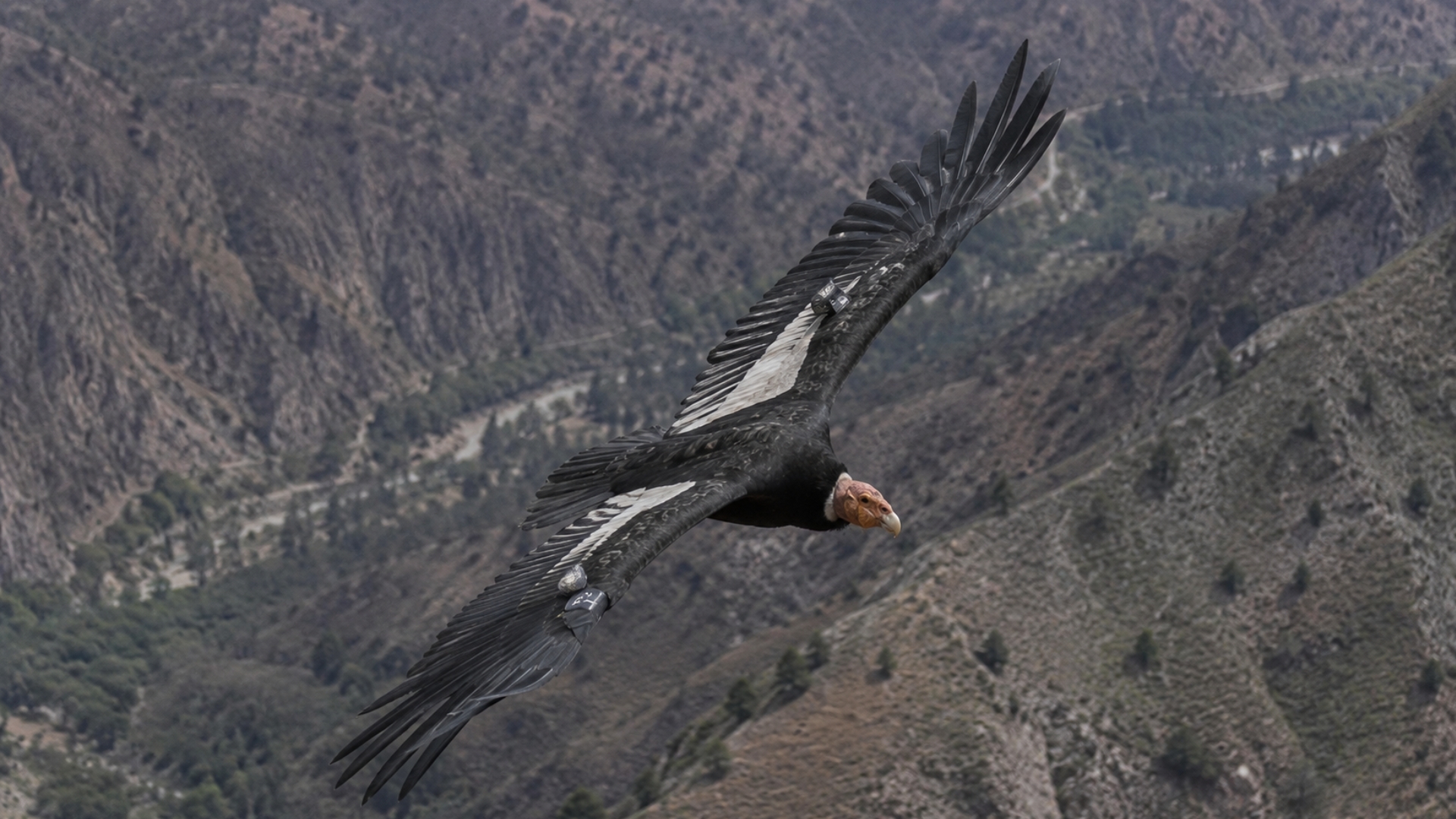
With a wingspan approaching 10 feet, it is the largest land bird in North America. These massive scavengers can travel long distances in search of food, soaring on rising air currents with minimal effort.
Unlike predators that kill prey themselves, condors feed primarily on carcasses. For thousands of years, they played an important ecological role by helping remove dead animals from the landscape.
That feeding strategy, however, has become one of the species’ greatest vulnerabilities.
How Lead Enters the Food Chain
Lead poisoning usually begins far from the condors themselves.
When hunters use lead ammunition, tiny fragments can remain inside animal carcasses or gut piles left behind after field dressing game. Those fragments are often too small to be noticed but can be consumed by scavengers feeding on the remains.
Condors, which routinely feed on large carcasses, may ingest multiple lead particles during a single meal.
Once inside the body, lead damages the nervous system and other organs. Affected birds may become weak, disoriented, unable to fly properly, or incapable of finding food. Without treatment, poisoning can be fatal.
Researchers have repeatedly identified lead exposure as the leading cause of death for many free-flying California condors.
Recovery Has Required Constant Human Intervention
The condor’s comeback is often described as a conservation success, but it remains far from a fully self-sustaining recovery.
Wildlife managers regularly capture birds to test blood lead levels. Individuals showing dangerous levels of contamination may require veterinary treatment, including procedures designed to remove lead from their bodies.
Without this intensive monitoring, many more condors would likely die.
The situation highlights an unusual reality of modern conservation: a species can recover in numbers while still depending heavily on human intervention to survive.
In many ways, the California condor remains one of the most carefully managed wild birds on Earth.
Lead Is Not the Only Challenge
Although lead poisoning receives the most attention, condors face several other threats.
Collisions with power lines, ingestion of trash, habitat pressures, and environmental contaminants can all affect survival. Small populations also remain vulnerable to genetic challenges because every living California condor descends from the tiny group saved during the 1980s.
Even so, conservation experts consistently point to lead exposure as the most immediate and widespread danger facing wild populations.
Unlike many conservation threats that require decades to address, lead poisoning is largely preventable.
That fact has made the issue particularly frustrating for wildlife managers who have spent years working to restore the species.
A Debate That Extends Beyond Condors
The lead issue has become part of a broader discussion about hunting, wildlife management, and ammunition choices.
Many conservation groups advocate for non-lead alternatives, arguing that they reduce risks not only for condors but also for eagles, vultures, ravens, and other scavenging animals.
Some hunting organizations and individual hunters have voluntarily adopted non-lead ammunition in condor habitat, while others have raised concerns about cost, availability, or regulatory requirements.
The debate can become politically charged, but wildlife biologists generally focus on a straightforward ecological question: how to prevent toxic fragments from entering the food chain.
For condors, the answer could have significant consequences.
The Species Has Come Too Far to Lose Momentum
The California condor’s survival demonstrates what determined conservation efforts can achieve.
Captive breeding, habitat protection, scientific research, veterinary care, and public support have brought the species back from the edge of extinction. A bird that once seemed destined to vanish now soars once again above western landscapes.
But recovery is not the same as security.
As long as lead poisoning continues to affect wild birds, conservationists will face the challenge of protecting a species that remains vulnerable despite decades of progress.
The California condor’s story is often told as a triumph. It is. Yet it is also a reminder that saving a species is rarely a single victory. The harder task is ensuring that the conditions allowing it to survive remain in place for generations to come.