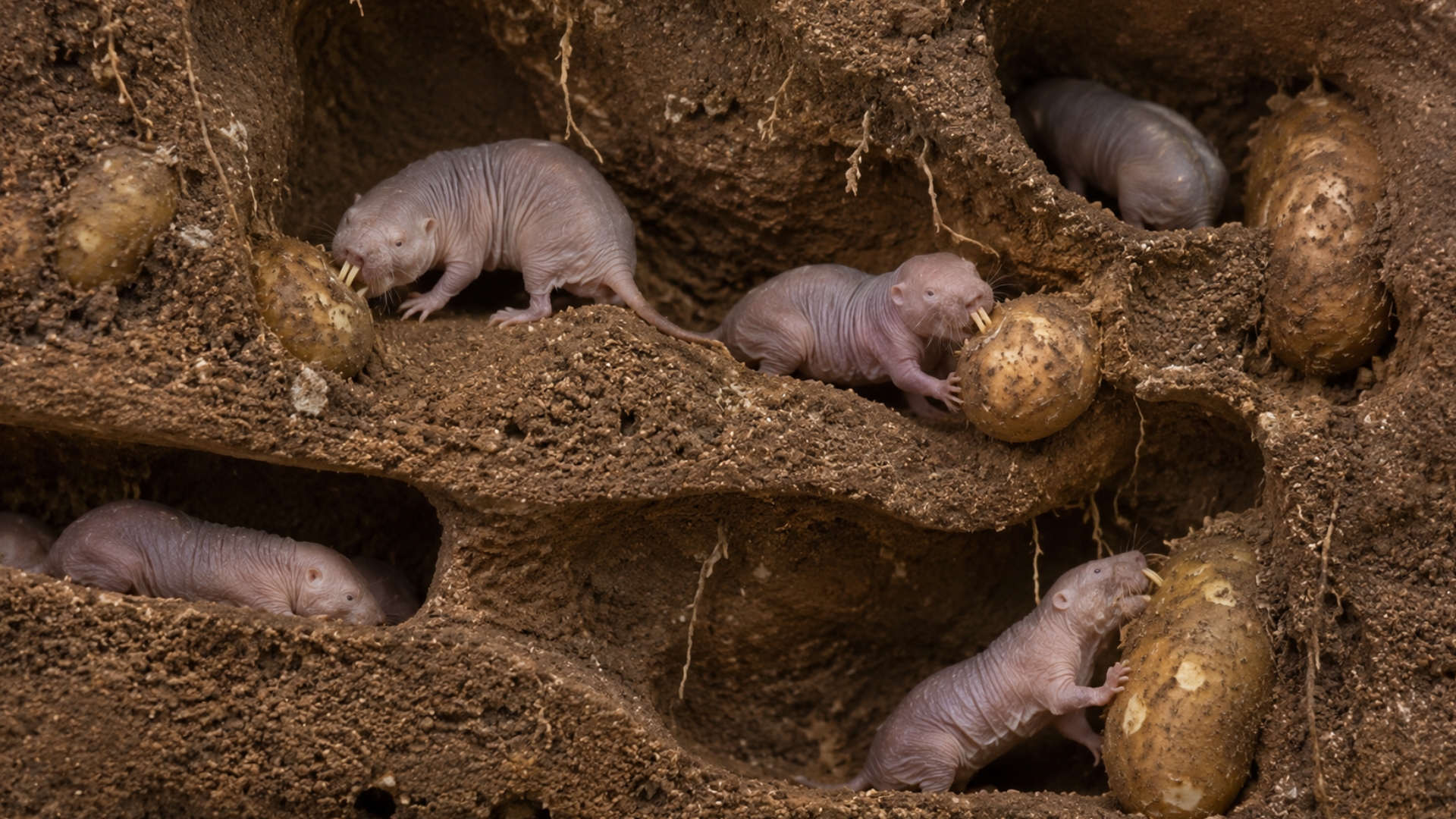
A Strange Discovery Beneath the African Savanna
When people think of farming animals, ants are usually the first example that comes to mind.
Certain ant species cultivate fungi, while some insects maintain surprisingly sophisticated agricultural systems. Mammals, however, are generally not considered farmers.
That is why the behavior of the giant mole-rat has attracted so much scientific attention.
Living almost entirely underground in parts of East Africa, these social rodents spend their lives digging extensive tunnel networks beneath grasslands and savannas. Deep within those burrows, researchers have observed a remarkable relationship with the giant tubers that grow underground.
Rather than completely consuming these food sources, the mole rats often feed on portions of them while leaving the plant alive.
The Underground Pantry That Keeps Growing
The giant mole-rat depends heavily on large underground tubers for food.
These plant structures act as nutrient-rich storage organs, sometimes reaching impressive sizes beneath the soil. For an animal that rarely emerges above ground, they represent a reliable source of calories.
What makes the behavior unusual is that the rodents frequently remove only part of a tuber before moving on.
The remaining portion continues to grow, effectively regenerating future food supplies. Instead of destroying the resource entirely, the animals appear to harvest it in a way that allows continued production.
Researchers have compared the strategy to a form of sustainable agriculture, although it differs significantly from human farming.
The mole rats are not planting crops or intentionally cultivating fields. Nevertheless, their feeding behavior can result in a renewable food source that persists within their tunnel systems.
Life Underground Rewards Long-Term Thinking
For most animals, food opportunities can be unpredictable.
Predators may fail to catch prey. Grazing animals may encounter drought. Seasonal changes can dramatically alter what resources are available.
Life underground creates a different set of challenges.
Digging through compact soil requires enormous amounts of energy, and locating new food sources can be difficult. Destroying every available tuber immediately might provide short-term benefits, but it could leave the colony with fewer resources later.
By feeding selectively and allowing plants to survive, mole rats may gain access to food that continues replenishing itself over time.
Whether this behavior evolved specifically for that purpose remains an active area of research, but the ecological advantages are easy to understand.
Social Living Makes the Strategy Even More Interesting
The giant mole-rat is not a solitary animal.
Like its more famous relative, the naked mole-rat, it lives in colonies with a highly organized social structure. Individuals cooperate in maintaining tunnels, locating food, and defending the group.
This social lifestyle may help explain why renewable food resources are especially valuable.
Large colonies require consistent access to nutrition. A food source that survives repeated harvesting could support many individuals without requiring constant expansion into new territory.
Scientists have long been fascinated by how social species solve resource challenges, and mole rats provide another example of how cooperation can shape unusual behaviors.
Is It Really Farming?
The question of whether mole rats truly farm remains debated.
Many researchers use the term cautiously because the behavior differs from classic examples of animal agriculture. Ants that cultivate fungi actively manage and protect their crops. Humans deliberately plant, tend, and harvest food.
Mole rats appear to benefit from natural plant regrowth rather than intentionally cultivating it.
Even so, the system occupies an intriguing middle ground.
The rodents alter their environment, repeatedly exploit the same food source, and gain long-term benefits from allowing that resource to remain alive. Those characteristics make the behavior one of the closest known examples of farming-like activity among mammals.
The Animal Kingdom Is More Innovative Than It Appears
The giant mole-rat’s underground lifestyle is a reminder that some of nature’s most surprising behaviors happen far from human view.
Beneath the soil, these rodents have evolved strategies that help them survive in an environment where food can be difficult to find and costly to reach. Whether scientists ultimately classify the behavior as true farming or something slightly different, it demonstrates an impressive level of ecological adaptation.
For many people, farming seems like a uniquely human achievement.
Yet the deeper researchers look into the natural world, the more they discover animals solving similar challenges in their own remarkable ways. The giant mole-rat may never cultivate fields like a farmer, but its relationship with underground food sources shows that nature often develops solutions that are far more sophisticated than they first appear.