Earth’s Hidden Giants: Colossal Structures Reshaping Our Planet From Within
When a colossal magnitude 8.0 earthquake shakes a remote corner of the Pacific, the initial tremor is fleeting, lasting mere seconds. Yet, the planet does not fall silent. In the hours that follow, the Earth continues to hum with vibrations at frequencies far below human hearing, resonating like a struck bell. This ongoing oscillation is meticulously recorded by thousands of seismometers strategically positioned across continents and the ocean floor, capturing data that travels not only outwards but also deep into the planet’s interior.
For decades, seismologists have observed peculiar behaviour in certain seismic waves as they traverse the deep mantle beneath Africa and the central Pacific. These waves exhibit a dramatic slowdown in these specific regions, suggesting they are passing through a material fundamentally different from the surrounding rock. While these signals are often faint, easily masked by the Earth’s incessant seismic noise, their persistence across numerous earthquakes points to the presence of something massive, hidden nearly 2,900 kilometres below the surface.
Unravelling the Deep Earth’s Secrets
A dedicated team of researchers at Utrecht University in the Netherlands embarked on a multi-year project, meticulously compiling these subtle signals from the most powerful earthquakes ever recorded. Their focus extended beyond mere wave speed; they delved into how much energy these waves lost during their journey, a property known as attenuation. By conceptualising the entire Earth as a single, vast vibrating system, they developed a sophisticated model capable of finally resolving the nature of what lies at the boundary between the Earth’s core and mantle.
The Planet’s Largest Internal Features Revealed
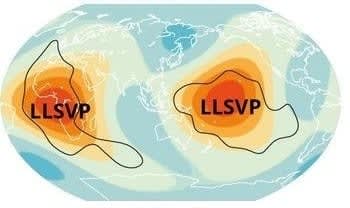
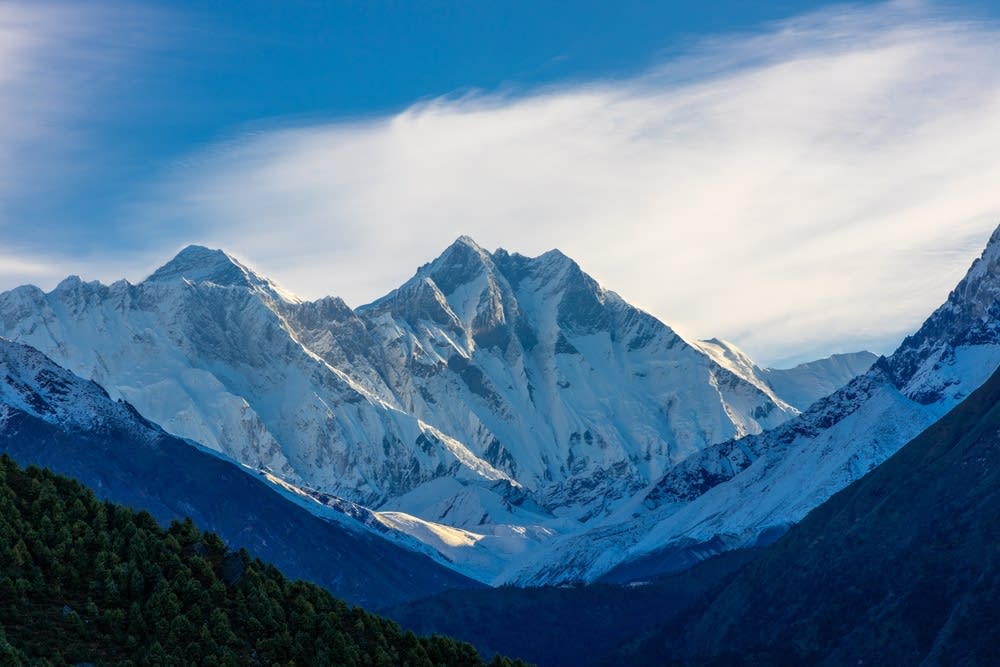
The resulting model unveiled two gargantuan structures that ascend from the core-mantle boundary, resembling inverted mountains. These colossal formations reach estimated heights of approximately 1,000 kilometres, a staggering figure nearly 100 times the height of Mount Everest. Identified as Large Low Shear Velocity Provinces, or LLSVPs, one of these behemoths lies beneath Africa, while the other sits under the central Pacific Ocean. Each structure spans an impressive 5,000 kilometres across, positioning them as some of the largest known features within our planet.
This groundbreaking research, published in the esteemed journal Nature, employed a sophisticated technique called normal-mode seismology. This method analyses the free oscillations of the Earth following significant seismic events. Unlike conventional seismic tomography, which primarily maps velocity variations, normal-mode seismology provides a more comprehensive understanding by resolving both elastic and anelastic properties of the Earth’s interior. The research team constructed a detailed 3D global model, designated QS4L3, which achieved a resolution up to spherical harmonic degree four – a first for the entire mantle.
Sujania Talavera-Soza, the lead author of the study, and her colleagues meticulously analysed data from earthquakes powerful enough to excite the planet’s normal modes. This innovative approach enabled them to differentiate between temperature-induced effects and compositional variations within the mantle, a distinction that had eluded previous models.
The Nature paper describes the LLSVPs with a crucial clarification: “These are not mountains in the conventional sense,” the authors emphasise, “but thermochemical structures that rise from the core-mantle boundary and influence mantle flow.” Nevertheless, their sheer scale undeniably marks them as the most towering identified features within the Earth.
A Billion-Year-Old Slab Graveyard
The study’s findings revealed a striking and consistent pattern. In the upper mantle, areas exhibiting high attenuation – where seismic waves lose significant energy – corresponded with low seismic velocity, precisely as expected for hot rock. However, in the lower mantle, this correlation reversed. The LLSVPs demonstrated low attenuation, indicating that seismic waves passed through them with greater efficiency, despite their lower velocity.
This unique combination strongly suggests a distinct chemical composition, rather than merely elevated temperatures. The researchers concluded that these structures are characterised by larger mineral grains and possess a chemical makeup different from the surrounding mantle. The team rigorously compared their model’s predictions with wave speeds and attenuation data derived from a laboratory-based viscoelastic model developed by Ulrich Faul of MIT and Ian Jackson. This comparison indicated that the circum-Pacific region is cooler and contains smaller grain sizes, while the LLSVPs are warmer and composed of larger grains.
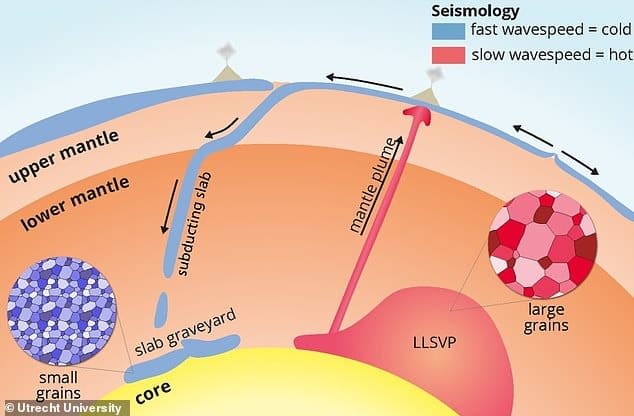
The prevailing scientific theory posits that LLSVPs are remnants of ancient subducted slabs – oceanic crust that descended into the mantle billions of years ago and accumulated at the core-mantle boundary. Their unique chemistry reportedly makes them resistant to mixing with the rest of the mantle through the process of mantle convection. “They appear to be chemically distinct domains that have persisted since the early stages of Earth’s history,” the authors state in their Nature publication.
How Normal-Mode Seismology Unlocked the Puzzle
The crucial breakthrough stemmed from the ability to precisely measure seismic attenuation in three dimensions throughout the entire mantle. Prior global attenuation models were largely confined to the upper mantle. The new QS4L3 model, however, resolves structures down to spherical harmonic degree four, representing a substantial leap in the precision of our understanding.
The research team, including Laura Cobden from Utrecht University, who contributed significantly to the mineral physics analysis, utilised splitting function measurements from normal modes. They meticulously analysed how the frequencies of Earth’s free oscillations were altered by lateral variations in internal structure. Their observations pinpointed the highest attenuation in the lower mantle within the seismically fast “ring around the Pacific,” while the lowest attenuation was consistently recorded within the LLSVPs themselves.
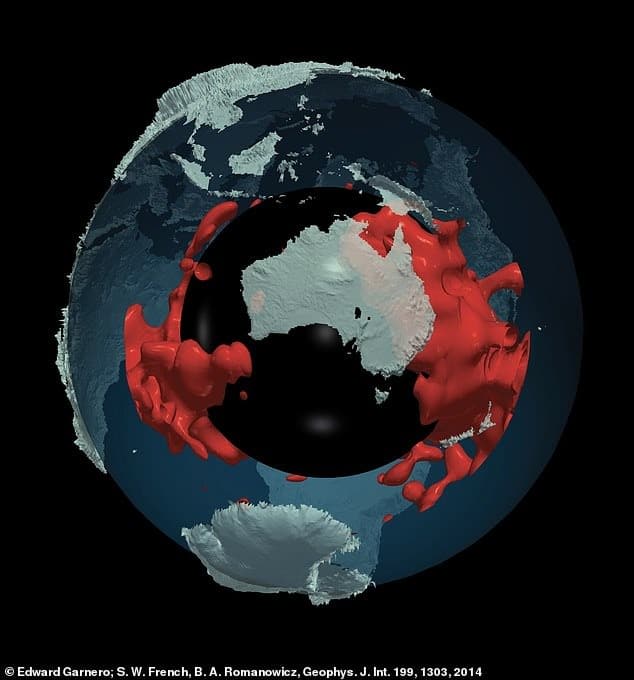
Further viscosity calculations, based on the inferred variations in grain size and temperature, confirmed that the LLSVPs are enduring and remarkably stable features. These findings strongly corroborate earlier research suggesting that LLSVPs have remained largely unchanged for hundreds of millions, if not billions, of years.
Anchors That Shape the Surface World
These two immense structures are situated directly above the outer core, a region where temperatures rival those on the surface of the Sun. Their sheer immensity is difficult to comprehend; if either LLSVP were hypothetically placed on the Earth’s surface, its peak would extend beyond the upper atmosphere and into the vacuum of space.
Scientists now theorise that these colossal structures act as critical anchors, influencing the slow, inexorable movement of tectonic plates above them. Furthermore, they are believed to be the source of volcanic hotspots, feeding chains like Hawaii and Iceland with plumes of superheated rock rising from their summits.
While no human will ever witness these subterranean peaks firsthand, and no camera will ever capture their imposing presence, their influence is undeniable. Every time a major earthquake sends reverberations through our planet, the echoes carry the indelible imprint of their shape. The true tallest mountains on Earth are not found in the Himalayas or even on the deepest ocean floor. They are buried more than a thousand miles down, at the profound interface where the mantle meets the core, and they have resided there since the planet was in its infancy.